Source page: McKinsey & Company
Commentary
Agentic AI adventures
Artificial Intelligence | Hospitality | Travel
November 20, 2025 – AI adoption in the travel industry has accelerated sharply, and travelers are also embracing AI. More than half the respondents to the 2025 Skift US Travel Tracker Survey say they have used AI tools for trip planning, with AI use rising notably over the past year. Yet the travel and hospitality sectors still trail others in AI maturity, note Senior Partner Alex Cosmas and coauthors. Key barriers include siloed data, outdated systems, and limited tech investment, given a focus on personal services. However, agentic AI can help amplify AI’s transformative potential, allow the sector to overcome these challenges, and enhance both efficiency and human connection for improved travel experiences.
To read the article, see “Remapping travel with agentic AI,” September 16, 2025.
customizer here
Visual form
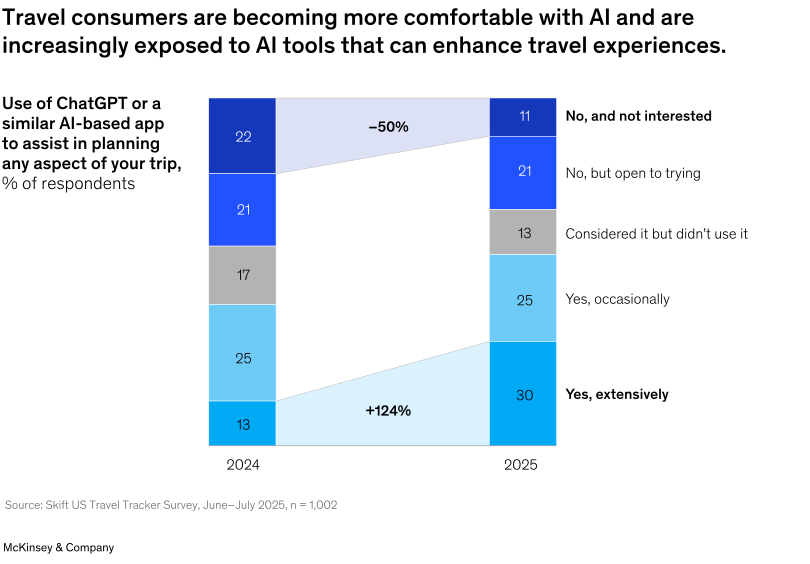
Connected stacked-column chart linking two response distributions from 2024 to 2025.
Layout / body structure
The graphic uses a single central layout with one stacked column for 2024 on the left and one for 2025 on the right, while the colored connector bands between them show how the response mix changes across the two years.
What is being compared
It compares how travel consumers answered the question of whether they used ChatGPT or a similar AI-based app to help plan any aspect of a trip, separating heavy use, occasional use, consideration without use, openness without use, and outright lack of interest.
Measurement system
The values are percentages of respondents. Each colored segment is labeled with its percentage inside the stack, and the connector wedges highlight the relative expansion or contraction of the major top and bottom portions of the response mix.
Visible structure inside the graphic
Both columns are split into five colored segments. The bottom bright-blue band marks extensive use, the light-blue band marks occasional use, the gray band marks consideration without use, and the two darker blue bands at the top represent nonusers. The central shaded connectors emphasize the shrinking nonuser block and the expanding heavy-use block.
Main takeaway from the visual
The distribution shifts toward adoption: extensive use grows sharply, occasional use stays sizeable, and the share of travelers who are not interested drops meaningfully.
Key standout values or extremes
The largest move is in ‘Yes, extensively,’ which rises from 13 percent in 2024 to 30 percent in 2025, marked with a +124 percent callout. ‘No, and not interested’ falls from 22 percent to 11 percent, marked with a -50 percent callout, while ‘Yes, occasionally’ remains at 25 percent.
Controls / sequence, when applicable
This is a static chart image with no in-chart controls to operate.
Companion media, when applicable
There is no separate companion audio or video; the chart image is the full visual on this page.