Source page: McKinsey & Company
Commentary
Aircraft deliveries set to take off
Aerospace | Supply Chain Management
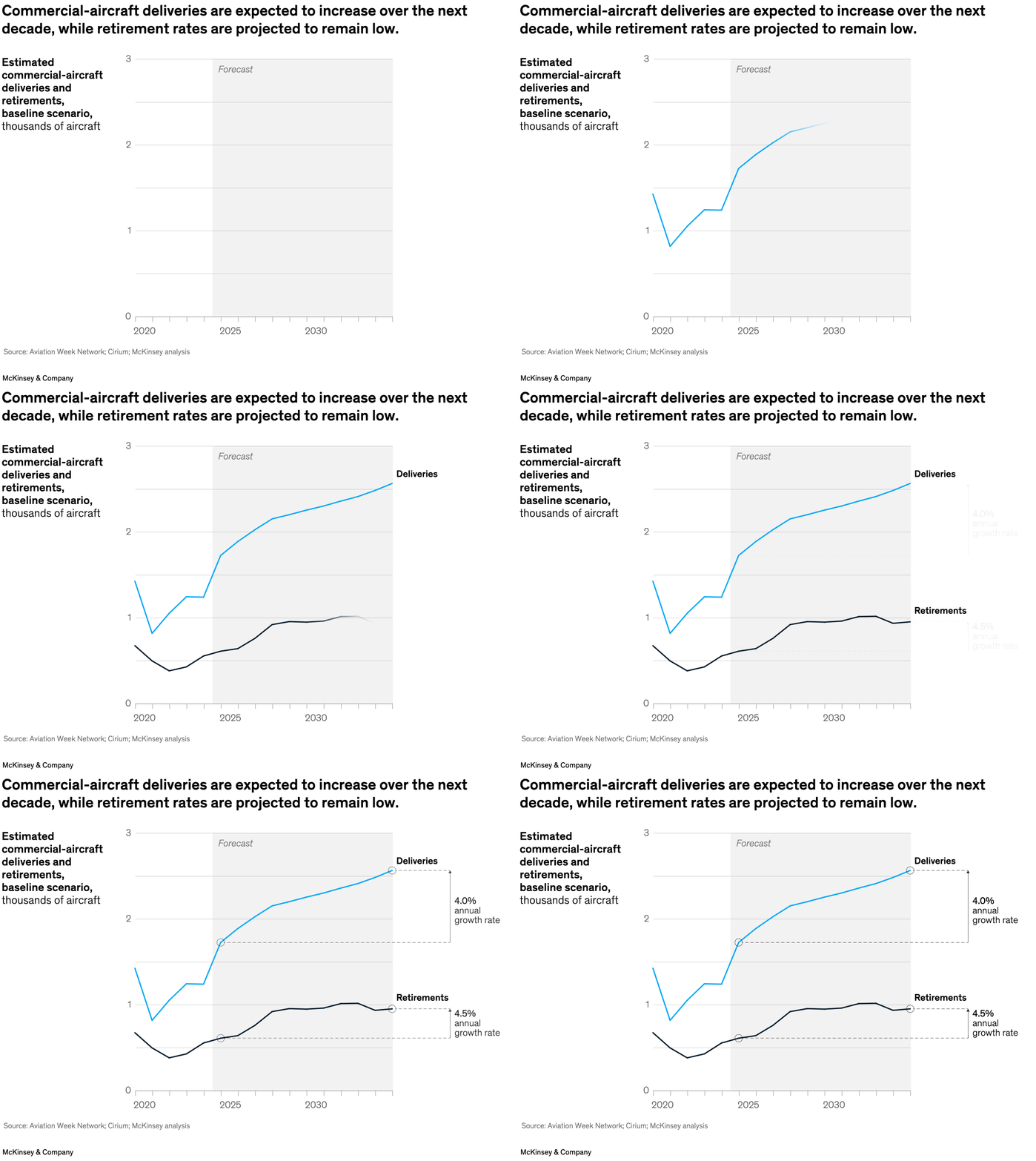
September 3, 2024 – The commercial-aviation industry is poised for an uptick in aircraft deliveries, owing to a backlog of orders and ongoing supply chain challenges. Aerospace OEMs are expected to ramp up production in the next few years, which should increase deliveries by an average of 4 percent annually for the next ten years, according to partner Daniel Leblanc and colleagues. Meanwhile, aircraft retirement rates will likely remain low, meaning a greater need for maintenance, repair, and overhaul services.
To read the article, see “What does the future hold for commercial-aviation maintenance?,” July 17, 2024.
customizer here
Visual form
Two-line forecast chart.
Layout / body structure
The chart is a single chart read left to right across time, with a shaded forecast window beginning around 2024 and two callout brackets on the right that summarize the projected growth rates for the two lines.
What is being compared
It compares estimated commercial-aircraft deliveries and retirements over time under a baseline scenario.
Measurement system
Both lines are measured in thousands of aircraft, the horizontal axis runs from the early 2020s into the mid-2030s, and the right-side annotations translate the forecast slopes into annual growth rates.
Visible structure inside the graphic
A bright blue line traces deliveries and a darker line traces retirements, with open circles marking the start and end of the forecast brackets and a gray background band separating the forecast period from the earlier observed period.
Main takeaway from the visual
Deliveries are projected to climb much more steeply than retirements while retirements stay comparatively low, which visually supports a decade of fleet expansion rather than one dominated by replacement alone.
Key standout values or extremes
Deliveries fall to well under 1.0 thousand aircraft around 2020, then rise to roughly 1.7 thousand at the start of the forecast and finish near 2.6 thousand; retirements begin around 0.6 thousand, dip near 0.4 thousand, and only climb to just under 1.0 thousand by the end of the forecast, with callouts showing about 4.0 percent annual growth for deliveries versus 4.5 percent for retirements off a much smaller base.
Controls / sequence, when applicable
This is a static chart image with no in-chart controls to operate.
Companion media, when applicable
There is no separate companion audio or video; the chart image is the full visual on this page.