Source page: McKinsey & Company
Commentary
All in on virtual learning? Not so fast
Education | Public Sector
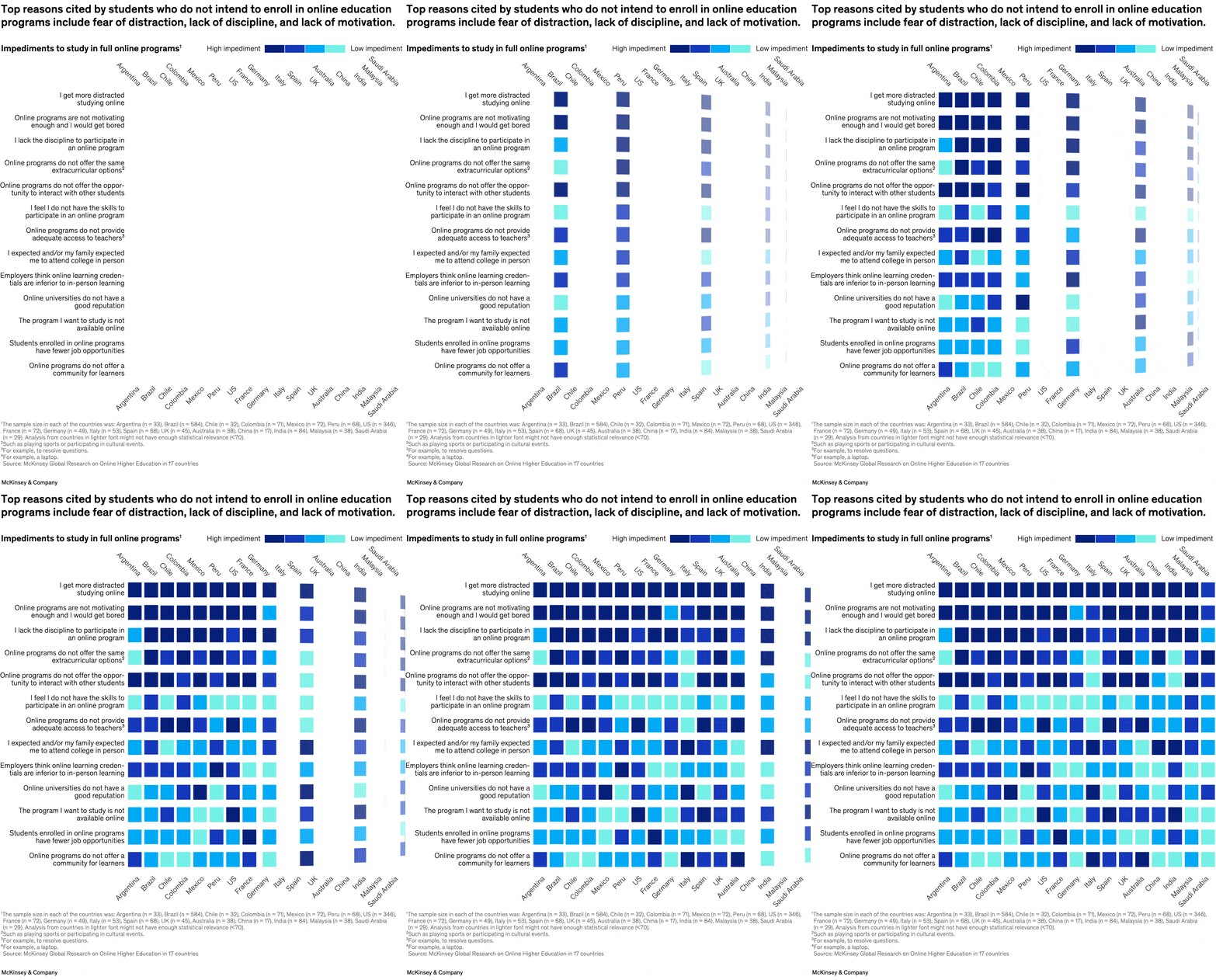
July 11, 2023 – The COVID-19 pandemic shifted much of higher education from in-person to online. According to a survey by senior partners Jonathan Law and Jimmy Sarakatsannis and coauthors, most students want to continue at least some aspects of virtual learning, but many have reservations about enrolling in fully remote programs. For example, students cite a fear of becoming more distracted, getting bored, and lacking discipline to complete the online program as the top three reasons they hesitate to go all in for online.
To read the article, see “What do higher education students want from online learning?,” June 7, 2023.
customizer here
Visual form
Heatmap matrix.
Layout / body structure
The page uses one large matrix with impediments listed as rows on the left and countries arranged as columns across the top, so the reader moves row by row and then scans across markets.
What is being compared
It compares the main reasons students say they do not intend to enroll in fully online education programs across Argentina, Brazil, Chile, Colombia, Mexico, Peru, the United States, France, Germany, Italy, Spain, the UK, Australia, China, India, Malaysia, and Saudi Arabia.
Measurement system
The graphic uses a color scale from high impediment to low impediment rather than a conventional axis, so the reader tracks relative intensity through the dark-to-light blue shading of each cell.
Visible structure inside the graphic
Each row is a distinct barrier, each column is a country, the legend at the top explains the shading scale, and the footnotes below document the country sample sizes and caveats.
Main takeaway from the visual
The upper rows stay visually strongest across many countries, showing that distraction, weak motivation, and lack of discipline are the most consistent barriers to fully online enrollment.
Key standout values or extremes
The first three rows carry the darkest concentration of cells, while lower rows such as community, reputation, and job-opportunity concerns lighten more often, which makes the ranking of objections visible even without a numeric axis.
Controls / sequence, when applicable
This is a static chart image with no in-chart controls to operate.
Companion media, when applicable
There is no separate companion audio or video; the chart image is the full visual on this page.