Source page: McKinsey & Company
Commentary
American 'sandwich generation' caregivers suffer the most
COVID-19 | Mental health | North America
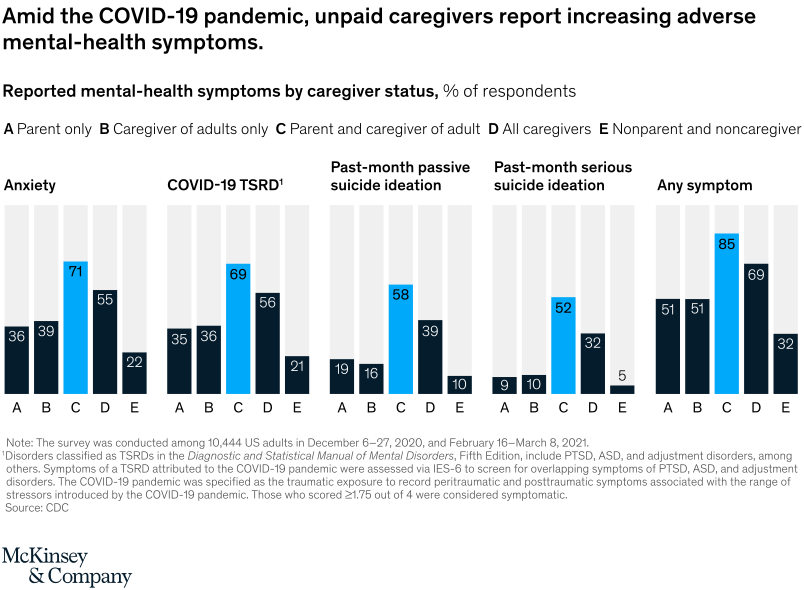
November 9, 2021 – Those who are a parent and a caregiver of an adult report the highest rate of mental-health symptoms, reporting high levels of anxiety, COVID-19 TSRD (trauma- and stressor-related disorder), and alarmingly, a full 52 percent experienced “active suicidal ideation,” sometimes referred to as serious suicidal thoughts.
To read the interview, see “Supporting unpaid caregivers in crisis: A talk with Alexandra Drane,” October 6, 2021.
customizer here
Visual form
Five-category grouped bar chart.
Layout / body structure
The chart is a single row of five mental-health categories, each category containing one bar for each caregiver-status group labeled A through E. Reader moves left to right from anxiety through any symptom and compares the relative height of the five bars within each symptom category.
What is being compared
The chart compares reported mental-health symptoms by caregiver status. It contrasts parents only, caregivers of adults only, parents who are also caregivers of adults, all caregivers, and nonparents who are noncaregivers across anxiety, COVID-19 TSRD, passive suicide ideation, serious suicide ideation, and any symptom.
Measurement system
The measurement is percent of respondents, with values printed above the bars. The five caregiver groups are encoded as A through E and repeated in each symptom category so the viewer can compare both within a symptom and across symptoms.
Visible structure inside the graphic
Each symptom cluster contains five bars, with the C group standing out in bright blue and often reaching the greatest height. In the any-symptom category, for example, the bars are labeled 51, 51, 85, 69, and 32, while the more severe categories such as passive and serious suicide ideation show lower overall levels but the same general ordering with the sandwich-generation group highest.
Main takeaway from the visual
Caregivers who are both parents and caregivers of adults report the heaviest mental-health burden across every symptom category. Their bar is tallest in all five clusters, making the sandwich-generation effect the clearest pattern on the page.
Key standout values or extremes
The highest number on the page is 85 percent for any symptom among the parent-and-caregiver-of-adult group. That same group also leads anxiety at 71 percent, COVID-19 TSRD at 69 percent, passive suicide ideation at 58 percent, and serious suicide ideation at 52 percent, while the nonparent noncaregiver group is typically the lowest and falls to just 5 percent for serious suicide ideation.
Controls / sequence, when applicable
This is a static chart image with no in-chart controls to operate.
Companion media, when applicable
There is no separate companion audio or video; the chart image is the full visual on this page.