Source page: McKinsey & Company
Commentary
An AI opportunity for health insurers
Artificial Intelligence | Healthcare | Generative AI
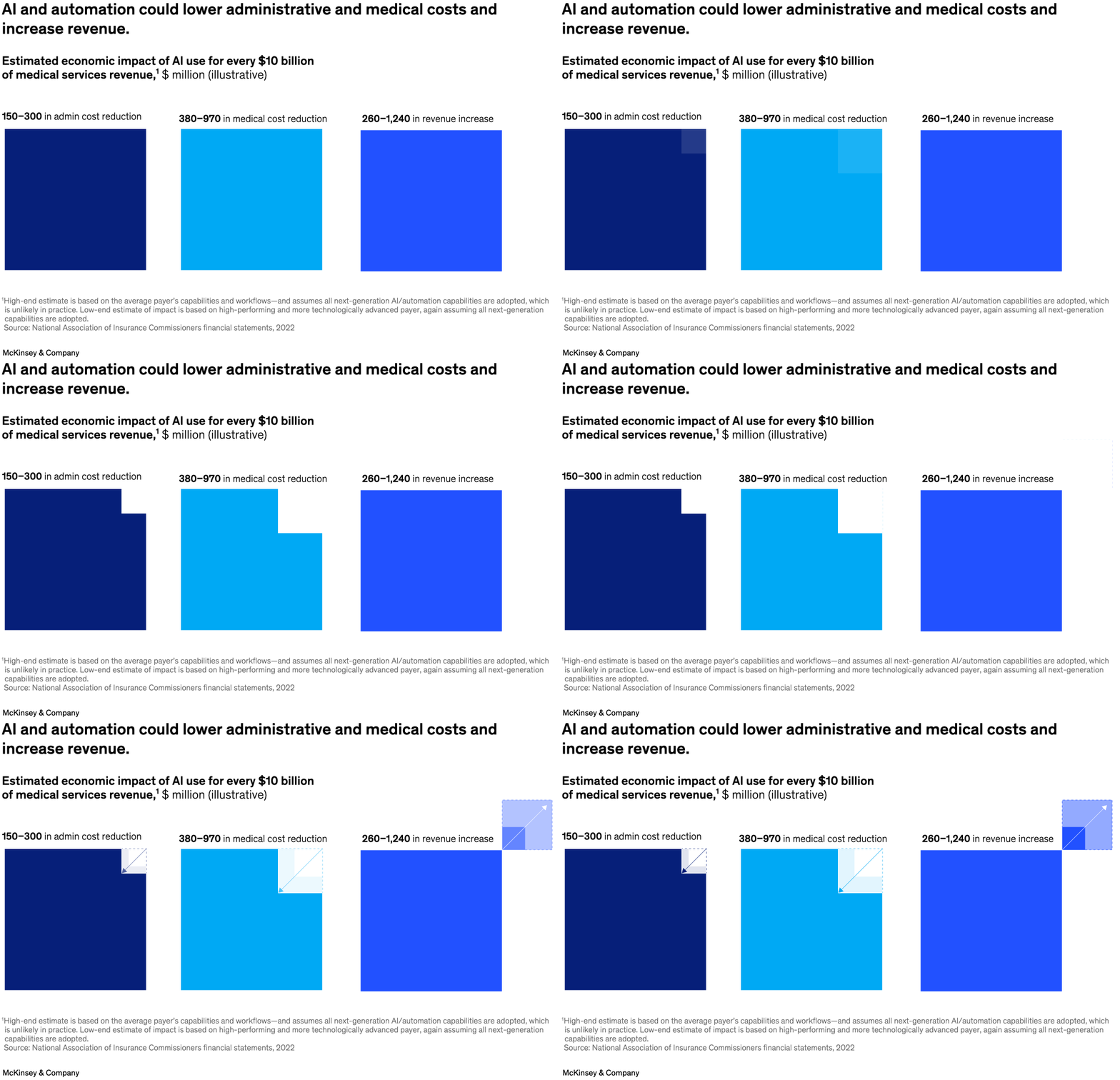
July 5, 2024 – Health insurers stand to gain substantial benefits if they can fully integrate AI and automation into the end-to-end processes of each part of their business, say partner Jessica Lamb and senior partner Shubham Singhal. They estimate that for every $10 billion in revenues, payers could save $150 million to $300 million in administrative costs and $380 million to $970 million in medical costs. Moreover, these technologies can help generate $260 million to $1,240 million in additional revenue. These estimates apply to an average-performing payer, so lower performers might experience even greater improvements, potentially surpassing their competitors.
To read the article, see “The AI opportunity: How payers can capture it now,” June 5, 2024.
customizer here
Visual form
Comparison infographic.
Layout / body structure
The page uses a single left-to-right three-block layout. Each block stands alone as its own value bucket, so the reading order is administrative savings first, medical savings second, and revenue upside third.
What is being compared
It compares three channels of AI value for health insurers: administrative cost reduction, medical cost reduction, and revenue increase.
Measurement system
The values are shown as dollar ranges in millions for every $10 billion of medical-services revenue. There are no axes; the comparison is carried by the labeled range totals placed directly on each block.
Visible structure inside the graphic
Three large colored rectangles dominate the chart. Small corner overlays and arrows indicate the stretch from lower-end to higher-end outcomes, and the third block on the right is visually paired with the largest upper-end range.
Main takeaway from the visual
The visual makes the revenue opportunity look largest, places medical-cost reduction second, and leaves administrative savings as the smallest value pool, so the strongest upside comes from growth and claims-side efficiency rather than back-office savings alone.
Key standout values or extremes
Administrative savings are shown at about $150 million to $300 million, medical-cost reduction at about $380 million to $970 million, and revenue increase at about $260 million to $1.24 billion, which is the widest and highest range on the page.
Controls / sequence, when applicable
This is a static chart image with no in-chart controls to operate.
Companion media, when applicable
There is no separate companion audio or video; the chart image is the full visual on this page.