Source page: McKinsey & Company
Commentary
Banking's AI angst
Artificial Intelligence | Banking | Consumer
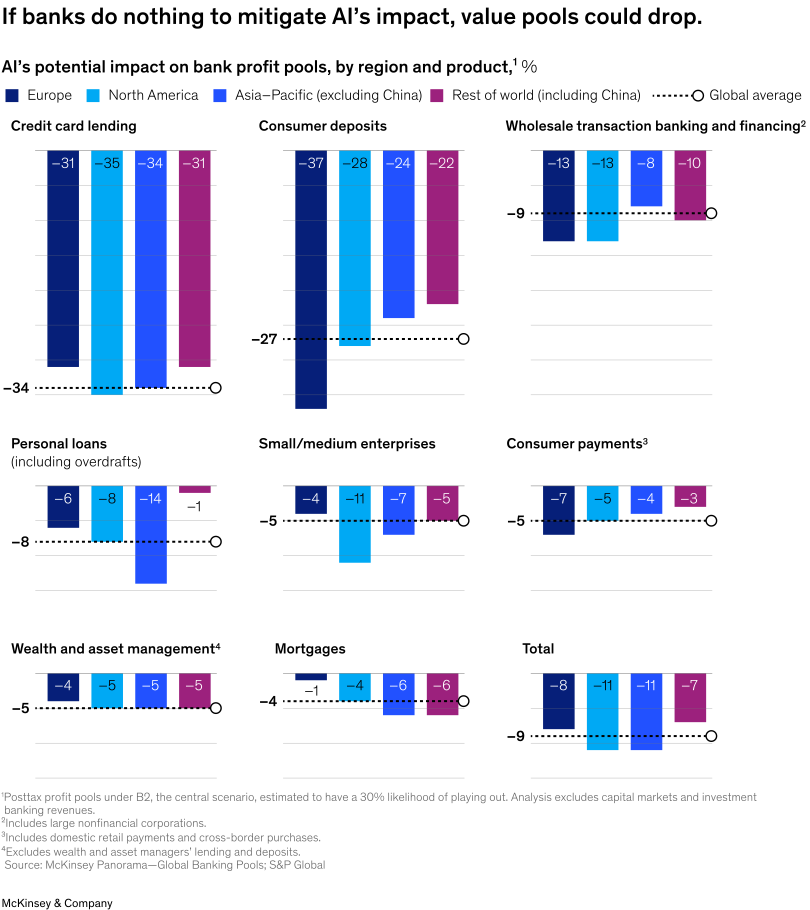
January 6, 2026 – If banks fail to respond to consumers’ adoption of AI—particularly their use of AI to make financial decisions—their profit pools could shrink by an average of 9 percent globally. Credit card lending and consumer deposits are the most vulnerable, with potential profit pool drops of 34 percent and 27 percent, respectively, according to McKinsey’s Darius Imregun, Ido Segev, Jon Steitz, Klaus Dallerup, Marti Riba, Miklós Gábor Dietz, Pradip Patiath, Saptarshi Ganguly, and coauthors find. While the impact is less severe in areas such as mortgages and wealth management, virtually all banking products could see a decline if banks do not take action. To limit potential disruptions, banks can adapt their business models to improve personalization and deploy their own AI agents before third-party platforms capture customer relationships.
To read the report, see “Global Banking Annual Review 2025: Why precision, not heft, defines the future of banking,” October 23, 2025.
customizer here
Visual form
Small-multiple bar chart.
Layout / body structure
The chart is arranged as a grid of product-level mini charts. It reads across the grid from credit card lending, consumer deposits, and wholesale transaction banking and financing on the top row to personal loans, small and medium enterprises, consumer payments, wealth and asset management, mortgages, and the overall total further down the page.
What is being compared
It compares AI’s potential impact on bank profit pools across regions and products. Inside each product panel, it compares Europe, North America, Asia – Pacific excluding China, and the rest of world including China against a dotted global-average benchmark.
Measurement system
The unit is percentage impact on profit pools. Each regional bar is labeled directly with its value, and the dotted benchmark line with an open circle marks the global average for that product or total category.
Visible structure inside the graphic
Every mini chart uses the same four regional bars, the same regional color palette, and a horizontal dotted benchmark line for the global average. The grid structure makes it easy to scan product by product and see where regional bars sit above or below the benchmark in each lending or fee pool.
Main takeaway from the visual
The chart shows the biggest downside risk in the traditional retail and deposit pools if banks do nothing to respond to AI. Credit card lending and consumer deposits carry the deepest negative bars across regions, while categories such as mortgages, consumer payments, and wealth and asset management show much smaller expected declines.
Key standout values or extremes
Credit card lending is the most severe panel, with regional impacts ranging from about negative 31 to negative 35 percent against a negative 34 percent global average. Consumer deposits also stand out, with Europe at negative 37 percent and the global average at negative 27 percent, while the total panel clusters around negative 7 to negative 11 percent against a negative 9 percent global average.
Controls / sequence, when applicable
This is a static chart image with no in-chart controls to operate.
Companion media, when applicable
There is no separate companion audio or video; the chart image is the full visual on this page.