Source page: McKinsey & Company
Commentary
Beyond benefits and pay
Human resources | Talent | Workforce
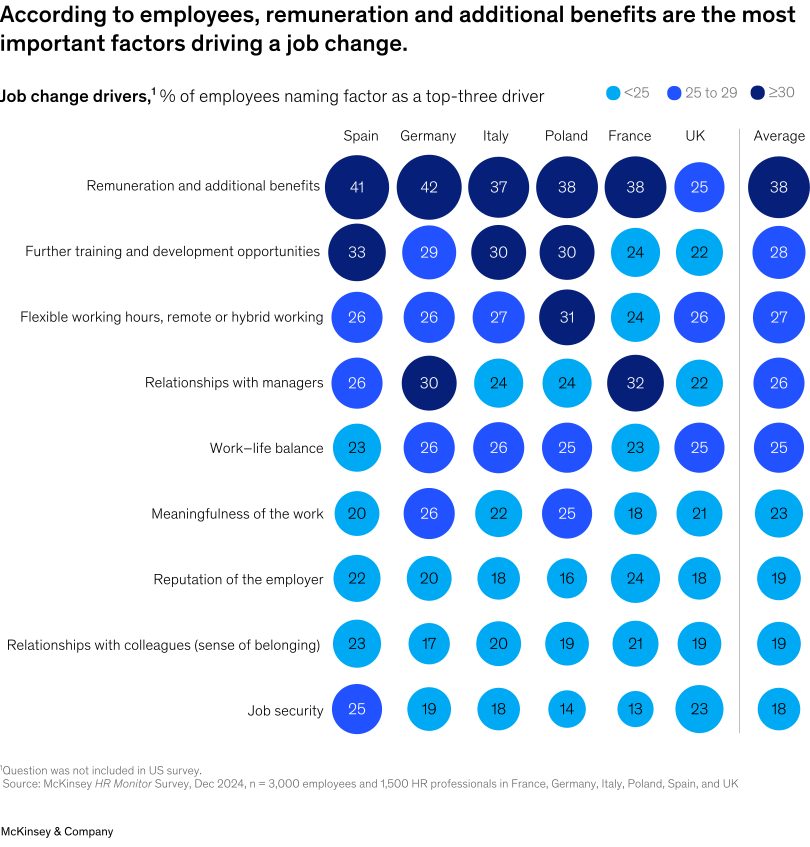
August 14, 2025 – Despite indications that the labor market is easing in many regions, talent acquisition remains challenging and is becoming more complex. McKinsey’s 2025 HR Monitor Survey shows that hiring success in Europe stands at just 46 percent. A contributing factor to limited hiring success may be a growing disconnect between HR measures and candidate preferences and needs. While the survey results point to remuneration along with additional benefits as a top factor in changing jobs, Partner Julian Kirchherr and coauthors caution against focusing primarily on compensation. Instead, HR departments should prioritize efforts across all the top five factors relevant for employees while also aligning with fast-changing business and candidate needs.
To read the report, see “HR Monitor 2025,” July 3, 2025.
customizer here
Visual form
Table (with Visual Encoding): ranked dot-matrix table of employee job-change drivers by European market.
Layout / body structure
The chart reads as a ranked table. Job-change drivers run down the left, the cross-market average and individual European countries run across the top, and each cell contains a labeled percentage circle. The reader scans down the rows to see the overall ranking, then across the columns to compare country differences.
What is being compared
It compares the factors employees name as top-three reasons for changing jobs across Spain, Germany, Italy, Poland, France, the United Kingdom, and the overall average. The age legend also separates respondents under 25, ages 25 to 29, and over 30.
Measurement system
The measure is percent of employees selecting each factor as one of their top three job-change drivers. The visual encoding combines exact printed percentages with circle markers and blue age-group shading, so it functions as a table with visual encoding rather than a plain text table.
Visible structure inside the graphic
Rows are sorted from stronger to weaker job-change drivers. Remuneration and additional benefits sits at the top, followed by nonpay factors such as further training and development, flexible working, work-life balance, and manager or colleague relationships; lower rows include reputation of the employer, belonging, and job security.
Main takeaway from the visual
Pay and benefits are the leading job-change driver, but the table shows that hiring and retention cannot be solved by compensation alone. Development, flexibility, work-life balance, and relationship factors remain large enough that HR teams need a broader candidate-value proposition.
Key standout values or extremes
Remuneration and additional benefits reaches 42 percent in Germany, 41 percent in Spain, and 38 percent on average. Further training and development averages 28 percent, flexible working averages 27 percent, and job security is much lower at an average of 18 percent.
Controls / sequence, when applicable
This is a static table with visual encoding; there are no in-chart controls to operate.
Companion media, when applicable
There is no separate companion audio or video; the table chart is the full visual on this page.