Source page: McKinsey & Company
Commentary
Buy less, repair more: The new look for fashionistas after COVID-19
COVID-19 | Sustainability | Retail | Europe
August 11, 2020 – A majority of UK and German shoppers say that after the pandemic they will buy more durable apparel, keep what they already own for longer, and repair items to prolong their use.
To read the survey, see “Survey: Consumer sentiment on sustainability in fashion,” July 17, 2020.
customizer here
Visual form
Stacked Bar / Stacked Column: Likert-style fashion-sustainability behavior bars.
Layout / body structure
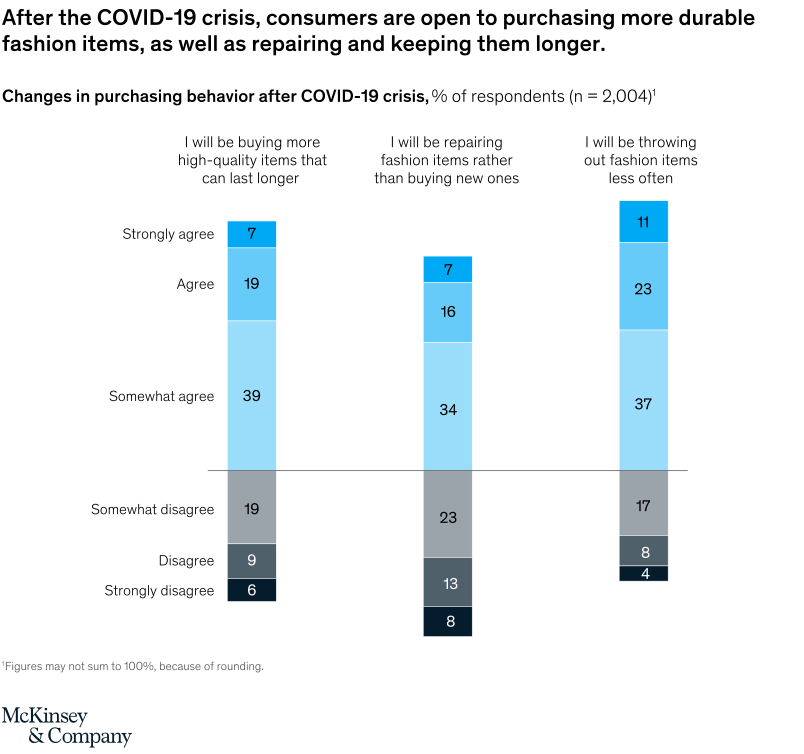
The visual has three vertical stacked columns, one for each post-COVID fashion behavior. Agreement segments stack above the center line, and disagreement segments stack below it.
What is being compared
It compares consumer openness to buying higher-quality durable fashion items, repairing items instead of buying new ones, and throwing out fashion items less often.
Measurement system
Each bar shows percent of respondents across strongly agree, agree, somewhat agree, somewhat disagree, disagree, and strongly disagree.
Visible structure inside the graphic
All three behaviors have larger positive agreement stacks than negative disagreement stacks. Throwing out fashion items less often has the strongest positive stack.
Main takeaway from the visual
The chart shows that many consumers expected to treat fashion more sustainably after COVID-19 by buying less, repairing more, and keeping items longer.
Key standout values or extremes
Positive agreement totals are about 65 percent for buying higher-quality items that last longer, 57 percent for repairing rather than buying new, and 71 percent for throwing out fashion items less often.
Controls / sequence, when applicable
This is a static Likert-style stacked-column chart; there are no in-chart controls to operate.
Companion media, when applicable
There is no separate companion audio or video; the fashion-sustainability chart is the full visual on this page.