Source page: McKinsey & Company
Commentary
Calling all clean-energy workers
Sustainability | Renewable energy
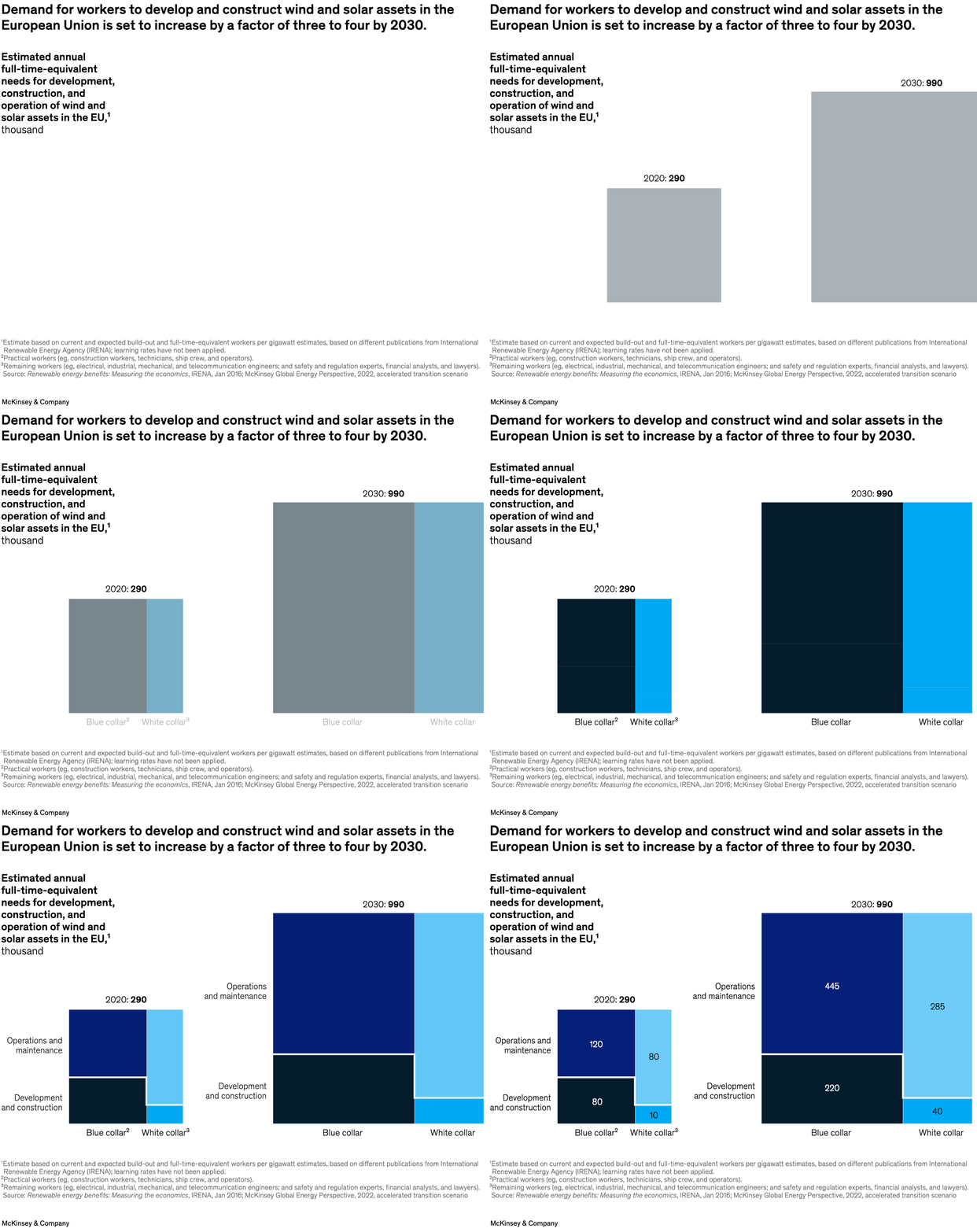
September 12, 2023 – The European Union, which accounts for about 8 percent of global energy-related emissions, could position itself as a leader in efforts to achieve net zero. Yet as senior partner Lorenzo Moavero Milanesi and coauthors explain, fulfilling these commitments requires attracting and training enough workers to scale up clean technologies. Demand for talent in wind and solar-power projects is expected to rise by as much as fourfold in EU countries by 2030.
To read the article, see “Five key action areas to put Europe’s energy transition on a more orderly path,” August 8, 2023.
customizer here
Visual form
Workforce-needs projection chart. It focuses on future labor demand rather than on prices or output alone.
Layout / body structure
The chart is a single projection view for annual full-time-equivalent needs tied to wind and solar development, construction, and operation in the European Union. The layout is organized around labor categories feeding into the 2030 requirement.
What is being compared
It compares the expected scale-up in worker demand across the clean-energy build-out, especially for the people needed to develop, construct, and operate wind and solar assets in the EU.
Measurement system
The unit is thousand full-time-equivalent workers per year. The chart is a forward-looking labor-demand projection rather than a backward-looking employment history.
Visible structure inside the graphic
The graphic uses a single projection framework with the worker categories embedded in the supporting notes, so the reader sees the build-out requirement as a labor pipeline problem. The emphasis is on the magnitude of the future hiring need.
Main takeaway from the visual
The labor requirement rises dramatically by 2030, which means the energy transition is constrained not only by technology and capital but also by skilled workers. The chart is built to show a threefold-to-fourfold increase in demand rather than a modest hiring bump.
Key standout values or extremes
The strongest standout is the projected factor-of-three-to-four increase in demand for wind and solar workers by 2030. The footnotes reinforce that the need spans practical workers, technical specialists, and professional roles, not just one labor category.
Controls / sequence, when applicable
This is a static chart image with no in-chart controls to operate.
Companion media, when applicable
There is no separate companion audio or video; the chart image is the full visual on this page.