Source page: McKinsey & Company
Commentary
Can a low-carbon recovery agenda create jobs and help the economy?
COVID-19 | Sustainability | Economy
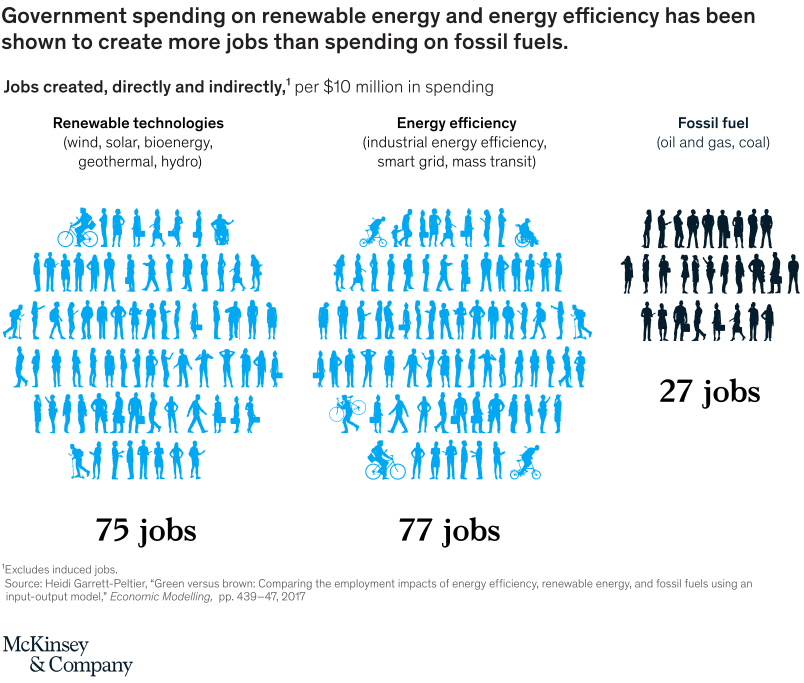
June 10, 2020 – In short, yes. One study showed that government spending on renewables creates 50 more jobs per $10 million invested than spending on fossil fuels.
To read the article, see “How a post-pandemic stimulus can both create jobs and help the climate,” May 27, 2020.
customizer here
Visual form
Table (with Visual Encoding): three-column pictogram comparison of jobs created per recovery-spending amount.
Layout / body structure
The graphic is organized as three side-by-side columns for renewable technologies, energy efficiency, and fossil fuel. Each column combines a large job-count label with rows of person icons, so the reader compares the columns by both the printed number and the density of icons.
What is being compared
It compares estimated job creation from three types of government stimulus spending: renewable energy, energy efficiency, and fossil fuels. The comparison is about jobs per equal spending amount, not total employment in each sector.
Measurement system
The measure is direct and indirect jobs created per 10 million dollars of government spending. The pictogram icons provide the visual encoding, while the large labels give the exact values.
Visible structure inside the graphic
Renewable technologies and energy efficiency have many more blue person icons than fossil fuel has dark icons. The renewable and efficiency columns sit close to each other, while the fossil-fuel column is visibly much smaller.
Main takeaway from the visual
The chart shows why a low-carbon recovery agenda can be framed as an employment strategy. The two low-carbon spending categories create far more jobs per dollar than fossil-fuel spending in the comparison shown.
Key standout values or extremes
Energy efficiency is the highest at 77 jobs per 10 million dollars, renewable technologies follows at 75 jobs, and fossil fuel is far lower at 27 jobs. That means the low-carbon categories create roughly 50 more jobs per 10 million dollars than fossil fuel.
Controls / sequence, when applicable
This is a static pictogram table; there are no in-chart controls to operate.
Companion media, when applicable
There is no separate companion audio or video; the pictogram comparison is the full visual on this page.