Source page: McKinsey & Company
Commentary
Carbon dioxide emissions would need to reach net zero by 2050 to avoid the worst effects of climate change
Sustainability | Climate change
September 21, 2020 – To avoid the most dangerous and irreversible effects of climate change, the world would need to limit global warming to 1.5 degrees Celsius. That means carbon emissions would need to reach net zero by 2050, a significant deviation from the path we’re on now.
To explore the interactive, see “The 1.5-degree challenge,” September 16, 2020.
customizer here
Visual form
Scenario trajectory line chart.
Layout / body structure
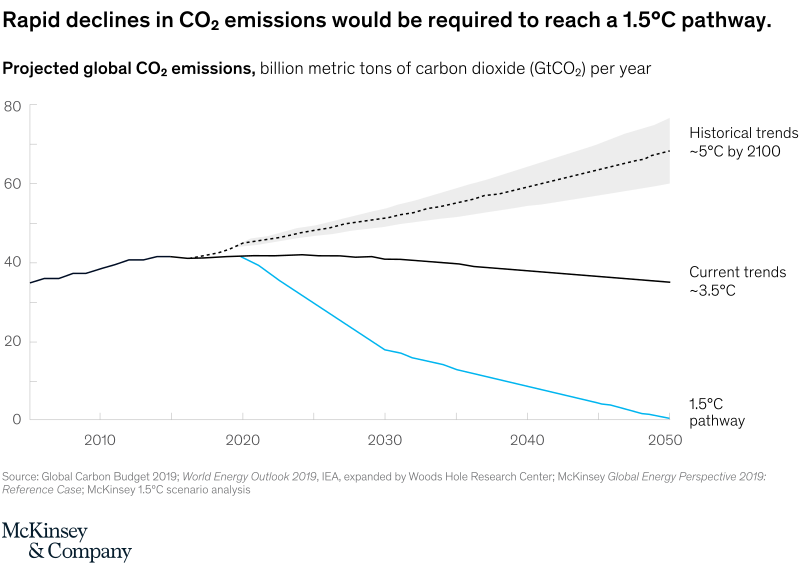
The visual is a single emissions-trajectory view organized across time, with the current-course path set against the much steeper 1.5-degree pathway needed by midcentury. The associated source expands the same story into multiple scenario variants, but the published page centers the main trajectory comparison.
What is being compared
It compares where global net CO2 emissions are headed under current momentum versus where they would need to move to stay on a 1.5-degree pathway.
Measurement system
The measurement system is net carbon-dioxide emissions over time, anchored by a remaining carbon budget and a 2050 net-zero endpoint. The important milestones are the 2030 cut and the 2050 destination rather than short-term month-to-month movement.
Visible structure inside the graphic
The chart is organized around declining emissions trajectories and milestone callouts tied to the carbon budget. The eye follows the current path forward and then sees how much steeper the 1.5-degree path would have to be to stay within the remaining budget.
Main takeaway from the visual
The visual shows that the required pathway is radically steeper than the world’s current course. Staying within a 1.5-degree budget demands immediate, sharp emissions declines through the 2020s and a net-zero endpoint by 2050, not a gradual late adjustment.
Key standout values or extremes
The key anchors are a remaining carbon budget of 570 gigatons of CO2 from 2018 onward, current-course exhaustion of that budget around 2031, a cut of more than 50 percent in net CO2 by 2030 relative to 2010, and net-zero emissions by 2050.
Controls / sequence, when applicable
This is a static chart image with no in-chart controls to operate.
Companion media, when applicable
There is no separate companion audio or video; the chart image is the full visual on this page.