Source page: McKinsey & Company
Commentary
Care inequities for people with disabilities
Healthcare | Inequality
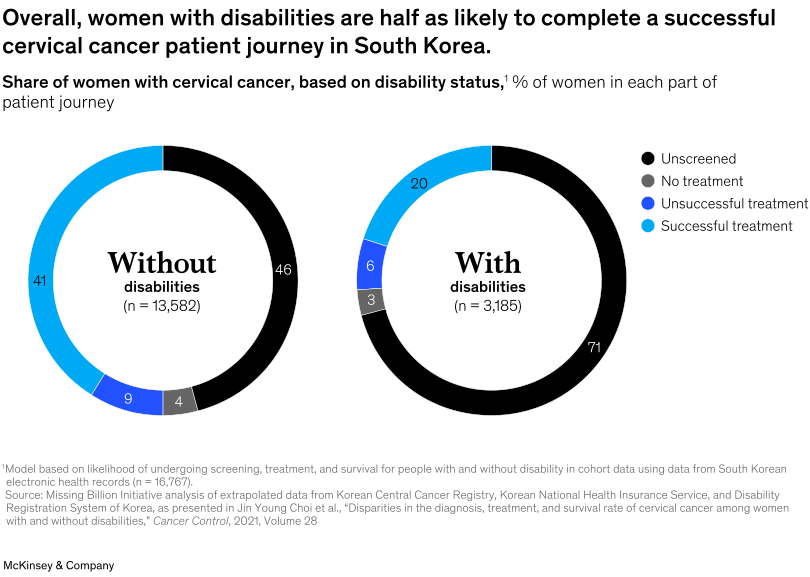
November 20, 2024 – The 1.3 billion people living with disabilities globally have a substantially higher disease prevalence, and they also face more challenges to receiving the care they need. While removing systemwide barriers must increase, addressing hurdles along disease-specific care pathways is equally important, say partner Mona Hammami and coauthors. For example, in cervical cancer, because of a combination of health inequities, women with disabilities have a 1.4 times higher mortality risk because they are half as likely as people without disabilities to complete successful treatment.
To read the article, see “Advancing inclusive care pathways for people with disabilities,” September 24, 2024.
customizer here
Visual form
Pair of donut charts.
Layout / body structure
The chart is split into two circular composition charts, one for women without disabilities and one for women with disabilities. Read the left donut first and then the right donut, comparing how the shares shift among the four patient-journey outcomes.
What is being compared
It compares the share of women with cervical cancer in each part of the patient journey based on disability status in South Korea. The outcome categories are unscreened, no treatment, unsuccessful treatment, and successful treatment.
Measurement system
Each donut is measured as a percentage composition that sums to 100 percent. Color encodes the four patient-journey outcomes, and the numeric shares are printed on the donut segments.
Visible structure inside the graphic
The visual is organized as two side-by-side rings with category colors repeated in both circles. The dominant black segment for unscreened women and the light-blue successful-treatment segment make the contrast between the two groups visible immediately.
Main takeaway from the visual
The chart shows that women with disabilities are much less likely to complete a successful cervical-cancer journey and much more likely to remain unscreened. The right donut has a much larger unscreened segment and a much smaller successful-treatment segment than the left donut.
Key standout values or extremes
Among women without disabilities, 41 percent are shown in successful treatment and 46 percent are unscreened. Among women with disabilities, only 20 percent reach successful treatment while 71 percent are unscreened, making the successful outcome roughly half as common and the unscreened outcome dramatically larger.
Controls / sequence, when applicable
This is a static chart image with no in-chart controls to operate.
Companion media, when applicable
There is no separate companion audio or video; the chart image is the full visual on this page.