Source page: McKinsey & Company
Commentary
Coronavirus shut down schools worldwide
COVID-19 | Education
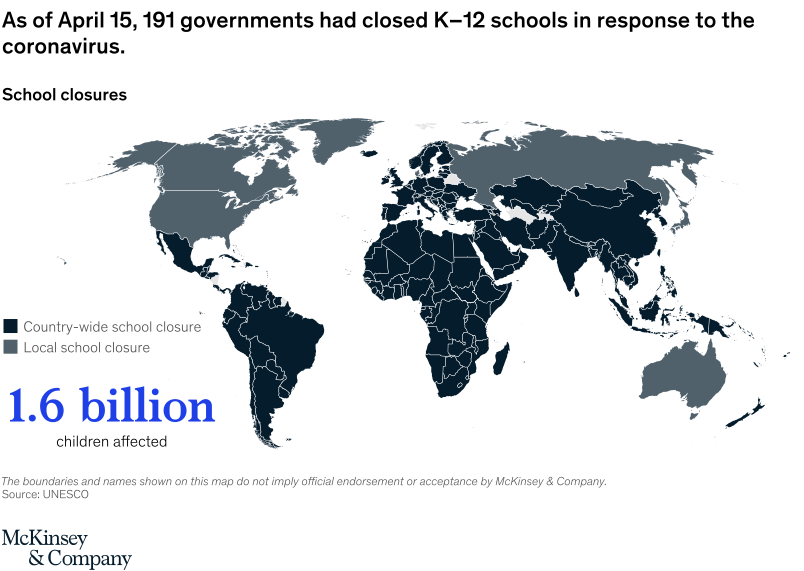
May 4, 2020 – As of mid-April, 191 countries had shut down all their primary and secondary schools, affecting almost 1.6 billion children. But the shift to remote learning has been uneven. Some systems were able to train teachers, roll out remote learning, and put in place student-support services in less than a week. Others are still struggling, constrained by lack of access to technology or expertise. The disparity is obvious among countries; it is also noticeable within them. Given that K–12 education in many countries is predominantly a local responsibility, students can live relatively near one another yet face very different prospects.
To read the article, see “School-system priorities in the age of coronavirus,” April 2020.
customizer here
Visual form
Choropleth Map and Single KPI / Metric: global school-closure map with an affected-children callout.
Layout / body structure
The visual is a single world map. Countries fill the main field, a small legend explains the closure categories, and a large numeric callout beneath the map gives the total number of children affected.
What is being compared
It compares national school-closure status across countries during the early coronavirus response. The map distinguishes country-wide K-12 closures from local closures, then uses the callout to show the global scale of affected students.
Measurement system
The map uses categorical shading rather than a continuous value scale. The separate metric is the number of children affected worldwide, tied to the count of governments that had closed K-12 schools by April 15.
Visible structure inside the graphic
Most of the world map is filled with the country-wide closure color, while a smaller group of countries uses the local-closure color. The large blue number below the map anchors the reader on the scale of the disruption.
Main takeaway from the visual
The map shows that COVID-19 school shutdowns were almost global, not a set of isolated local actions. The KPI makes the consequence concrete by translating that geographic spread into children affected.
Key standout values or extremes
The headline figure is 1.6 billion children affected. The page text states that 191 governments had closed K-12 schools as of April 15, making country-wide closure the dominant status shown on the map.
Controls / sequence, when applicable
This is a static choropleth map with a KPI callout; there are no in-chart controls to operate.
Companion media, when applicable
There is no separate companion audio or video; the map and KPI callout are the full visual on this page.