Source page: McKinsey & Company
Commentary
Curbing battery emissions
Sustainability | Electric vehicles | Automotive
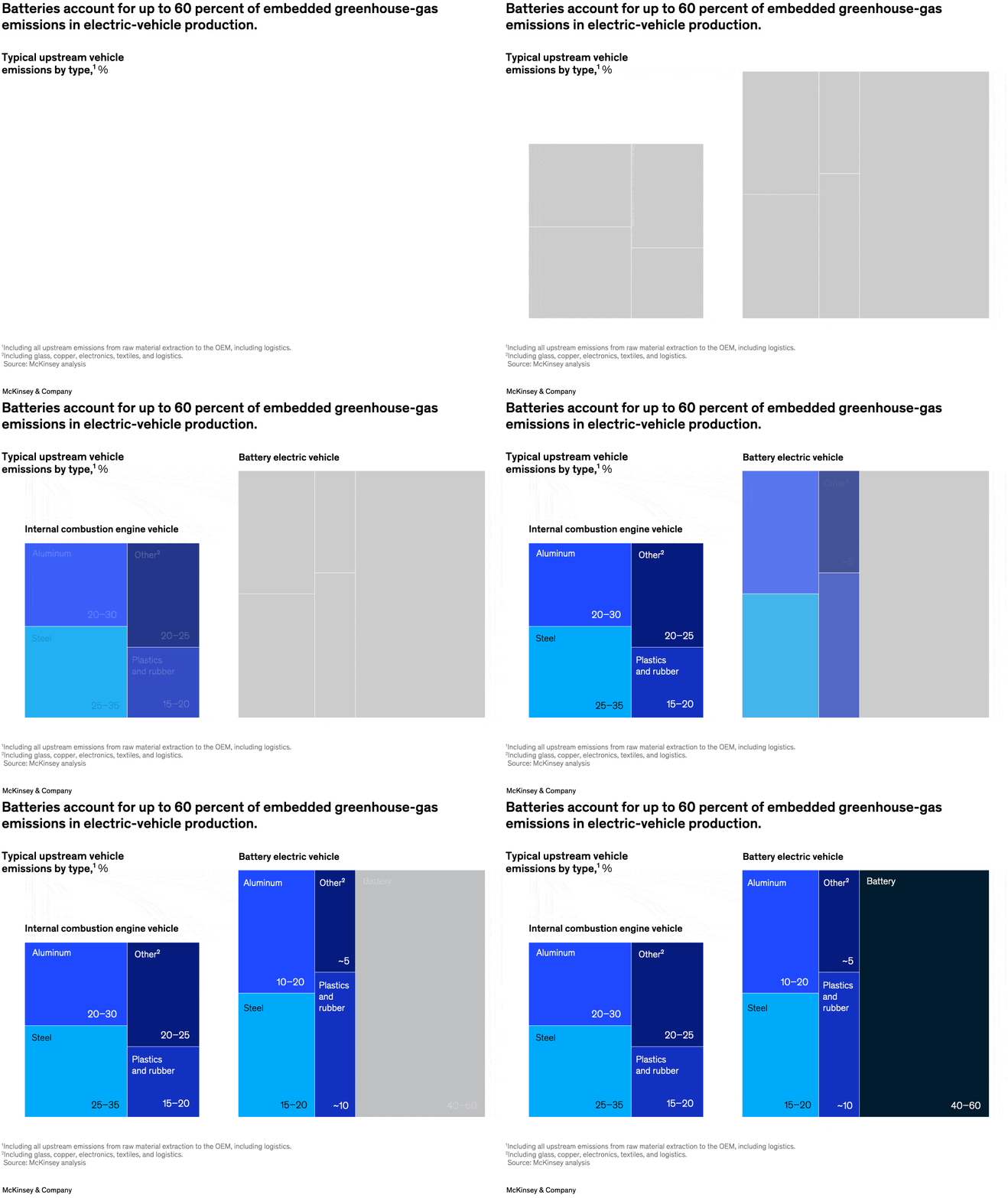
March 27, 2023 – Unlike vehicles with internal combustion engines, electric vehicles (EVs) do not produce direct tailpipe emissions from burning diesel and gasoline. But battery-powered EVs have a major emissions challenge of their own. Producing the large lithium-ion batteries used to power EVs is a highly carbon-intensive process, accounting for about 40 to 60 percent of total EV production emissions, estimate senior partners Martin Linder and Tomas Nauclér and coauthors.
To read the article, see “The race to decarbonize electric-vehicle batteries,” February 23, 2023.
customizer here
Visual form
Proportional block comparison chart.
Layout / body structure
The page uses two large side-by-side area blocks, one for a typical internal combustion engine vehicle and one for a battery electric vehicle, with each block subdivided by emissions source.
What is being compared
It compares upstream production emissions by material type for conventional internal combustion engine vehicles versus battery electric vehicles.
Measurement system
The measurements are percentage or percentage-range shares of typical upstream vehicle emissions, so the size of each internal block shows how much a given material category contributes to the total production footprint.
Visible structure inside the graphic
Both vehicle blocks are segmented into aluminum, steel, plastics and rubber, and other components, but the battery electric vehicle block also contains a very large battery section. The internal combustion block is smaller overall, which makes the total production-footprint difference visible before the reader even inspects the segment labels.
Main takeaway from the visual
The battery section dominates the battery electric vehicle block, which makes it clear that battery manufacturing is the main reason electric vehicles carry much higher upstream production emissions than internal combustion vehicles.
Key standout values or extremes
The battery portion alone is labeled at roughly 40 to 60 percent of battery electric vehicle production emissions. By contrast, the other component blocks cluster around smaller ranges such as 10 to 20 percent or 15 to 20 percent, so no other segment comes close to the battery footprint.
Controls / sequence, when applicable
This is a static chart image with no in-chart controls to operate.
Companion media, when applicable
There is no separate companion audio or video; the chart image is the full visual on this page.