Source page: McKinsey & Company
Commentary
Finding profit on the edge
Telecommunications | 5G
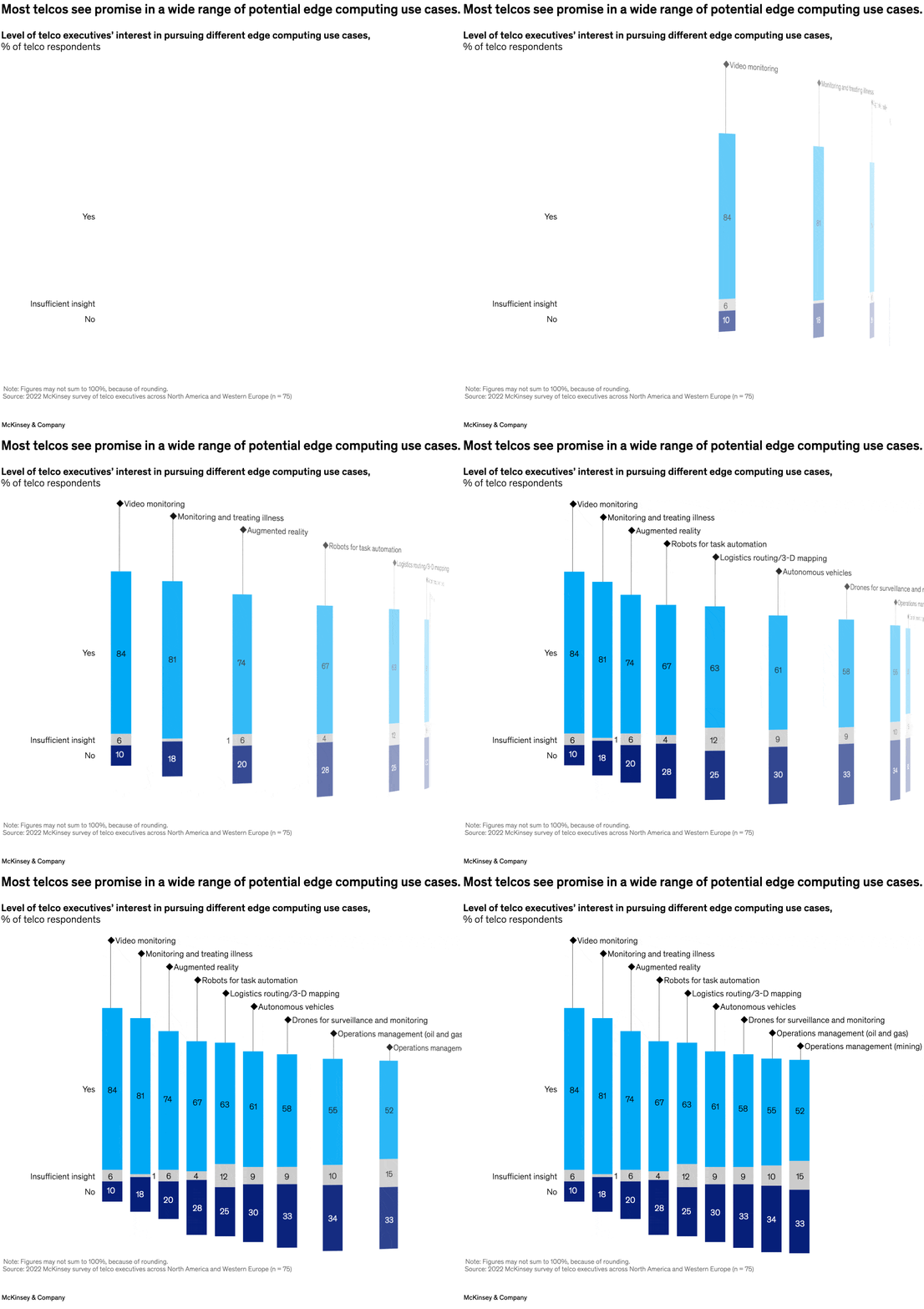
November 15, 2023 – The telecommunications industry is devising elaborate plans to overhaul everything from business models to operations to customer experience. A key innovation that could transform telcos, find senior partner Tomás Lajous and colleagues, is edge computing, a much faster way of handling data that involves moving processing to the “edge” of a network rather than a distant data center, as is the case now. A McKinsey survey of 75 telco executives found broad interest in edge computing use cases, led by its applications for video monitoring, assessing illnesses, and augmented reality.
To read the article, see “Tech talent in transition: Seven technology trends reshaping telcos,” October 13, 2023.
customizer here
Visual form
Diverging stacked bar chart. Each use case has one vertical bar split into yes, insufficient insight, and no response shares.
Layout / body structure
The chart is arranged as a descending ranked list of edge-computing use cases from left to right. Each bar rises above the baseline for yes responses, sits as a thin gray segment for insufficient insight, and drops below the baseline for no responses, with the use-case labels called out above.
What is being compared
The chart compares executive interest in pursuing different edge-computing use cases inside telecom. It is comparing categories such as video monitoring, monitoring and treating illness, augmented reality, robots for task automation, logistics routing and 3-D mapping, autonomous vehicles, drones for surveillance and monitoring, and operations-management uses in oil and gas or mining.
Measurement system
The values are percentages of telco respondents. Positive interest is shown above the baseline, insufficient insight is shown as a smaller middle segment, and no responses are shown below the baseline, so the balance of interest can be read for each use case without switching chart types.
Visible structure inside the graphic
Each bar contains three stacked segments and a label pointing to the associated use case. The descending order matters because it ranks the most promising use cases first and lets the reader see how interest drops off and no-share rises as the list moves toward the less favored applications.
Main takeaway from the visual
Executives see promise across a wide range of edge-computing uses, but enthusiasm is strongest for monitoring-heavy and care-related applications. The ranking structure makes that visible by placing video monitoring and monitoring and treating illness at the top with the biggest yes segments and smaller no segments than the lower-ranked use cases.
Key standout values or extremes
Video monitoring leads with 84 percent yes, followed by monitoring and treating illness at 81 percent and augmented reality at 74 percent. At the lower end, operations management in mining shows 52 percent yes and 33 percent no, while drones for surveillance and monitoring shows 55 percent yes and 34 percent no.
Controls / sequence, when applicable
This is a static chart image with no in-chart controls to operate.
Companion media, when applicable
There is no separate companion audio or video; the chart image is the full visual on this page.