Source page: McKinsey & Company
Commentary
Full COVID-19 vaccine courses could be available for the entire global adult population by the end of 2021
COVID-19 | Public Health
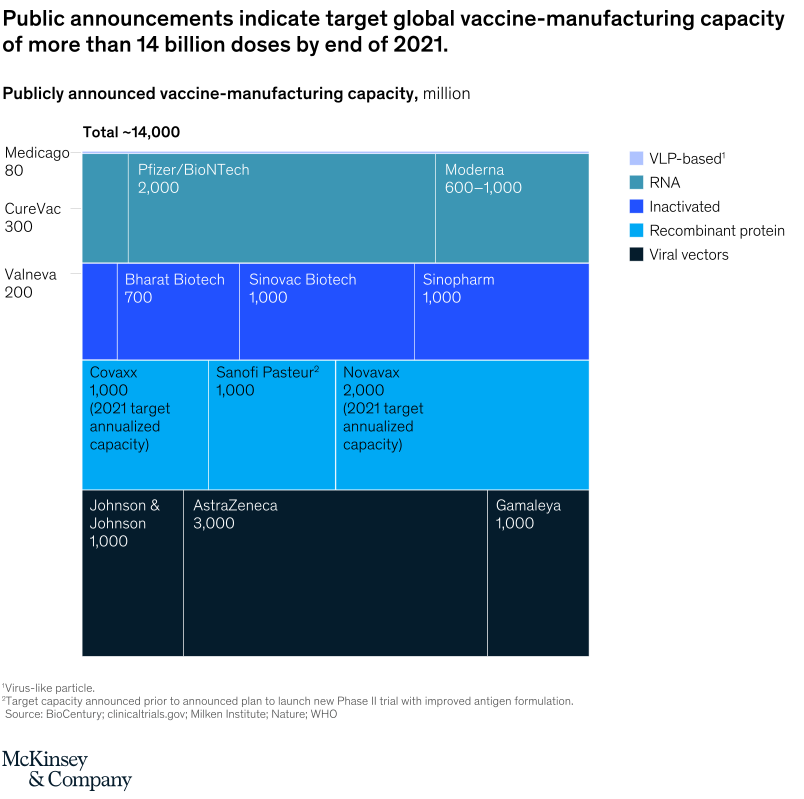
March 1, 2021 – More than 14 billion doses (including 2020 doses) are planned for 2021, enough for six billion individuals—assuming that all innovators’ vaccines are successful and require two doses.
To read the article, see “On pins and needles: Tracking COVID-19 vaccines and therapeutics,” February 18, 2021.
customizer here
Visual form
Treemap-style capacity allocation chart.
Layout / body structure
The chart is one large rectangular field subdivided into labeled blocks, with smaller platform tiles stacked at the far left and larger manufacturer blocks filling the main rectangle. Reader scans the whole area first to see platform size, then reads the labels inside the blocks to see which manufacturers account for that capacity.
What is being compared
It compares publicly announced global COVID-19 vaccine-manufacturing capacity for named producers by the end of 2021 and groups them by platform: VLP-based, RNA, inactivated, recombinant protein, and viral vectors.
Measurement system
The measure is millions of doses, with a total of about 14,000 million across the full chart. Rectangle size encodes capacity and the legend ties each color to a vaccine platform, while many blocks also print the company name and announced dose target.
Visible structure inside the graphic
The chart works like a platform-colored treemap. A few small side boxes sit outside the main mass, while the biggest rectangles belong to AstraZeneca, Pfizer or BioNTech, Novavax, and several one-billion-dose programs, making the capacity hierarchy readable at a glance.
Main takeaway from the visual
The announced 2021 vaccine pipeline is both very large and spread across several technologies rather than concentrated in only one platform. Viral vectors, RNA, recombinant protein, and inactivated platforms all contain billion-dose blocks, which makes the overall manufacturing base look broad as well as large.
Key standout values or extremes
AstraZeneca is the single largest labeled block at 3,000 million doses, while Pfizer or BioNTech and Novavax are each shown at 2,000 million. Johnson and Johnson, Gamaleya, Covaxx, Sanofi Pasteur, Sinovac Biotech, and Sinopharm are each shown at 1,000 million, Moderna is shown at 600 to 1,000, and the smallest side boxes are Medicago at 80, Valneva at 200, and CureVac at 300.
Controls / sequence, when applicable
This is a static chart image with no in-chart controls to operate.
Companion media, when applicable
There is no separate companion audio or video; the chart image is the full visual on this page.