Source page: McKinsey & Company
Commentary
Health meets wealth
Resilience | Strategy
March 16, 2023 – Investments in healthcare could add trillions of dollars to global GDP—all while improving quality of life, find McKinsey global managing partner Bob Sternfels, World Economic Forum president Børge Brende, and contributors. Investment areas that could bolster healthcare systems and reduce the global disease burden include improving environmental sustainability, encouraging healthier behaviors, and improving access to vaccines and preventative treatments.
To read the article, see “Seizing the momentum to build resilience for a future of sustainable inclusive growth,” February 23, 2023.
customizer here
Visual form
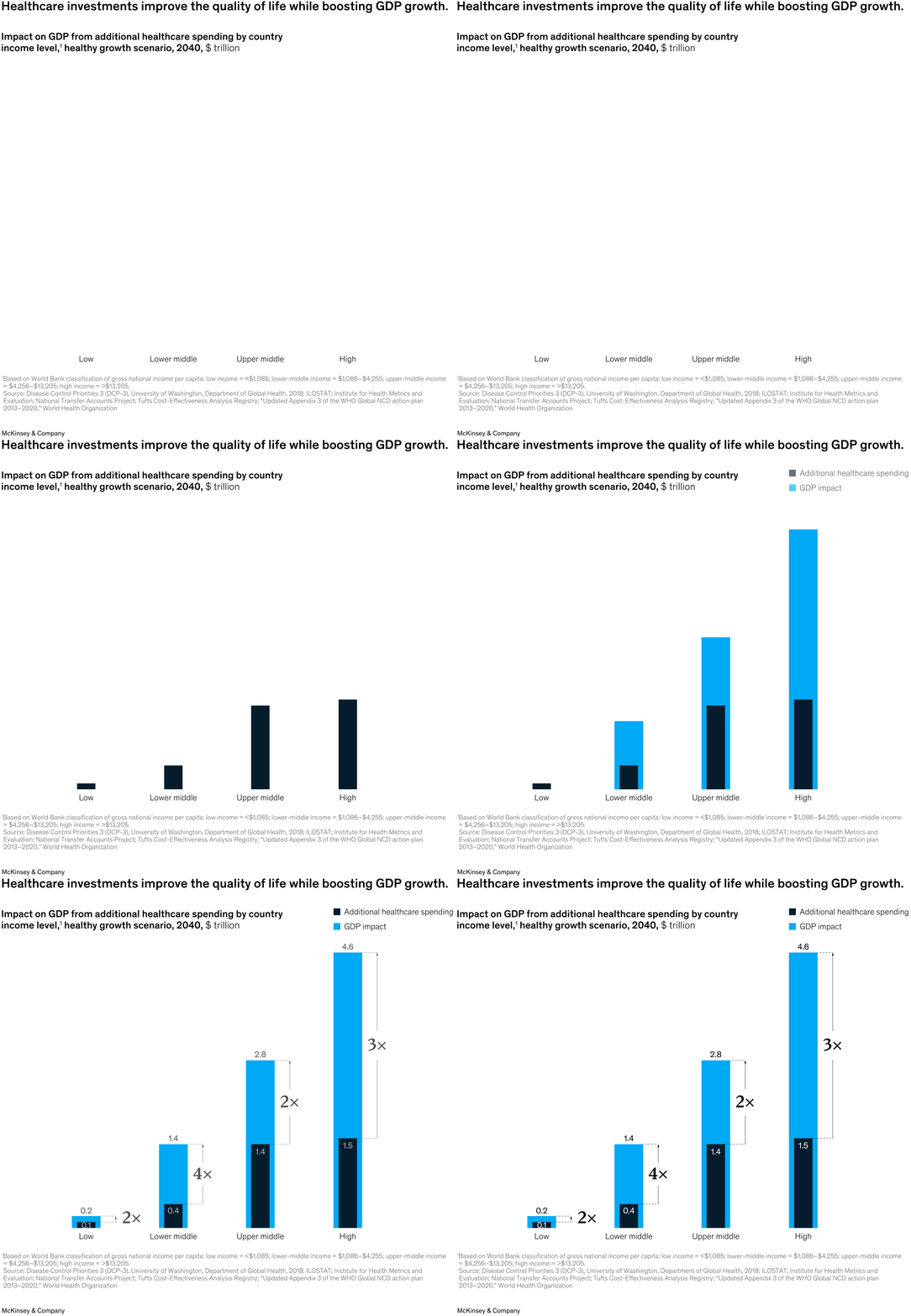
Layered bar chart.
Layout / body structure
The page uses four vertical bars arranged by country income level from low through high. Each bar combines a dark base for additional healthcare spending with a taller bright extension showing the GDP impact, and multiplier callouts sit to the right of the bars.
What is being compared
It compares low-, lower-middle-, upper-middle-, and high-income country groups, showing how much additional healthcare spending is associated with how much total GDP impact under the healthy-growth scenario.
Measurement system
The values are measured in trillions of dollars, with the dark portion showing spending and the full height showing the GDP effect. The multiplier annotations summarize how many times larger the GDP impact is than the spending input.
Visible structure inside the graphic
Each income group is one bar, and the bars grow sharply from left to right as the income level rises. The overlay treatment makes it easy to separate the spending input from the much larger GDP output, and the multiplier brackets reinforce that ratio visually.
Main takeaway from the visual
Healthcare investment generates a larger GDP effect than the initial spending in every income group, and that payoff is especially pronounced in the middle-income categories where the return multiples are the largest.
Key standout values or extremes
Low-income countries rise from 0.1 trillion dollars of spending to 0.2 trillion of GDP impact, or about 2 times. Lower-middle-income countries rise from 0.4 to 1.4 trillion, or about 4 times. Upper-middle-income countries rise from 1.4 to 2.8 trillion, or 2 times, while high-income countries rise from 1.5 to 4.6 trillion, or 3 times.
Controls / sequence, when applicable
This is a static chart image with no in-chart controls to operate.
Companion media, when applicable
There is no separate companion audio or video; the chart image is the full visual on this page.