Source page: McKinsey & Company
Commentary
Healthcare workers: A critical shortfall
Healthcare | Workforce
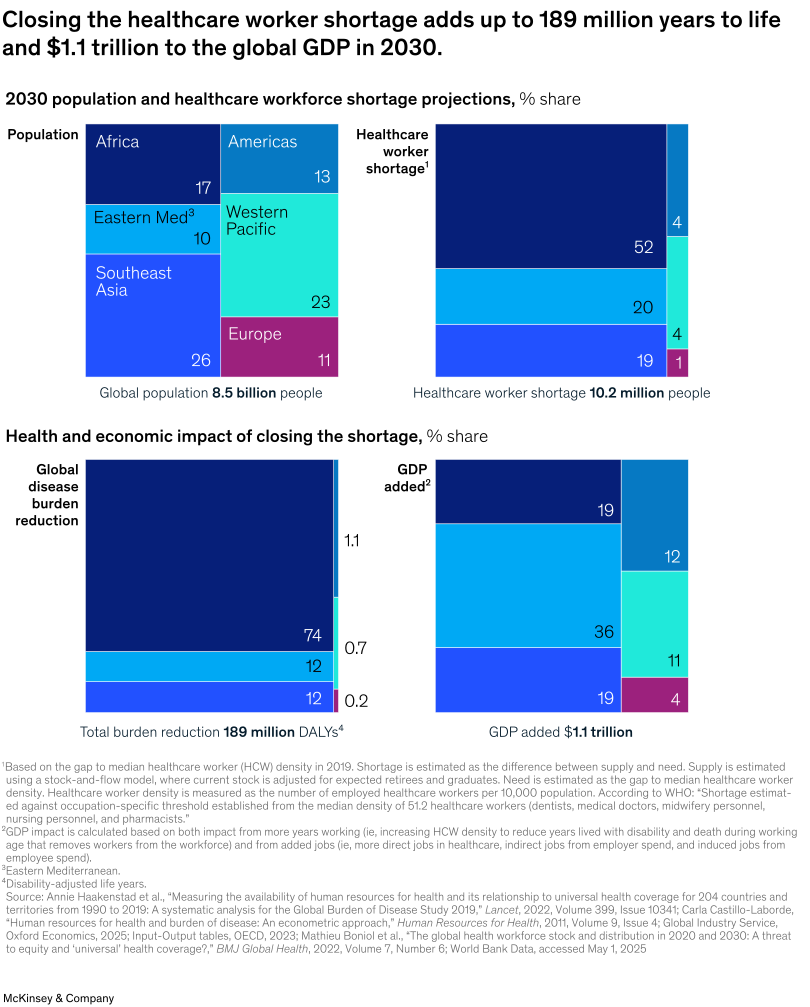
June 18, 2025 – Nearly 60 percent of the global population lack access to essential health services. This challenge is compounded by the healthcare worker shortage, which the World Health Organization projects could reach at least ten million workers by 2030. Closing the workforce gap could eliminate 7 percent of the disease burden and add $1.1 trillion to the economy, say Senior Partner Pooja Kumar and coauthors. However, the shortage and the improvement potential are unevenly distributed. Africa, for example, has 17 percent of the world’s population but more than 70 percent of the opportunity to reduce disease burden. The continent accounts for 52 percent of the worker shortage but less than 20 percent of the GDP opportunity.
To read the report, see “Heartbeat of health: Reimagining the healthcare workforce of the future,” May 14, 2025.
customizer here
Visual form
Four-panel treemap-style share chart.
Layout / body structure
The chart is arranged as a two-by-two grid. The top row compares global population share with healthcare worker shortage share, and the bottom row compares disease-burden reduction share with GDP-added share if the shortage is closed.
What is being compared
It compares world regions, especially Africa, the Americas, Eastern Mediterranean, Southeast Asia, Western Pacific, and Europe, across four related dimensions: 2030 population share, healthcare worker shortage share, global disease-burden reduction share, and GDP-added share from closing the shortage.
Measurement system
All four treemap panels use percentage share, while the totals beneath the lower panels add headline totals of 189 million disability-adjusted life years reduced and 1.1 trillion dollars of GDP added. The top row also labels the global population at 8.5 billion people and the healthcare worker shortage at 10.2 million people.
Visible structure inside the graphic
In the population panel, Southeast Asia is the largest block at 26 percent, Western Pacific is 23, Africa is 17, the Americas 13, Europe 11, and Eastern Mediterranean 10. In the worker-shortage panel, Africa dominates at 52 percent, followed by the Americas at 20 and Southeast Asia at 19. In the bottom row, Africa again dominates disease-burden reduction at 74 percent, while the GDP-added panel is led by the Americas at 36 percent, with Africa and Southeast Asia both at 19.
Main takeaway from the visual
The chart shows that the healthcare worker shortage and the benefits of closing it are distributed very unevenly across regions. Africa bears a disproportionately large share of the shortage and the disease-burden opportunity, while the GDP gains are more spread and especially large in the Americas.
Key standout values or extremes
Africa accounts for 17 percent of global population but 52 percent of the healthcare worker shortage and 74 percent of disease-burden reduction opportunity. The GDP-added panel totals 1.1 trillion dollars, with the Americas taking the largest share at 36 percent. The chart also anchors the global shortage at 10.2 million workers.
Controls / sequence, when applicable
This is a static chart image with no in-chart controls to operate.
Companion media, when applicable
There is no separate companion audio or video; the chart image is the full visual on this page.