Source page: McKinsey & Company
Commentary
Landing the right aerospace and defense talent
Aerospace | Defense | Talent
September 24, 2024 – This week, our charts feature the latest insights in aviation—from soaring fleet demands to landing the right talent and more.
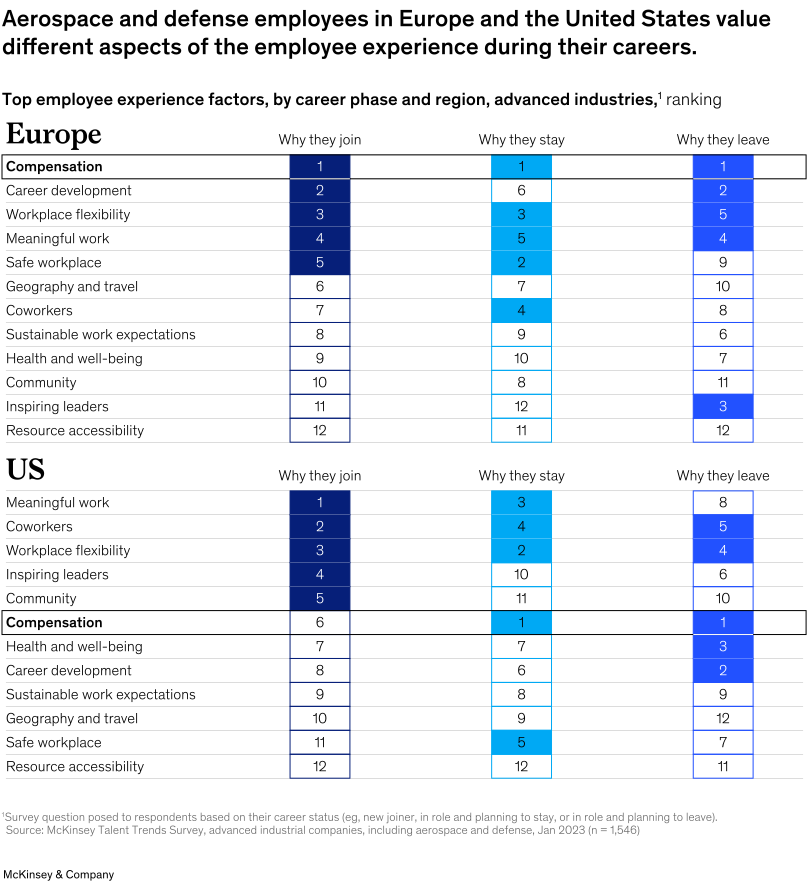
The global aerospace and defense sector is thriving, yet finding enough skilled workers remains a persistent challenge. To bridge the talent gap, employers operating internationally might have to implement strategies tailored to specific regions or countries, as effective solutions will vary by location, say senior partner Brooke Weddle and colleagues. For instance, a McKinsey talent survey shows that in Europe, factors such as pay, career progression, and impactful work influence employees’ decisions to join or leave companies. In contrast, in the United States, workplace flexibility and coworker relationships play a bigger role.
To read the article, see “The talent gap: The value at stake for global aerospace and defense,” July 17, 2024.
customizer here
Visual form
Ranked table matrix.
Layout / body structure
The chart is arranged as two stacked regional tables, with Europe on top and the United States below. Within each region, three ranking columns show why employees join, why they stay, and why they leave, so the page is read top to bottom by region and left to right across career phases.
What is being compared
It compares the top employee-experience factors valued by aerospace and defense employees across two regions and three career phases, showing where the same themes rank differently depending on location and whether the employee is joining, staying, or leaving.
Measurement system
The reader tracks ordinal rankings rather than percentages. The numbered cells show positions from 1 through 12, and the blue shading emphasizes higher-priority ranks in each column.
Visible structure inside the graphic
Each region has a left-hand list of employee-experience factors and three aligned ranking columns beside it. Highlighted rows and darker cells pull attention to the strongest-ranked factors, while the repeated table structure makes Europe-to-US comparison straightforward.
Main takeaway from the visual
The visual shows that compensation is central in Europe across all three career moments, while the US table gives more prominence to meaningful work and coworkers when employees join. Once employees are staying or leaving, compensation moves to the top in the US as well, showing some common retention pressure despite different entry priorities.
Key standout values or extremes
In Europe, compensation ranks number 1 for why employees join, stay, and leave. In the US, meaningful work ranks number 1 for why employees join, but compensation ranks number 1 for both why employees stay and why they leave, while coworkers sits number 2 for joining.
Controls / sequence, when applicable
This is a static chart image with no in-chart controls to operate.
Companion media, when applicable
There is no separate companion audio or video; the chart image is the full visual on this page.