Source page: McKinsey & Company
Commentary
Life in the fast lane
Economics | Productivity
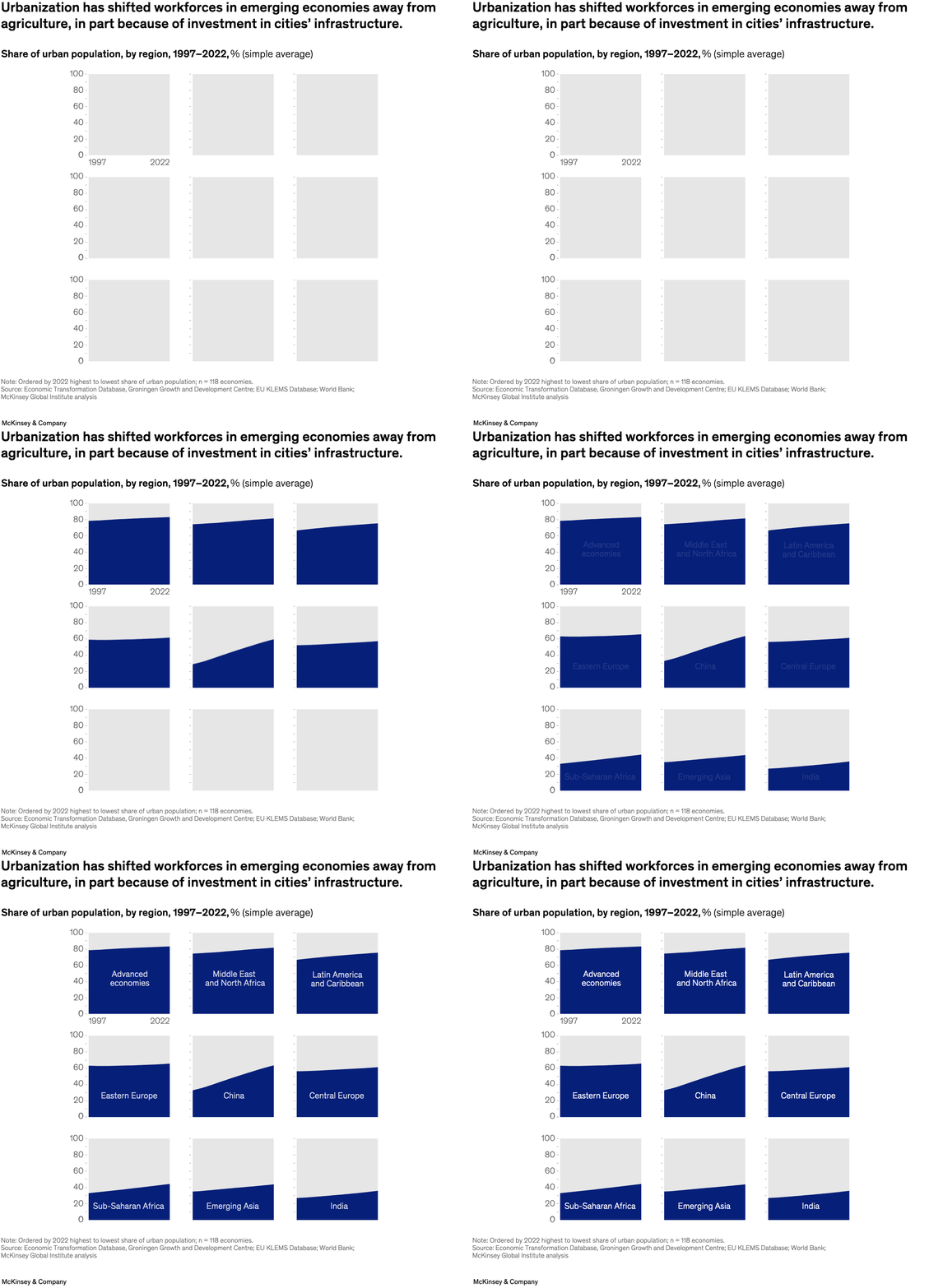
May 13, 2024 – Emerging economies in the “fast lane” of productivity growth—that is, those that could reach advanced-economy productivity levels in the next 25 years—have made great strides, in part due to urbanization. According to Chris Bradley, a senior partner and a McKinsey Global Institute director, and coauthors, fast-lane economies tend to have better developed city infrastructure and buildings, creating environments more conducive to investment and growth. The urban share of the population in emerging economies has increased on average by nearly ten percentage points over the past quarter century.
To read the report, see “Investing in productivity growth,” March 27, 2024.
customizer here
Visual form
Multi-panel image sequence.
Layout / body structure
The chart is a 3-by-3 grid of regional panels, each showing the change from 1997 to 2022. Read across the top row first and then continue row by row through the lower regions.
What is being compared
It compares the share of urban population by region over time, covering advanced economies, the Middle East and North Africa, Latin America and the Caribbean, Eastern Europe, China, Central Europe, Sub-Saharan Africa, Emerging Asia, and India.
Measurement system
The y-axis in each panel is percentage share of population living in urban areas, and the x-axis runs from 1997 to 2022. The dark lower area represents the urban share, while the light upper area represents the remaining nonurban share.
Visible structure inside the graphic
Each regional panel is a compact area chart. Some panels slope gently upward over time, while China and several emerging-economy panels show a steeper rise, making the regional differences visible at a glance.
Main takeaway from the visual
The visual shows that urbanization increased across most regions, but the pace and level differ sharply, with already-urbanized regions moving gradually while China and several emerging regions show much larger structural shifts away from agriculture and toward city-based economies.
Key standout values or extremes
Advanced economies start near the upper 70s and rise into the low 80s, while China climbs from roughly the low 30s to around 60 percent. India and Sub-Saharan Africa remain among the lowest panels by 2022, even though both trend upward over the period.
Controls / sequence, when applicable
This is a static chart image with no in-chart controls to operate.
Companion media, when applicable
There is no separate companion audio or video; the chart image is the full visual on this page.