Source page: McKinsey & Company
Commentary
Lives lost, livelihoods disrupted
Strategy | Global Trade
April 20, 2022 – The Russian invasion of Ukraine has caused a humanitarian crisis. In a recent episode of The McKinsey Podcast, Sven Smit, senior partner and chair of the McKinsey Global Institute, talks with Lucia Rahilly, global editorial director, about some of the potential effects of ongoing war and uncertainty in Ukraine.

For more, go to “The rising toll of the war in Ukraine,” March 30, 2022.
customizer here
Visual form
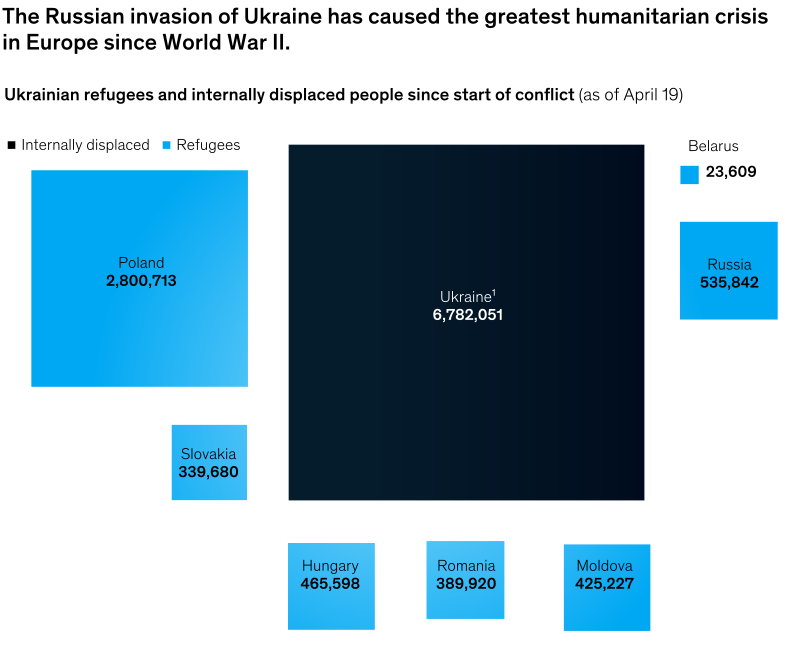
Treemap-style humanitarian-displacement comparison.
Layout / body structure
The chart is one field of differently sized rectangles, with a legend above the boxes and country labels embedded inside the larger shapes. Read the central Ukraine block first, then compare the surrounding refugee rectangles to see how the outflow is distributed across neighboring countries.
What is being compared
The page compares internally displaced people within Ukraine with refugee counts in nearby countries since the start of the conflict. It sets Ukraine’s internal displacement against refugee flows to Poland, Russia, Hungary, Moldova, Romania, Slovakia, and Belarus.
Measurement system
The sizes of the rectangles encode absolute people counts, and the values are printed directly inside or beside the blocks. Color also carries meaning: the dark central block marks internally displaced people, while the blue surrounding rectangles mark refugees in neighboring countries.
Visible structure inside the graphic
Ukraine sits as a single dominant dark rectangle in the center, surrounded by blue refugee blocks of very different sizes. Poland forms the largest blue rectangle by far, while the smaller countries appear as much smaller boxes around the edge, making the imbalance in refugee destinations immediately legible.
Main takeaway from the visual
The humanitarian crisis is immense both inside Ukraine and across its borders, but the graphic shows two especially dominant burdens: the very large internally displaced population within Ukraine and the outsized refugee load carried by Poland. The rest of the neighboring-country boxes are visibly smaller, which makes the concentration of displacement stand out.
Key standout values or extremes
Ukraine is labeled at 6,782,051 internally displaced people, which is the largest block on the page. Among refugee destinations, Poland is highest at 2,800,713, followed by Russia at 535,842, Hungary at 465,598, Moldova at 425,227, Romania at 389,920, Slovakia at 339,680, and Belarus at 23,609.
Controls / sequence, when applicable
This is a static chart image with no in-chart controls to operate.
Companion media, when applicable
There is no separate companion audio or video; the chart image is the full visual on this page.