Source page: McKinsey & Company
Commentary
Make me a match
Artificial Intelligence | Talent | Technology
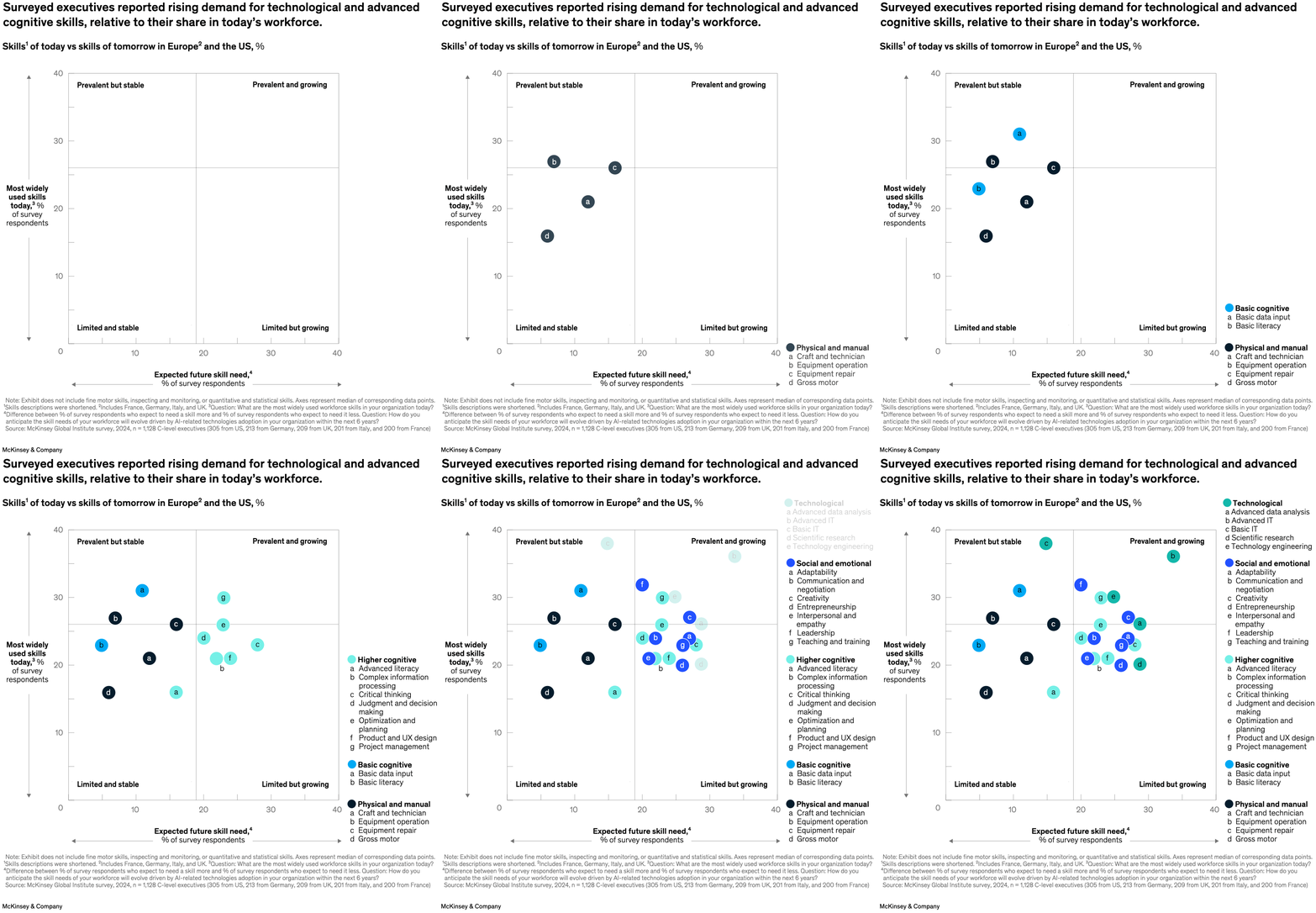
June 10, 2024 – As AI reshapes the business landscape, leaders are grappling with skills mismatches. About one-third of executives in a recent McKinsey survey indicate shortfalls among their employees in critical areas, including social and emotional skills and technological skills, Sven Smit, senior partner and chair of the McKinsey Global Institute, and coauthors explain. Approximately 40 percent of respondents indicate a shortage of workers with higher cognitive skills such as critical thinking, which is important for working with new tech such as AI and automation.
To read the report, see “A new future of work: The race to deploy AI and raise skills in Europe and beyond,” May 21, 2024.
customizer here
Visual form
Scatter plot.
Layout / body structure
This is a single quadrant scatter plot with skill groups distributed across four labeled zones. The reading order is across the horizontal future-need axis and up the vertical current-use axis, with the legend on the right decoding each colored skill family and lettered dot.
What is being compared
It compares current workforce skill prevalence against expected future skill need in Europe and the United States, across technological, social and emotional, higher cognitive, basic cognitive, and physical and manual skills.
Measurement system
Both axes are percentages of survey respondents. The horizontal axis shows expected future skill need and the vertical axis shows the skills most widely used today, while the median lines split the plot into prevalent-and-growing, prevalent-but-stable, limited-but-growing, and limited-and-stable quadrants.
Visible structure inside the graphic
Each skill is plotted as a labeled colored dot. The densest cluster sits in the right half of the chart, and the legend maps each letter to a specific skill such as communication, leadership, project management, basic IT, or scientific research.
Main takeaway from the visual
The plot shows that technological and advanced cognitive skills are moving into the growing-demand side of the chart more often than physical and manual or basic cognitive skills, indicating that future demand is shifting toward digital, analytical, and higher-order work.
Key standout values or extremes
Communication and negotiation sits high and to the right in the prevalent-and-growing quadrant, while advanced data analysis, scientific research, and technology engineering also land in the higher future-need half. Several physical and manual skills remain on the left side, showing lower projected demand growth.
Controls / sequence, when applicable
This is a static chart image with no in-chart controls to operate.
Companion media, when applicable
There is no separate companion audio or video; the chart image is the full visual on this page.