Source page: McKinsey & Company
Commentary
Meet your virtual coworker
Artificial Intelligence | Generative AI
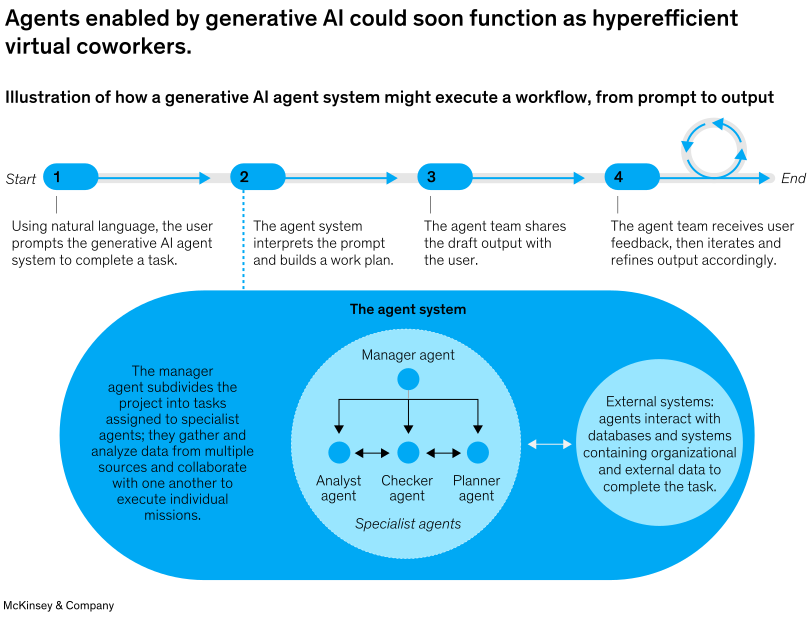
September 4, 2024 – Generative AI could soon create “virtual coworkers” that could help complete complex tasks by organizing specialized agents to analyze data and refine outputs. Senior partner Lareina Yee and coauthors explain that this could be achieved by creating AI-powered agent systems that first understand a natural-language prompt, coordinate specialized agents to fulfill the task, and finally iterate on the output based on user feedback.
To read the article, see “Why agents are the next frontier of generative AI,” July 24, 2024.
customizer here
Visual form
Workflow and system-architecture diagram for generative AI agents.
Layout / body structure
The top row shows a four-step prompt-to-output workflow, and the lower portion shows the agent system: a manager agent, specialist agents, and external systems connected inside a large blue architecture shape.
What is being compared
It explains how a generative AI agent system might execute work, moving from natural-language prompt to planning, task execution, feedback, and refined output.
Measurement system
There is no numerical axis. The chart uses process steps, agent roles, and system boundaries as its organizing structure.
Visible structure inside the graphic
The numbered workflow runs left to right from start to end, with a feedback loop after step four. The lower diagram shows a manager agent subdividing work to analyst, checker, and planner agents, with external systems feeding data back into the agent system.
Main takeaway from the visual
Generative AI agents could function as virtual coworkers by breaking a user request into tasks, coordinating specialist agents, using external systems, and iterating based on feedback.
Key standout values or extremes
The standout structure is the manager-agent hub connected to three specialist agents and external systems, which makes the workflow more than a single chatbot exchange.
Controls / sequence, when applicable
This is a static chart image with no in-chart controls to operate.
Companion media, when applicable
There is no separate companion audio or video; the chart image is the full visual on this page.