Source page: McKinsey & Company
Commentary
Mental health stigma persists
Healthcare | Mental health
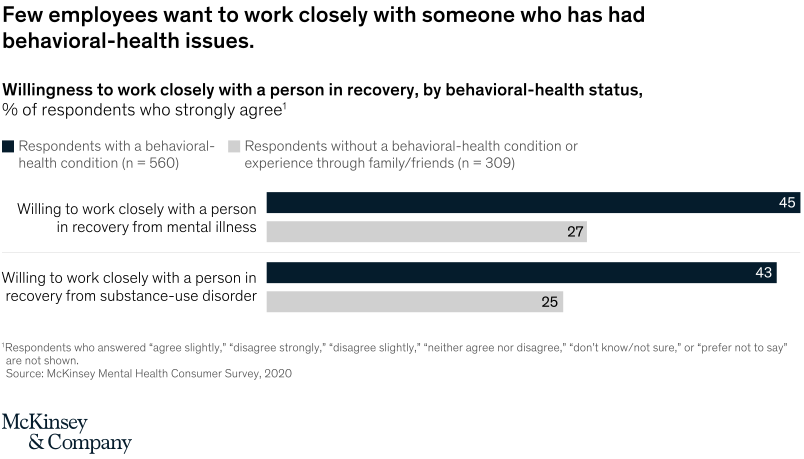
August 5, 2021 – Experience matters. In surveys conducted by McKinsey’s Center for Societal Benefit through Healthcare, about a quarter of respondents who have little experience with behavioral-health issues indicated they would be willing to work closely with someone who has a substance-use disorder or mental health issue. Those figures climbed by more than 65 percent among respondents who are familiar with behavioral-health conditions.
To read the article, see “Overcoming stigma: Three strategies toward better mental health in the workplace,” July 23, 2021.
customizer here
Visual form
Paired horizontal bar chart.
Layout / body structure
The chart is a single two-row comparison read from top to bottom. In each row, compare the dark bar with the gray bar for the same question before moving to the next behavioral-health category.
What is being compared
The chart compares willingness to work closely with a person in recovery between two respondent groups: people with a behavioral-health condition and people without a behavioral-health condition or related experience through family or friends. It does this for recovery from mental illness and for recovery from substance-use disorder.
Measurement system
The measure is the percent of respondents who strongly agree. Dark bars represent respondents with a behavioral-health condition, gray bars represent respondents without such a condition or experience, and the exact values are printed at the bar ends.
Visible structure inside the graphic
There are two stacked horizontal-bar rows. The upper row covers willingness to work closely with a person in recovery from mental illness, and the lower row covers willingness to work closely with a person in recovery from substance-use disorder, with each row showing one dark bar and one gray bar aligned on the same scale.
Main takeaway from the visual
The chart shows that willingness is low overall and that respondents with their own behavioral-health experience are substantially more open than respondents without it. In both rows, the dark bar extends far beyond the gray bar, making the empathy gap visible at a glance.
Key standout values or extremes
For recovery from mental illness, the dark bar reaches 45 percent while the gray bar reaches 27 percent. For recovery from substance-use disorder, the dark bar reaches 43 percent versus 25 percent for the gray bar. The widest visible gap is therefore 18 points in both comparisons.
Controls / sequence, when applicable
This is a static chart image with no in-chart controls to operate.
Companion media, when applicable
There is no separate companion audio or video; the chart image is the full visual on this page.