Source page: McKinsey & Company
Commentary
Meta-value
Technology | Marketing & Sales
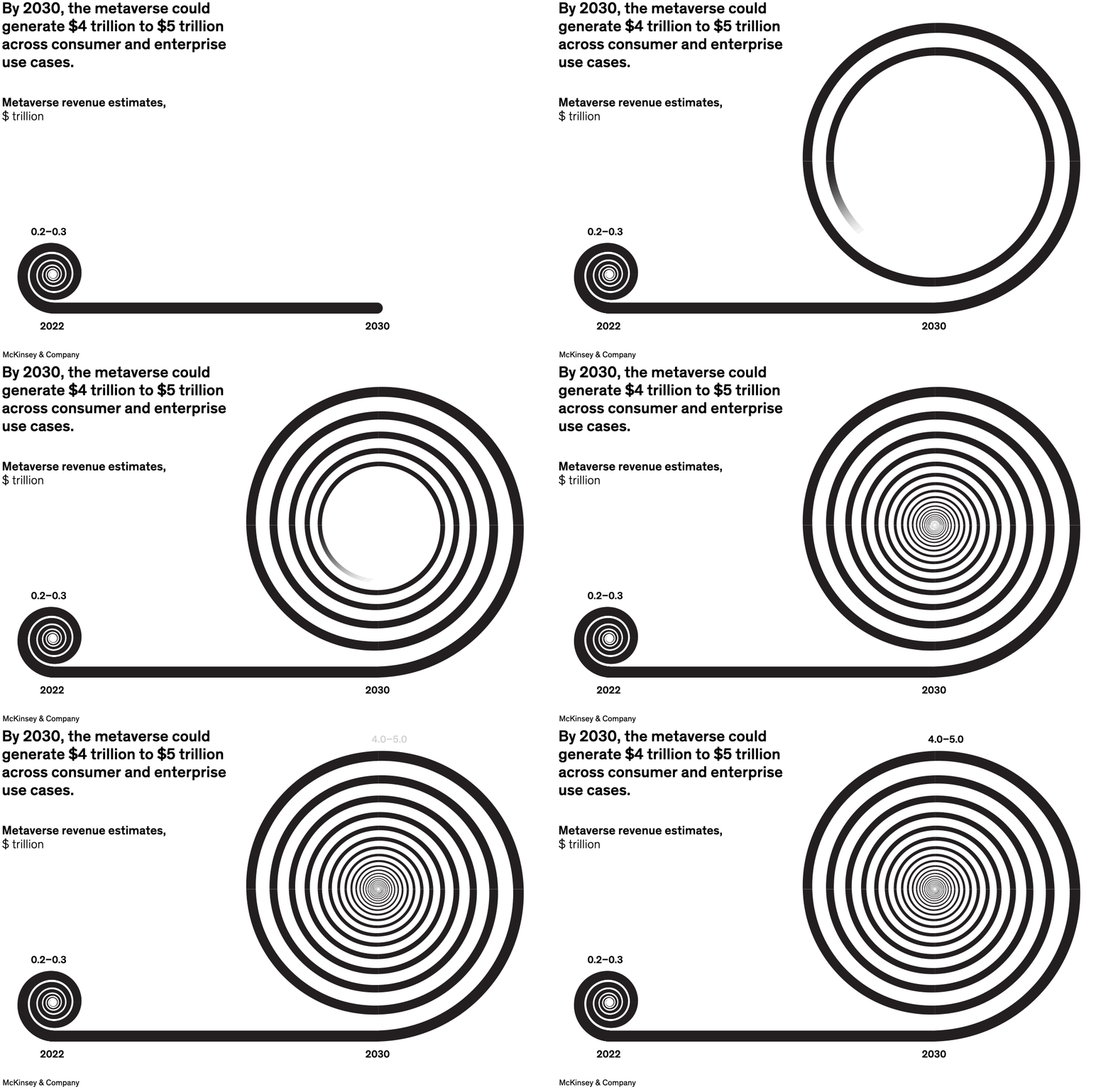
March 7, 2023 – As leaders try to make sense of the metaverse, here’s one sign of opportunity: the market value of metaverse activity could grow to $4 trillion to $5 trillion by 2030, find managing partner for global client capabilities Homayoun Hatami and colleagues. The value creation could come from both consumer use cases (e-commerce, gaming, and ads, for example) and enterprise (banking, manufacturing, and training).
To read the article, see “A CEO’s guide to the metaverse,” January 24, 2023.
customizer here
Visual form
Two-circle proportional value graphic.
Layout / body structure
The page uses one small circular spiral on the left for 2022 and one much larger circular spiral on the right for 2030, with a connecting base line between them. The reading order is from the small present-day circle toward the much larger future-value circle.
What is being compared
It compares metaverse revenue estimates in 2022 with projected value in 2030 across the combined consumer and enterprise use-case landscape.
Measurement system
The values are trillions of dollars, encoded by the relative size of the circles and reinforced by direct labels placed above each one.
Visible structure inside the graphic
The left spiral is compact and labeled 0.2 to 0.3, while the right spiral expands outward in many rings and is labeled 4.0 to 5.0. The large jump in area does almost all of the storytelling, with the geometry itself serving as the comparison mechanism.
Main takeaway from the visual
The page is built to show scale change rather than category breakdown. The future circle dwarfs the present one, which makes the projected expansion of metaverse value the dominant visual message.
Key standout values or extremes
The 2022 estimate is 0.2 to 0.3 trillion dollars, while the 2030 estimate is 4.0 to 5.0 trillion. That shift is visually extreme because the future circle is many times larger in radius and area than the starting point.
Controls / sequence, when applicable
This is a static chart image with no in-chart controls to operate.
Companion media, when applicable
There is no separate companion audio or video; the chart image is the full visual on this page.