Source page: McKinsey & Company
Commentary
Microaggressions remain a parity pitfall
Talent | Workplace
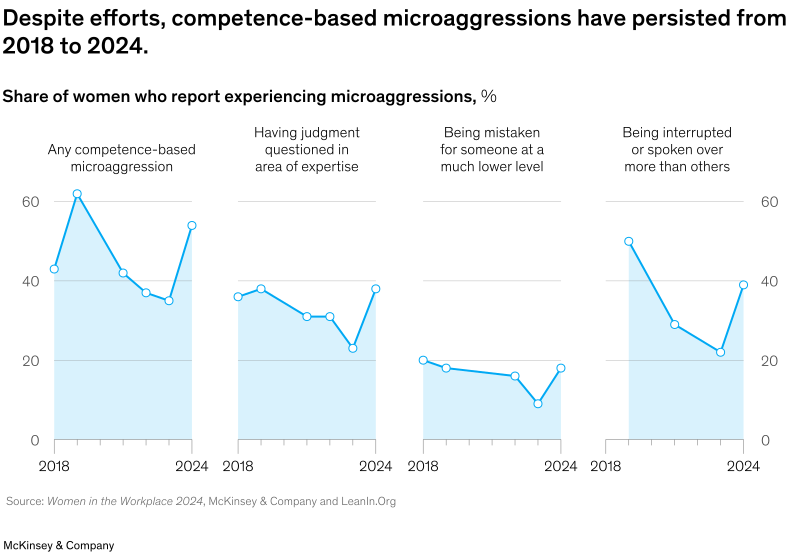
October 31, 2024 – While companies have made strides toward gender parity, the work environment itself has not significantly improved for women. For example, women still face microaggressions, and employees concur that their organizations have made less headway in addressing these issues, say senior partner Lareina Yee and colleagues in McKinsey’s tenth-anniversary Women in the Workplace report. The likelihood of women encountering microaggressions remains unchanged from five years ago. By not stemming these behaviors, companies risk losing skilled employees and their valuable contributions.
To read the report, see “Women in the Workplace 2024: The 10th-anniversary report,” September 17, 2024.
customizer here
Visual form
Four-panel small-multiple line chart.
Layout / body structure
The chart is arranged as four narrow line panels running left to right across the page. Read each panel across the 2018 to 2024 span, then compare the levels and shapes across the panels for the broader any-competence-based measure and the three specific forms of competence-based microaggressions.
What is being compared
It compares the share of women reporting different competence-based microaggressions over time. The panels cover any competence-based microaggression, having judgment questioned in an area of expertise, being mistaken for someone at a much lower level, and being interrupted or spoken over more than others.
Measurement system
The vertical axis is measured as percentage share of women reporting each experience, and the horizontal axis runs from 2018 to 2024. Each panel has its own line with point markers, and the light-blue fill beneath the line highlights the trend area.
Visible structure inside the graphic
Each panel contains a single line with annual points, and the four panels sit side by side so the reader can compare levels without crowding multiple lines into one plot. The leftmost panel starts much higher than the others, while the rightmost and middle panels show lower but still persistent shares.
Main takeaway from the visual
The visual shows that competence-based microaggressions have not gone away and remain elevated even after some declines from earlier highs. The headline any-competence-based panel dips after 2019 but remains substantial and rises again by 2024, while the other three specific behaviors also remain present rather than disappearing.
Key standout values or extremes
Any competence-based microaggression peaks above 60 percent early in the series and still sits in the mid-50s by 2024. Having judgment questioned in an area of expertise stays around the low-to-high 30s and ends near 38 percent, being interrupted or spoken over starts near 50 percent and ends near 39 percent, and being mistaken for someone at a lower level remains lower overall but still rebounds to about 18 percent by 2024.
Controls / sequence, when applicable
This is a static chart image with no in-chart controls to operate.
Companion media, when applicable
There is no separate companion audio or video; the chart image is the full visual on this page.