Source page: McKinsey & Company
Commentary
Nurses share promise and pitfalls of AI
Artificial Intelligence | Healthcare
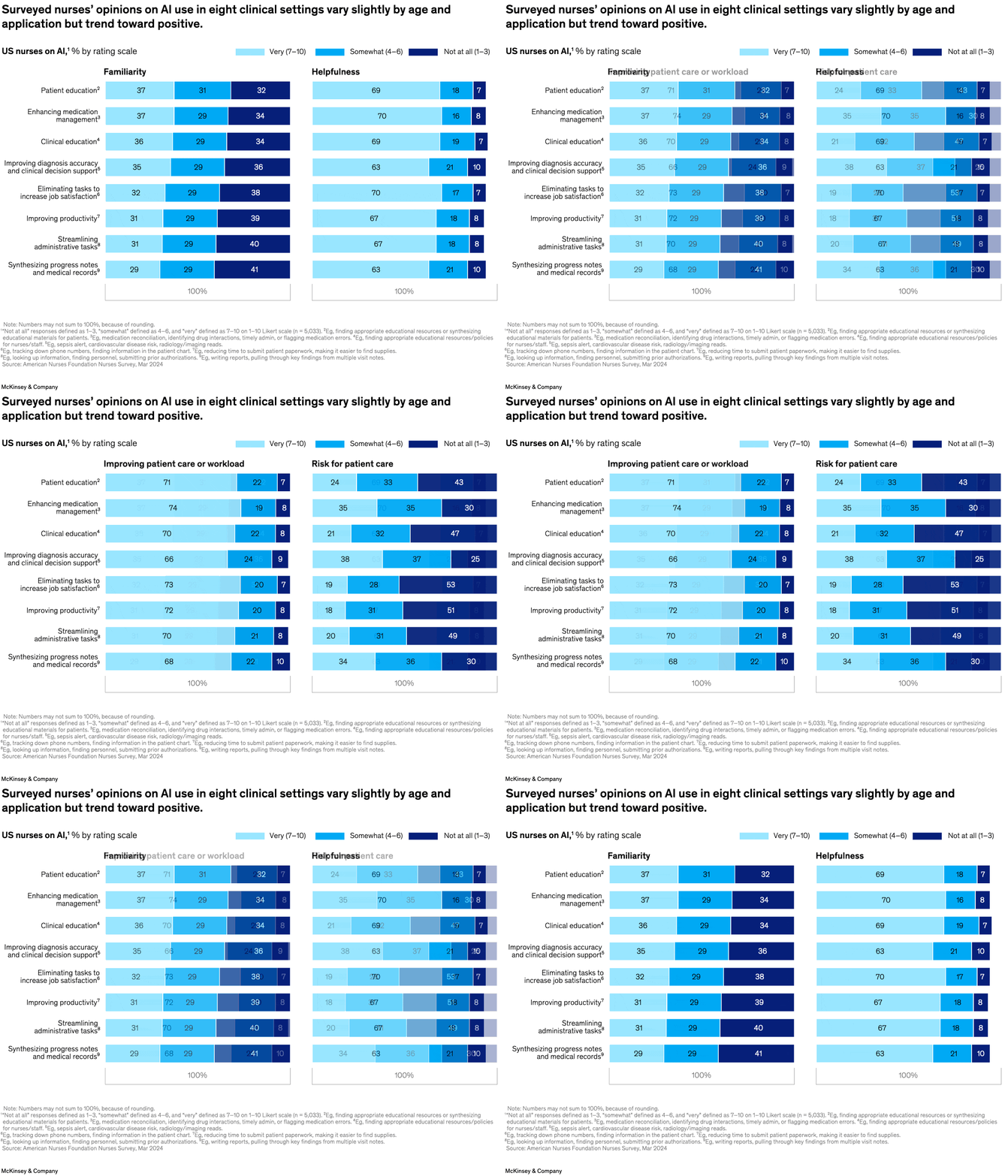
November 27, 2024 – Just like in other industries, AI has the potential to reshape healthcare as well. To understand where and how AI can help, it is key to hear from those on the frontlines of patient care: nurses. Overall, nurses are cautiously enthusiastic, note senior partner Gretchen Berlin and colleagues. About two-thirds of nurses who responded to a survey say AI could be very helpful across nine possible applications and more than two-thirds point to at least some opportunity to improve patient care or case workload. However, they also express concern about maintaining care quality, with 38 percent seeing the greatest risk in using AI for clinical diagnoses and decisions.
To read the article, see “The pulse of nurses’ perspectives on AI in healthcare delivery,” October 1, 2024.
customizer here
Visual form
Two-panel 100 percent stacked horizontal bar chart.
Layout / body structure
The visual is divided into two side-by-side sections labeled Familiarity and Helpfulness. Read each clinical setting across the three rating segments from left to right, then compare the same setting between the Familiarity and Helpfulness panels.
What is being compared
It compares nurses’ views of AI across eight clinical settings, measuring both familiarity with the application and perceived helpfulness. The settings include patient education, enhancing medication management, clinical education, improving diagnosis accuracy and clinical decision support, eliminating tasks to increase job satisfaction, improving productivity, streamlining administrative tasks, and synthesizing progress notes and medical records.
Measurement system
Each bar is measured as a percentage of respondents and totals to 100 percent. The three color bands represent very positive ratings, somewhat positive ratings, and not at all positive ratings on the underlying 1-to-10 rating scale.
Visible structure inside the graphic
The chart is organized as two aligned columns of horizontal stacked bars, one column for Familiarity and one for Helpfulness. Each row repeats the same three-band structure, making it easy to see that helpfulness bars are much more heavily weighted toward the light positive segment than familiarity bars are.
Main takeaway from the visual
The visual shows that nurses are more positive about the helpfulness of AI applications than they are familiar with them. Across nearly every clinical setting, the Helpfulness panel has much larger very-positive segments, while Familiarity remains more mixed and often includes a sizable not-at-all segment.
Key standout values or extremes
In the Helpfulness panel, very-positive shares cluster between about 63 and 70 percent across all eight settings, with medication management and eliminating tasks both reaching 70 percent. In the Familiarity panel, very-positive shares are much lower, ranging from about 29 to 37 percent, and the dark not-at-all segment rises as high as 41 percent for synthesizing progress notes and medical records and 40 percent for streamlining administrative tasks.
Controls / sequence, when applicable
This is a static chart image with no in-chart controls to operate.
Companion media, when applicable
There is no separate companion audio or video; the chart image is the full visual on this page.