Source page: McKinsey & Company
Commentary
Powering AI with brain capital
Artificial Intelligence | Public Health
March 18, 2026 – In the AI era, advantage will hinge on how well we combine human and machine strengths. That makes investment in brain capital—brain health and brain skills—more urgent than ever. Yet the brain has long been underprioritized in global policy and investment, according to McKinsey’s Erica Coe, Jacqueline Brassey, Kana Enomoto, Lucy Pérez, and coauthors. Continued underinvestment has a substantial cost: based on 2025 projections, brain health conditions account for 24 percent of the global disease burden. Half of mental health conditions appear by the age of 14, and three-quarters by 24. Advances in science and AI-driven disruption have made coordinated investment in the brain an economic imperative.
To read the report, see “The human advantage: Stronger brains in the age of AI,” January 15, 2026.
customizer here
Visual form
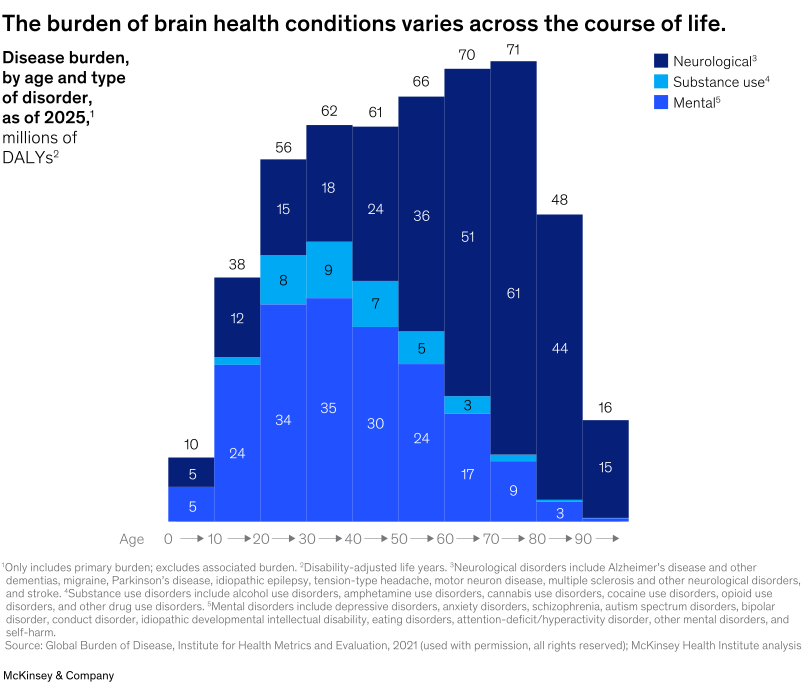
Stacked Bar / Stacked Column: age-by-age global brain-health disease-burden chart split by disorder type.
Layout / body structure
Each vertical stack represents one age band from childhood through older adulthood. Within each stack, color segments separate neurological disorders, substance-use disorders, and mental disorders so the reader can compare both total burden and burden composition across the life course.
What is being compared
It compares brain-health disease burden across age groups and separates that burden into neurological, substance-use, and mental-health conditions.
Measurement system
The values are millions of disability-adjusted life years, or DALYs. Taller stacks mean more years of healthy life lost in that age group.
Visible structure inside the graphic
The younger age groups show a larger mental-disorder share, while the older age groups become dominated by neurological conditions. Substance-use burden appears as a smaller middle segment, peaking in early adulthood and then declining.
Main takeaway from the visual
The chart shows that brain health is a life-course issue, not a problem isolated to old age or to mental health alone. The burden shifts from mental conditions in adolescence and working age toward neurological conditions in later life.
Key standout values or extremes
Ages 70 to 80 show the highest total burden at about 71 million DALYs, including about 61 million from neurological disorders. Ages 20 to 30 through 40 to 50 stay high at roughly 56 million to 62 million DALYs, with mental disorders contributing around 30 million to 34 million.
Controls / sequence, when applicable
This is a static stacked-column disease-burden chart; there are no in-chart controls to operate.
Companion media, when applicable
There is no separate companion audio or video; the brain-health burden stacked-column chart is the full visual on this page.