Source page: McKinsey & Company
Commentary
Recharging the battery supply chain
Electric vehicles | Mobility
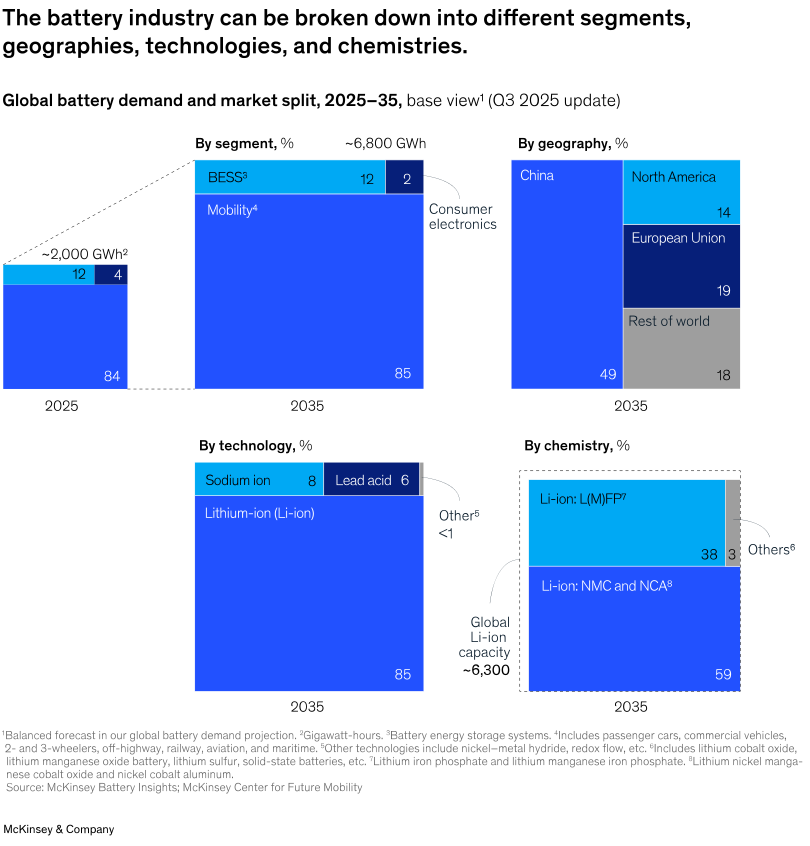
February 26, 2026 – The global lithium-ion (Li-ion) battery industry is at an inflection point, say McKinsey Partners Andreas Breiter, Denny Thiemig, Patrick Schaufuss, Raphael Rettig, Wenting Gao, and Yunjing Kinzel. McKinsey analysis projects the global battery market will grow to 4.2 terawatt-hours (TWh) in 2030 and 6.8 TWh by 2035. More than 85 percent of this demand is due to Li-ion batteries, fueled largely by interest in battery electric vehicles and energy storage. At the same time, Asia’s dominance, particularly in upstream and midstream supply chains, has created imbalances throughout the global battery value chain. Although governments are investing heavily to localize battery production, companies must go beyond regulatory compliance to build globally competitive industries outside Asia.
To read the article, see “Battery 2035: Building new advantages,” January 1, 2026.
customizer here
Visual form
Treemap: small-multiple battery-market composition charts by end use, geography, technology, and chemistry.
Layout / body structure
The chart is built from several treemaps arranged side by side. The first pair compares 2025 and 2035 demand by end use, while the later treemaps break 2035 demand into geography, battery technology, and lithium-ion chemistry.
What is being compared
It compares projected global battery demand by segment, region, technology type, and battery chemistry, with special attention to how lithium-ion batteries dominate the 2035 mix.
Measurement system
Demand is measured in gigawatt-hours, with each treemap rectangle sized by share of demand. Percent labels show each category’s share of the relevant total.
Visible structure inside the graphic
Mobility occupies the largest demand block in both 2025 and 2035, while battery energy storage systems form a smaller but meaningful block. The geography treemap shows China as the largest 2035 demand region, and the technology treemap shows lithium-ion as the dominant technology.
Main takeaway from the visual
The visual shows that battery demand grows sharply while remaining concentrated in mobility, Asia, and lithium-ion technologies. The supply-chain challenge is not only demand growth but also concentration across geographies and chemistries.
Key standout values or extremes
Total demand rises from about 2,000 GWh in 2025 to about 6,800 GWh in 2035. Mobility accounts for about 85 percent of 2035 demand, China accounts for 49 percent by geography, lithium-ion accounts for 85 percent by technology, and NMC/NCA chemistries account for 59 percent of 2035 lithium-ion cells.
Controls / sequence, when applicable
This is a static treemap chart; there are no in-chart controls to operate.
Companion media, when applicable
There is no separate companion audio or video; the battery-market treemap chart is the full visual on this page.