Source page: McKinsey & Company
Commentary
Remote driving gains traction
Mobility | Automotive
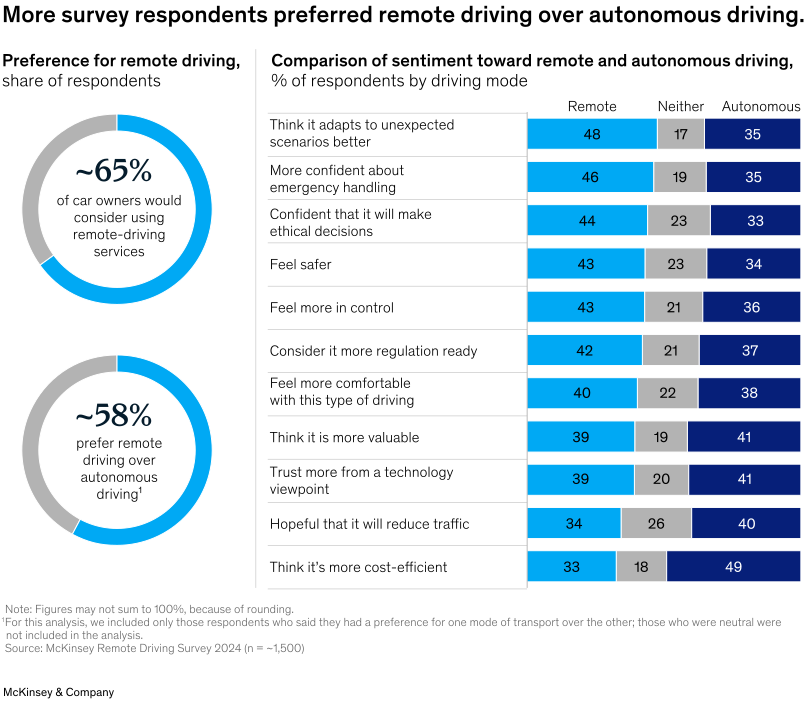
February 6, 2025 – A majority of car owners would consider using remote-driving services, where someone offsite uses a simulator to drive the car, such as for maintenance appointments; 58 percent report preferring remote over autonomous driving. Survey respondents favored remote driving due to higher perceived safety, control, and regulatory readiness, note Partner Ani Kelkar and coauthors.
To read the article, see “Remote-driving services: The next disruption in mobility innovation?,” January 3, 2025.
customizer here
Visual form
Pie / Donut Chart and Stacked Bar / Stacked Column: remote-driving preference summary with statement-level response bars.
Layout / body structure
Two donut charts on the left show headline preference measures. The right side lists sentiment statements in rows, each followed by a three-part horizontal stacked bar for Remote, Neither, and Autonomous responses.
What is being compared
It compares consumer preference for remote driving versus autonomous driving, then compares the two modes across safety, control, emergency handling, ethics, regulation, comfort, value, traffic, and cost statements.
Measurement system
All values are percent of respondents. Donut centers show the headline shares, and the stacked bars show the Remote, Neither, and Autonomous distribution for each statement.
Visible structure inside the graphic
The left rings isolate the top-line results, while the right table shows repeated blue-gray-dark-blue bars. Remote-driving segments are longer on most trust and safety rows, while autonomous-driving segments lead on cost efficiency.
Main takeaway from the visual
The chart shows consumers leaning toward remote driving over autonomous driving, especially on practical trust, control, and safety dimensions.
Key standout values or extremes
About 65 percent of car owners would consider remote-driving services, and about 58 percent prefer remote over autonomous driving. Remote driving leads autonomous driving by 48 to 35 on adapting to unexpected scenarios, 46 to 35 on emergency handling, and 43 to 34 on feeling safer, while autonomous driving leads on cost efficiency at 49 to 33.
Controls / sequence, when applicable
This is a fixed donut-and-stacked-bar chart; there are no in-chart controls to operate.
Companion media, when applicable
There is no separate companion audio or video; the remote-driving preference chart is the visual on this page.