Source page: McKinsey & Company
Commentary
Robots on the rise
Artificial Intelligence | Innovation | Future of Work
August 7, 2025 – Robots could soon handle labor-intensive work tasks that until recently only humans could do, such as selecting and placing items, directing instruments, and operating handheld equipment. Many tasks in the consumer and manufacturing sectors could be automated, explain Senior Partner Mark Patel and coauthors, such as retail operations, warehouse work, and chemical processing. Although general-purpose robotics may take years to develop, companies can prepare by setting long-term automation goals and upskilling their workforces now.
To read the article, see “Will embodied AI create robotic coworkers?,” June 30, 2025.
customizer here
Visual form
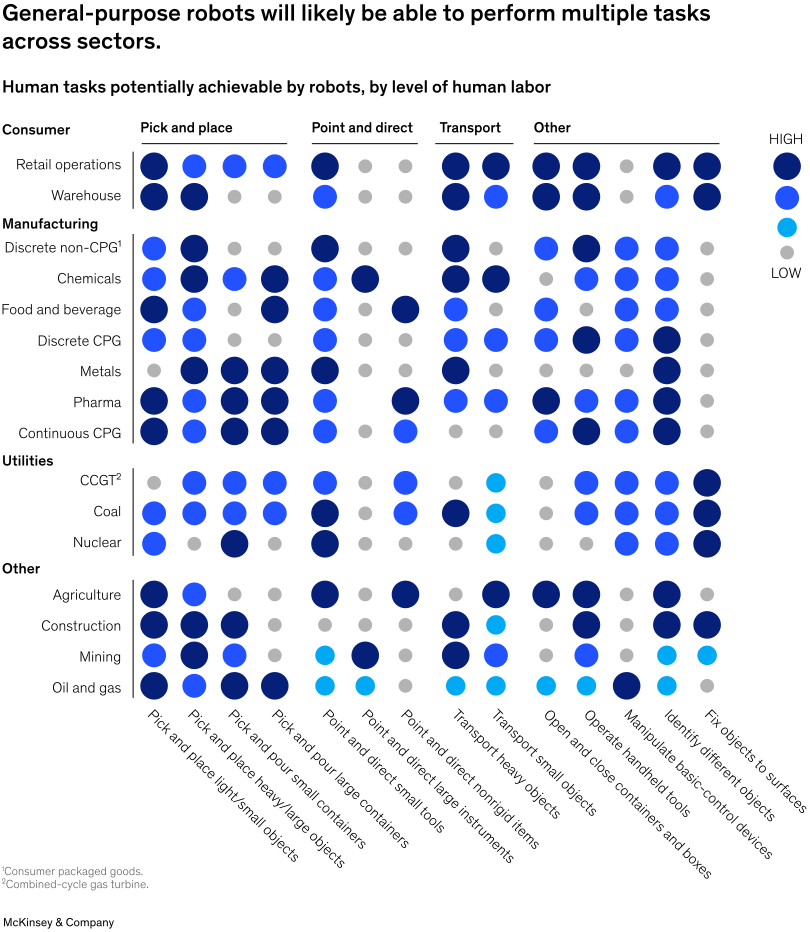
Dot-matrix task map.
Layout / body structure
This is a single matrix-style chart read top to bottom by sector and left to right by task type. The columns are grouped into Pick and place, Point and direct, Transport, and Other, while the rows are grouped into Consumer, Manufacturing, Utilities, and Other sectors.
What is being compared
It compares many specific human tasks across sectors to show how achievable each task is for general-purpose robots. Examples range from pick-and-place tasks in retail and warehouses to point-and-direct work, transport tasks, and other actions such as operating handheld tools, manipulating containers, identifying objects, and fixing objects to surfaces.
Measurement system
The chart uses an ordinal color scale rather than a numeric axis. Circle color moves from low to high achievability, with gray at the low end and progressively darker blues at higher levels.
Visible structure inside the graphic
Each row-sector combination contains a series of colored dots aligned under task columns. Dark blue dots mark tasks with high robot achievability, lighter blue and cyan dots indicate intermediate levels, and gray dots mark low achievability. The legend on the right shows the high-to-low color ramp. The manufacturing section is especially dense, with multiple rows and many filled dots across pick-and-place, point-and-direct, transport, and other task families.
Main takeaway from the visual
The chart shows that general-purpose robots can likely span many tasks across many sectors rather than staying boxed into a narrow set of repetitive use cases. The densest clusters of high-achievability dots appear in consumer operations and manufacturing, but utilities and extractive sectors also show targeted task opportunities.
Key standout values or extremes
Retail operations and warehouse rows have many dark-blue dots across pick-and-place and transport activities, signaling broad potential. Manufacturing rows such as chemicals, pharma, and continuous CPG also show strong coverage across multiple task families. By contrast, several niche actions in utilities and mining remain lighter or gray, which marks lower readiness.
Controls / sequence, when applicable
This is a static chart image with no in-chart controls to operate.
Companion media, when applicable
There is no separate companion audio or video; the chart image is the full visual on this page.