Source page: McKinsey & Company
Commentary
Scale up, bring emissions down
Sustainability | Decarbonization | Renewable energy
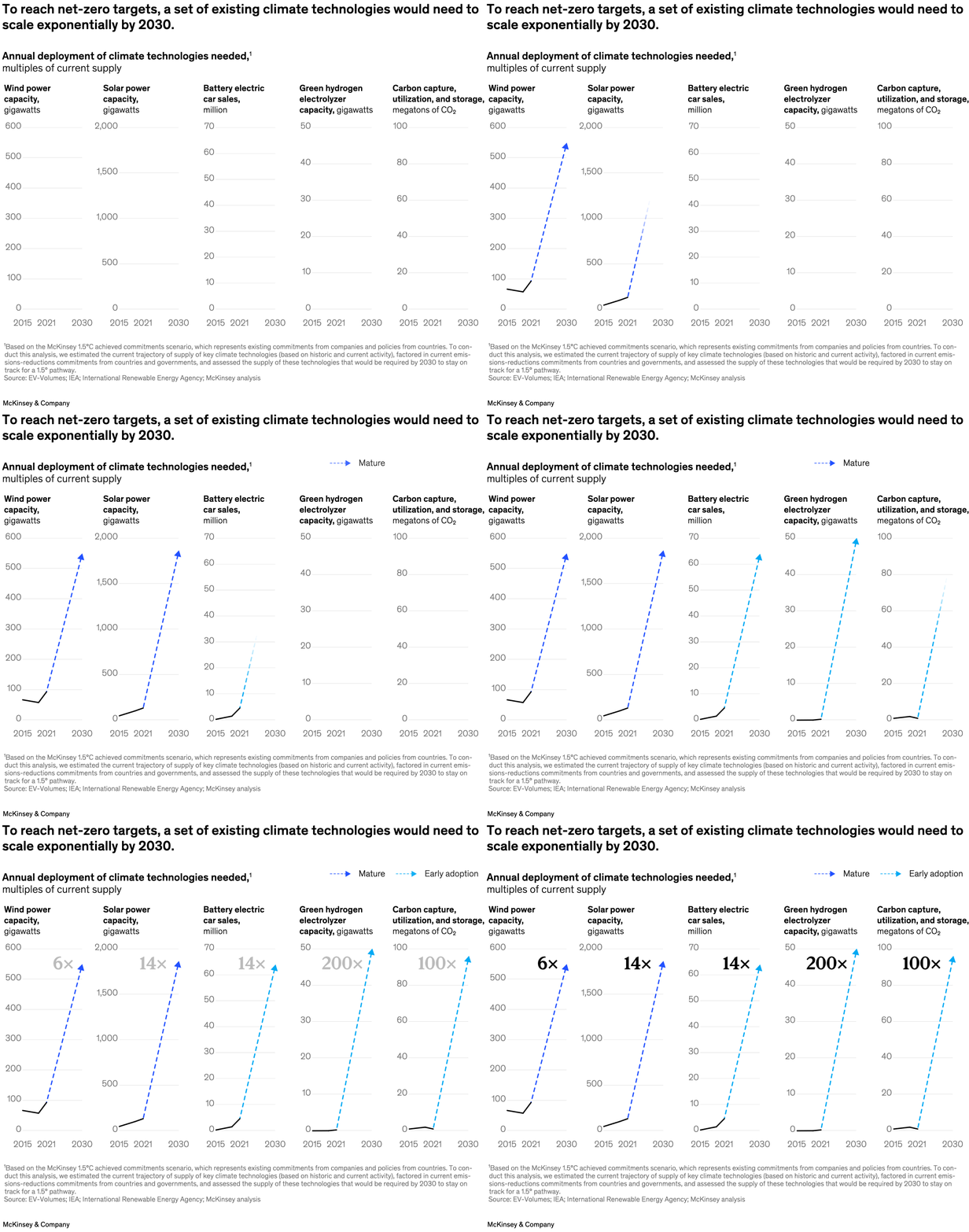
April 3, 2023 – To hit net-zero targets and fend off the worst effects of climate change, a set of key technologies needs to scale exponentially, say senior partner Tomas Nauclér and colleagues. Solar power, for example, would need to scale by a factor of 14 times by 2030. For carbon capture, utilization, and storage, a technology that is still in the earlier stages of adoption, the scaling factor is 100 times.
To read the article, see “Scaling green businesses: Next moves for leaders,” March 10, 2023.
customizer here
Visual form
Five-panel small-multiple line chart.
Layout / body structure
The page lays out five narrow panels side by side, one for each climate technology, and the reader scans across them from left to right to compare the scale-up challenge technology by technology.
What is being compared
It compares the current deployment path versus the required 2030 deployment path for wind power capacity, solar power capacity, battery electric car sales, green-hydrogen electrolyzer capacity, and carbon capture, utilization, and storage.
Measurement system
Each panel uses the unit appropriate to that technology, including gigawatts, millions of car sales, and megatons of CO2, and each one also adds a multiplier that states how many times larger deployment must become by 2030.
Visible structure inside the graphic
Every panel combines a short solid historical line through 2021 with a steep dashed projection line out to 2030. Large multiplier labels sit near the top of each panel, making it easy to compare the relative scale-up required even though the units differ.
Main takeaway from the visual
All five technologies are well below their 2030 requirements, but the gap is especially steep for the less mature technologies, so the chart shows a general scaling challenge with the biggest relative jumps clustered in hydrogen and carbon capture.
Key standout values or extremes
Wind power needs to scale 6 times, solar power 14 times, and battery electric car sales 14 times. Green-hydrogen electrolyzer capacity has the most extreme target at 200 times, and carbon capture, utilization, and storage needs to rise 100 times.
Controls / sequence, when applicable
This is a static chart image with no in-chart controls to operate.
Companion media, when applicable
There is no separate companion audio or video; the chart image is the full visual on this page.