Source page: McKinsey & Company
Commentary
Seeing double with AI
Advanced industries | Artificial Intelligence
January 30, 2023 – AI has the potential to accelerate problem solving for industrial companies in a few key ways, find senior partners Alex Singla and Bill Wiseman and colleagues. For example, AI can create a “digital twin” of a component, as a way to more quickly evaluate the component’s design across different performance metrics. The technology could help companies reduce sourcing costs for parts and bring higher-performing products to market faster.
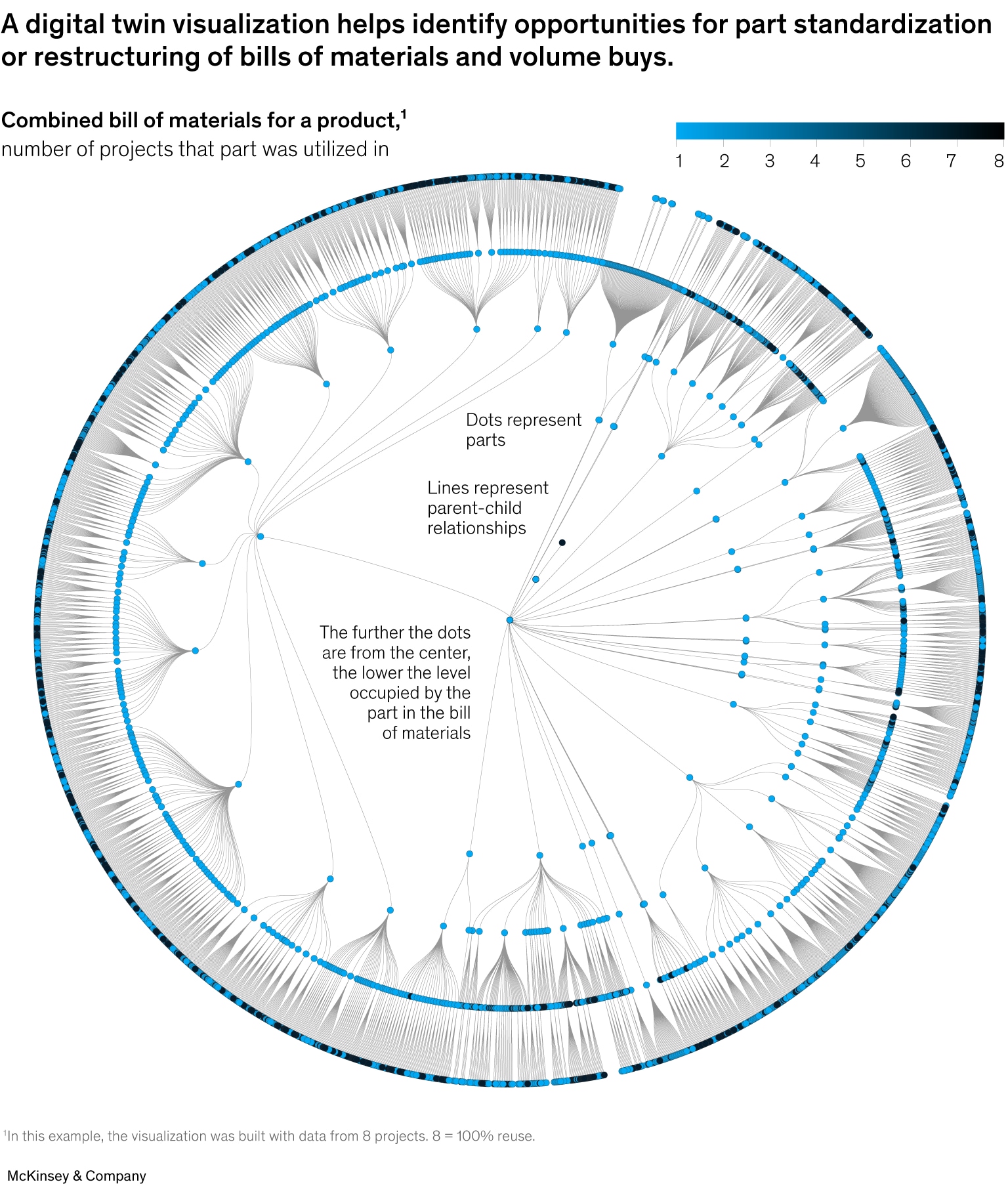
To read the article, see “The future is now: Unlocking the promise of AI in industrials,” December 6, 2022.
customizer here
Visual form
Diagrammatic workflow chart.
Layout / body structure
The page uses a single left-to-right workflow-style chart rather than a conventional axis chart. Reader follows the logic from a digital model of a part through the evaluation and redesign steps that uncover sourcing and standardization opportunities.
What is being compared
It compares alternative component designs and sourcing decisions inside a digital-twin process, with the emphasis on how AI can reveal opportunities to standardize parts or restructure bills of materials.
Measurement system
This chart leans more on categorical labels and decision logic than on a numeric axis. The important labels are the part categories, design relationships, and sourcing or volume-buy implications identified along the workflow.
Visible structure inside the graphic
The graphic is built from part illustrations, labeled workflow stages, and directional links showing how one design or sourcing decision leads to another. The internal pieces are the component views, the AI or digital-twin stage, and the callouts that identify standardization or restructuring opportunities.
Main takeaway from the visual
The chart is designed to show that AI is valuable here because it exposes duplication and redesign opportunities that are hard to see in a static parts list. The visual logic moves from model to decision, making the productivity gain a matter of structure rather than just speed.
Key standout values or extremes
The page does not revolve around one dominant numeric label. Its standout element is the explicit visual link between the digital twin and the opportunities for part standardization, bill-of-material restructuring, and larger volume buys.
Controls / sequence, when applicable
This is a static chart image with no in-chart controls to operate.
Companion media, when applicable
There is no separate companion audio or video; the chart image is the full visual on this page.