Source page: McKinsey & Company
Commentary
Taking the pulse of women's heart health
Healthcare | Life Sciences
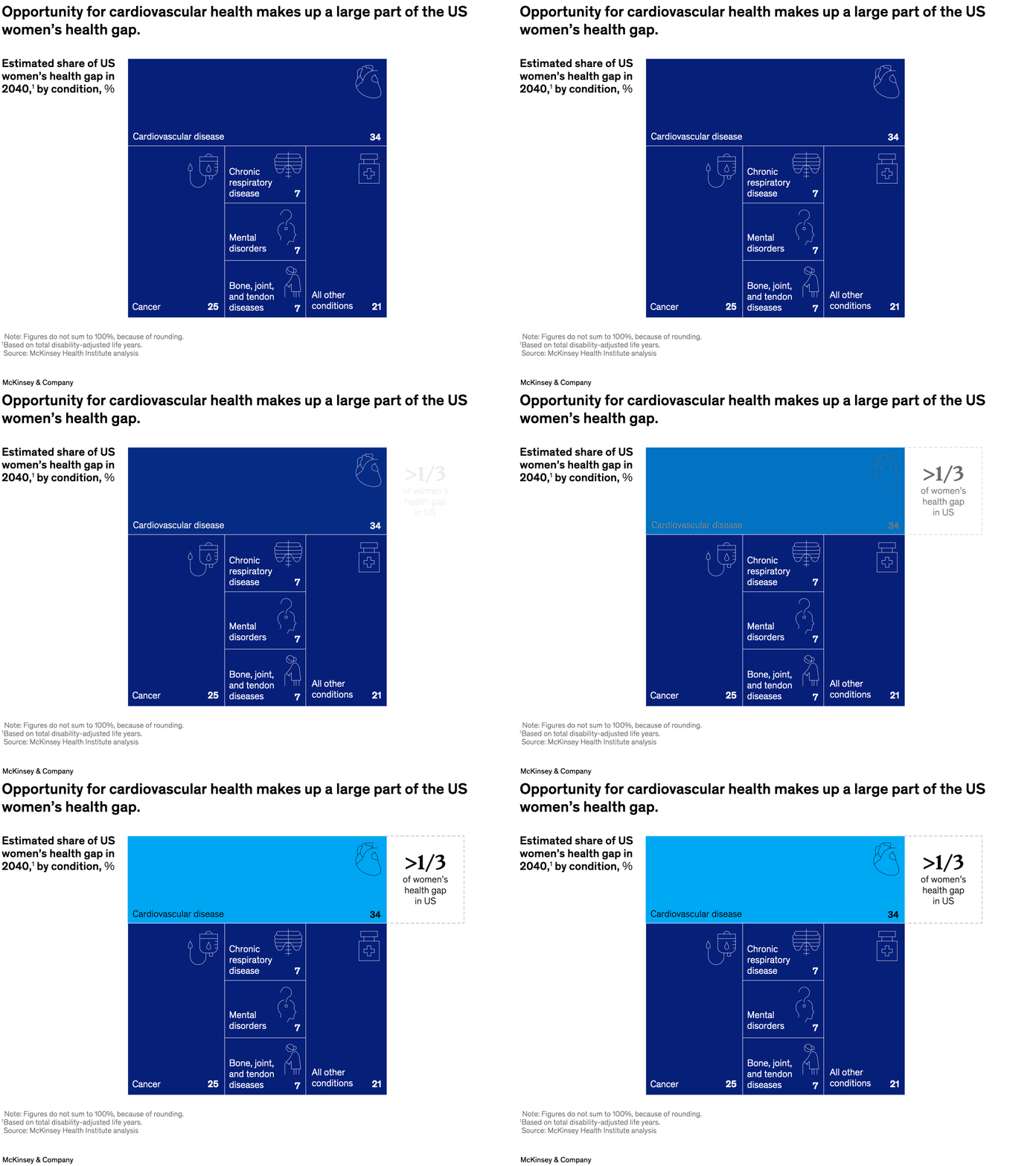
July 24, 2024 – More than 60 million women in the United States are living with cardiovascular disease (CVD). CVD is also the leading cause of death among women, who are more likely than men to die from a heart attack. In fact, a third of the health gap between US men and women, as measured in potential years of healthy life, is due to CVD. If the gap between men’s and women’s heart health is closed, the United States could possibly add $28 billion in GDP by 2040, say senior partner Lucy Pérez, partner Megan Greenfield, and coauthors.
To read the report, see “The state of US women’s heart health: A path to improved health and financial outcomes,” June 25, 2024.
customizer here
Visual form
Treemap-style composition chart.
Layout / body structure
The page presents one large rectangular composition where the top band is reserved for cardiovascular disease and the lower area is subdivided among cancer, chronic respiratory disease, mental disorders, bone-joint-and-tendon diseases, and all other conditions.
What is being compared
It compares the estimated share of the US women’s health gap in 2040 attributable to different conditions.
Measurement system
The values are percentages of the total women’s health gap, and the area of each block corresponds to its share while the chart also calls out the cardiovascular slice as more than one-third of the total.
Visible structure inside the graphic
The treemap uses large colored rectangles with category names and percentages written inside them, plus simple condition icons embedded in several blocks and a dashed callout box on the right emphasizing the cardiovascular share.
Main takeaway from the visual
Cardiovascular disease is the dominant contributor by a clear margin, taking up the largest block in the composition and outweighing any single category in the lower half of the chart.
Key standout values or extremes
Cardiovascular disease accounts for 34 percent of the gap, cancer for 25 percent, all other conditions for 21 percent, and chronic respiratory disease, mental disorders, and bone, joint, and tendon diseases each account for 7 percent.
Controls / sequence, when applicable
This is a static chart image with no in-chart controls to operate.
Companion media, when applicable
There is no separate companion audio or video; the chart image is the full visual on this page.