Source page: McKinsey & Company
Commentary
The future of AI workloads
Artificial Intelligence | Infrastructure
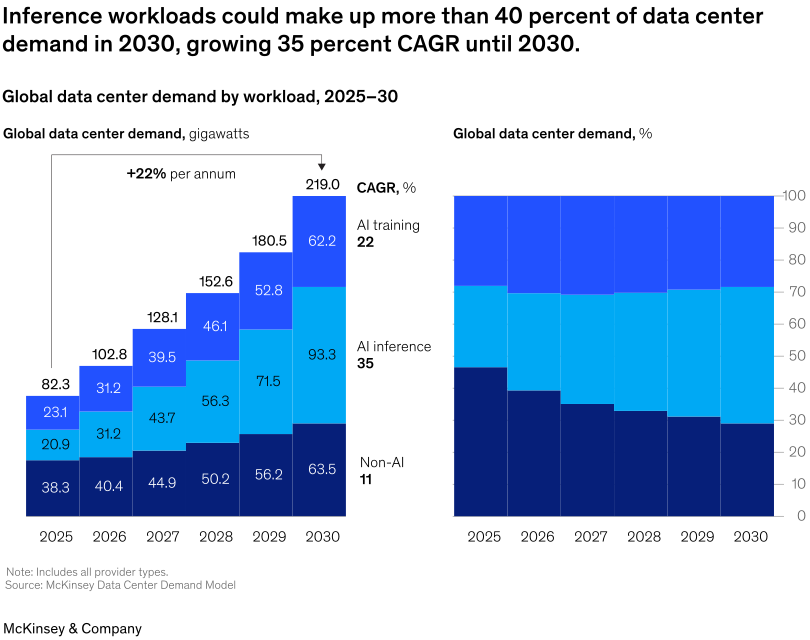
February 24, 2026 – AI has become the main growth engine for US data centers, reshaping data center economics, power planning, and leasing decisions. Demand is split between two workloads—training and inference. While training workloads require large, high-density campuses with advanced mechanical, electrical, and plumbing systems and specialized hardware integration, AI inference is driving build-outs in metro and near-metro sites optimized for low latency, strong network connectivity, and energy efficiency, explain McKinsey’s Marc Sorel, Pankaj Sachdeva, and coauthors. By 2030, inference will surpass training to become the dominant workload in AI data centers, representing more than half of all AI compute and roughly 30 to 40 percent of total data center demand. This transition from one-time model training to sustained inference activity will increasingly inform hyperscalers’ decisions on location, network design, and power provisioning.
To read the article, see “The next big shifts in AI workloads and hyperscaler strategies,” December 17, 2025.
customizer here
Visual form
Stacked Bar / Stacked Column: paired data-center demand charts showing absolute gigawatts and 100-percent workload share.
Layout / body structure
The left panel stacks annual demand in gigawatts by non-AI workloads, AI inference, and AI training. The right panel restates the same categories as a 100-percent stacked bar chart, making the mix shift visible apart from the absolute demand growth.
What is being compared
It compares projected global data-center demand from 2025 to 2030 across non-AI workloads, AI inference, and AI training.
Measurement system
The absolute panel is measured in gigawatts of data-center demand. The share panel is measured as percent of total demand, and category labels include compound annual growth rates.
Visible structure inside the graphic
Total demand rises sharply in the left panel, while the right panel shows AI inference taking a larger share each year. Non-AI workloads grow in absolute terms but shrink as a percentage of the total.
Main takeaway from the visual
The chart shows that inference becomes the main growth engine for AI data-center demand. Training remains large, but sustained inference use changes the power, location, and network planning problem for hyperscalers.
Key standout values or extremes
Total demand rises from 82.3 GW in 2025 to 219.0 GW in 2030. AI inference grows from 20.9 GW to 93.3 GW at a 35 percent CAGR, overtaking non-AI by 2029; AI training grows from 23.1 GW to 62.2 GW.
Controls / sequence, when applicable
This is a static paired stacked-bar chart; there are no in-chart controls to operate.
Companion media, when applicable
There is no separate companion audio or video; the AI workload demand stacked-bar chart is the full visual on this page.