Source page: McKinsey & Company
Commentary
To go from science fiction to reality, urban flying vehicles need to operate way more cheaply than helicopter shuttles do
Mobility | Cities
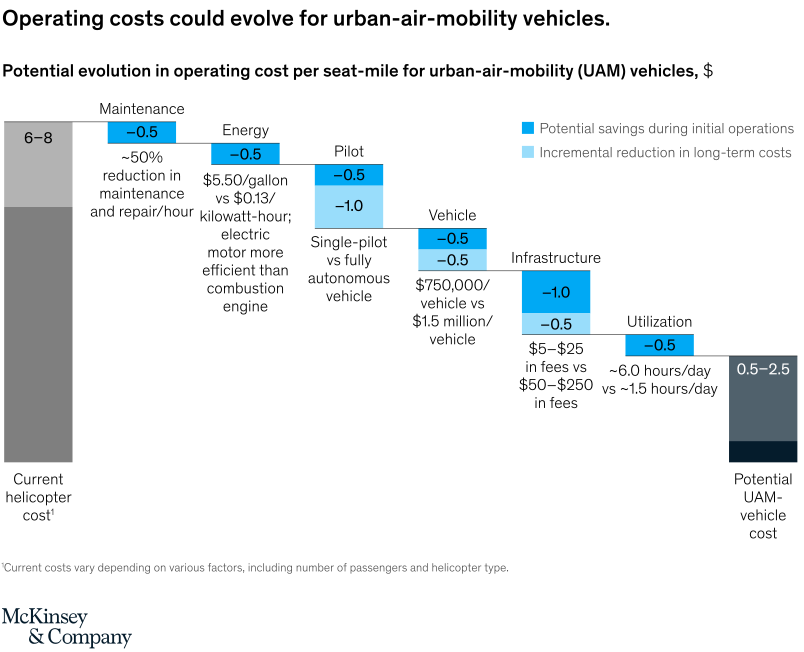
September 14, 2020 – For congested cities, urban-air-mobility vehicles could be a promising alternative to ground transportation. But to be successful, these vehicles need to cost 80 percent less to operate than helicopters currently do.
To read the article, see “To take off, flying vehicles first need places to land,” August 31, 2020.
customizer here
Visual form
Waterfall Chart: operating-cost bridge from helicopter shuttles to urban-air-mobility vehicles.
Layout / body structure
The chart starts with current helicopter cost on the left, steps downward through maintenance, energy, pilot, vehicle, infrastructure, and utilization savings, and ends with potential urban-air-mobility cost on the right.
What is being compared
It compares current helicopter operating cost per seat-mile with the lower cost range projected for urban flying vehicles, while breaking out the individual cost levers needed to get there.
Measurement system
The measure is dollars per seat-mile. The starting range is 6 to 8 dollars, intermediate blocks show dollar reductions, and the ending range is 0.5 to 2.5 dollars per seat-mile.
Visible structure inside the graphic
The tall gray helicopter bar is followed by descending blue step blocks. Darker blue marks savings possible during initial operations, while lighter blue marks longer-term reductions.
Main takeaway from the visual
The chart shows that urban flying vehicles need a stack of cost reductions to become economically plausible. No single lever creates the full drop from helicopter cost to the target range.
Key standout values or extremes
The total movement is from 6 to 8 dollars per seat-mile down to 0.5 to 2.5 dollars. The named levers include maintenance, energy, pilot shifts, vehicle cost, infrastructure, and higher utilization.
Controls / sequence, when applicable
This is a static waterfall chart; there are no in-chart controls to operate.
Companion media, when applicable
There is no separate companion audio or video; the urban-air-mobility cost bridge is the full visual on this page.