Source page: McKinsey & Company
Commentary
Two if by land, one if by drone
Retail | E-commerce | Mobility
February 16, 2023 – Are delivery drones set to take off? Under certain conditions—when pooling deliveries doesn’t make practical sense, for example—drones may already be the most cost-effective mode of delivery, say partner Robin Riedel and coauthors. They are also environmentally friendly, with CO2 emissions typically lower than those of electric cars and vans making a single delivery, and significantly lower than those of gasoline-powered vehicles.
To read the article, see “Drones take to the sky, potentially disrupting last-mile delivery,” January 3, 2023.
customizer here
Visual form
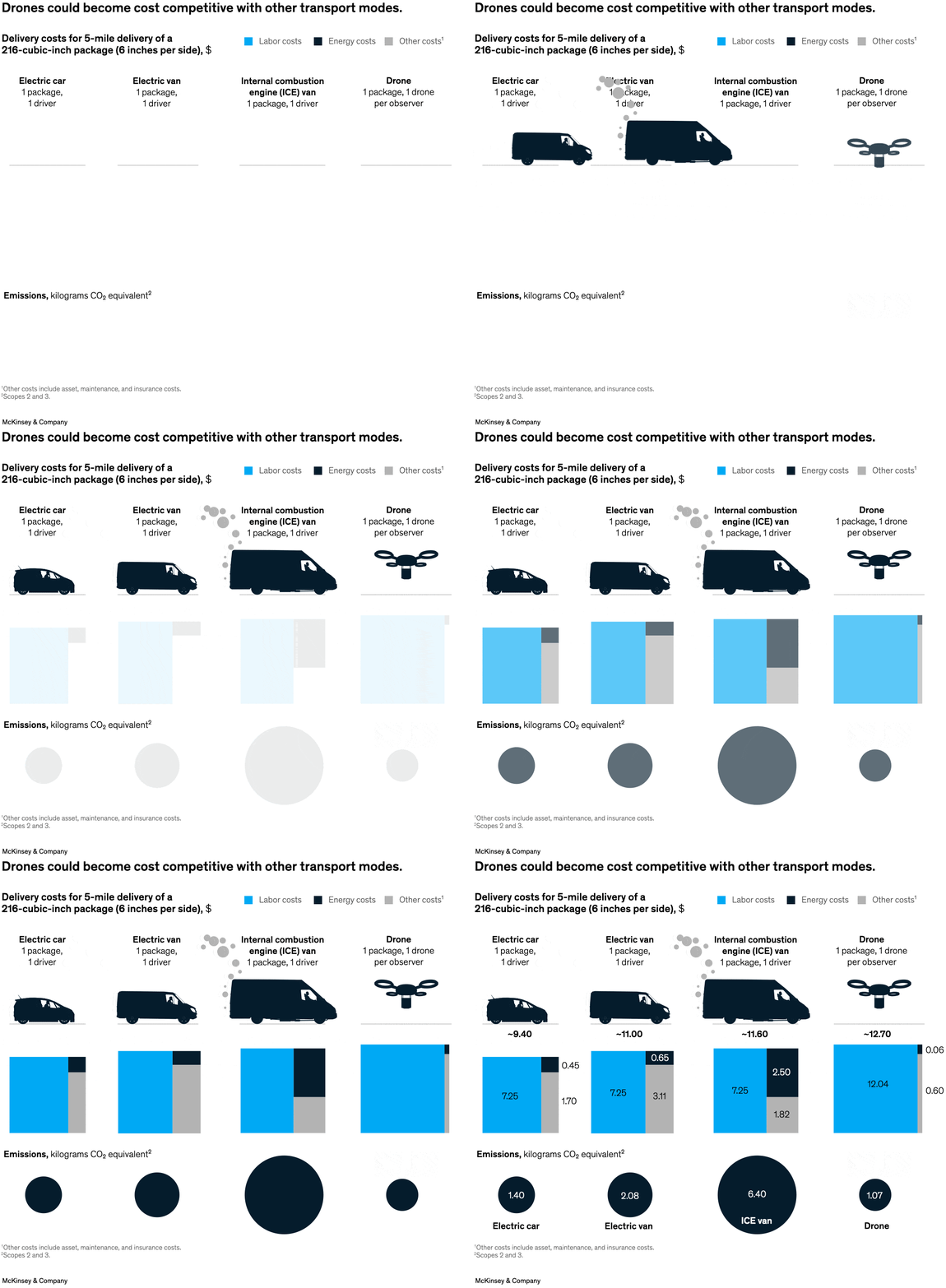
Comparative cost-and-emissions chart.
Layout / body structure
The page is organized into two horizontal layers. The top layer compares delivery cost stacks across four transport modes, and the bottom layer uses emission bubbles aligned beneath those same modes.
What is being compared
It compares drones, electric cars, electric vans, and internal-combustion-engine vans for a five-mile delivery of a six-inch parcel.
Measurement system
The cost comparison is measured in dollars per package and split into labor, energy, and other costs, while the emissions comparison is measured in kilograms of CO2 equivalent.
Visible structure inside the graphic
Each transport mode is shown with a vehicle icon above a stacked cost column. The cost stacks use separate colors for labor, energy, and other costs, and the lower row uses labeled circles to show the emissions footprint for the same four options.
Main takeaway from the visual
Drones are not the cheapest option in the cost stacks, but they are visually the cleanest option in the emissions row. The chart is built to show a trade-off between current operating cost and environmental advantage.
Key standout values or extremes
The drone delivery cost is about 12.70 dollars per package, above the roughly 9.40 to 11.60 dollar range for the ground vehicles. But the emissions bubble for drones is 1.07 kilograms of CO2 equivalent, below the electric car at 1.40, the electric van at 2.08, and far below the internal-combustion van at 6.40.
Controls / sequence, when applicable
This is a static chart image with no in-chart controls to operate.
Companion media, when applicable
There is no separate companion audio or video; the chart image is the full visual on this page.