Source page: McKinsey & Company
Commentary
US banks’ credit losses from COVID-19 could exceed those from the global financial crisis
COVID-19 | Banking | North America
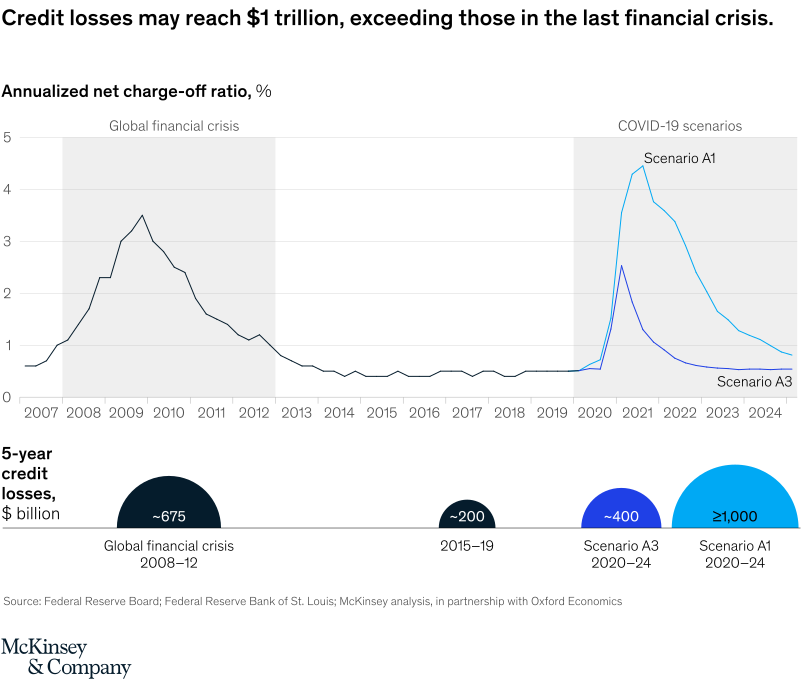
June 5, 2020 – Most of the losses will come from commercial and industrial loans to the sectors most affected by lockdowns. The extent of estimated losses depends on whether the virus recurs later in the year (scenario A1) or is contained (scenario A3).
To read the article, see “Stability in the storm: US banks in the pandemic and the next normal,” May 13, 2020.
customizer here
Visual form
Long-run line chart paired with bubble callouts for five-year credit losses.
Layout / body structure
The line chart tracks annualized net charge-off ratios across the global financial crisis, the postcrisis period, and COVID-19 scenarios. The lower bubbles summarize five-year credit losses for each period or scenario.
What is being compared
It compares US bank credit-loss severity in the global financial crisis, the 2015-2019 period, and two COVID-19 scenarios.
Measurement system
The line chart is measured as annualized net charge-off ratio in percent. The bubble callouts are measured in billions of dollars of five-year credit losses.
Visible structure inside the graphic
The historical financial-crisis line peaks around 2009 and then falls. The COVID-19 scenario lines spike sharply around 2021, with Scenario A1 rising much higher than Scenario A3 before easing.
Main takeaway from the visual
COVID-19 credit losses could exceed losses from the global financial crisis, especially in the more severe Scenario A1 path.
Key standout values or extremes
The lower callouts show roughly 675 billion dollars of losses in the global financial crisis, about 200 billion dollars in 2015-2019, about 400 billion dollars in Scenario A3, and more than 1 trillion dollars in Scenario A1.
Controls / sequence, when applicable
This is a static chart image with no in-chart controls to operate.
Companion media, when applicable
There is no separate companion audio or video; the chart image is the full visual on this page.