Source page: McKinsey & Company
Commentary
We’re gonna need a bigger shovel
Metals and mining | Sustainability
January 27, 2022 – The transition to a net-zero economy will be metal-intensive. New technologies will require base metals—for example, copper for electrification and nickel for battery EVs. Green technologies will also need hefty amounts of rarer metals, such as lithium and cobalt for batteries, tellurium for solar panels, and neodymium for the permanent magnets used both in wind power generation and EVs. The required pace of transition means that, for some of these commodities, we will soon need ten times or more than is available today.
To read the article, see “The raw-materials challenge: How the metals and mining sector will be at the core of enabling the energy transition,” January 10, 2022.
customizer here
Visual form
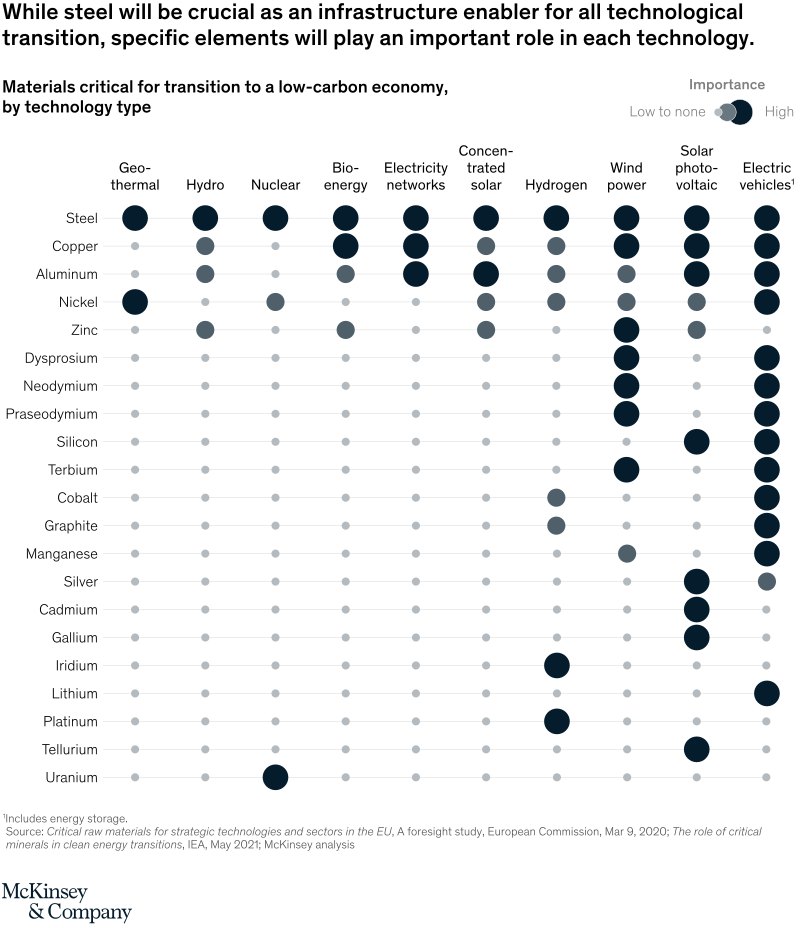
Bubble-matrix comparison chart.
Layout / body structure
The chart is a single grid with material names running down the rows and low-carbon technologies running across the columns. Reader scans left to right by technology type and then up and down each column to see which materials matter most within that technology.
What is being compared
The chart compares the importance of different raw materials across low-carbon technologies. It is matching materials such as steel, copper, aluminum, nickel, lithium, dysprosium, and graphite against geothermal, hydro, nuclear, bioenergy, electricity networks, concentrated solar, hydrogen, wind power, solar photovoltaic, and electric vehicles.
Measurement system
There is no numeric axis; importance is encoded visually by dot size and darkness, moving from low or none to high. The row and column labels carry the categorical structure, and the legend in the upper right explains the low-to-high importance scale.
Visible structure inside the graphic
Each cell in the matrix contains a dot whose size signals how critical that material is for that technology. Broadly useful inputs such as steel and copper appear across many columns, while more specialized minerals cluster in narrower bands around wind, solar photovoltaic, hydrogen, and electric vehicles.
Main takeaway from the visual
The chart shows that steel is a broad infrastructure material across the transition, but the most technology-specific dependencies sit with a smaller set of minerals. Electric vehicles, wind power, and solar technologies pull in the deepest combinations of critical elements, which makes the mining challenge look highly technology specific rather than uniform.
Key standout values or extremes
Steel has high-importance dots across nearly every technology column, while electric vehicles show one of the densest high-importance clusters, including large markers for steel, copper, aluminum, nickel, lithium, cobalt, graphite, and several rare earths. Wind power is especially strong for zinc and rare-earth materials such as dysprosium, neodymium, praseodymium, and terbium, while solar photovoltaic stands out for silver, cadmium, gallium, and tellurium.
Controls / sequence, when applicable
This is a static chart image with no in-chart controls to operate.
Companion media, when applicable
There is no separate companion audio or video; the chart image is the full visual on this page.