Source page: McKinsey & Company
Commentary
Working from home? You're still in the minority.
COVID-19 | Remote work
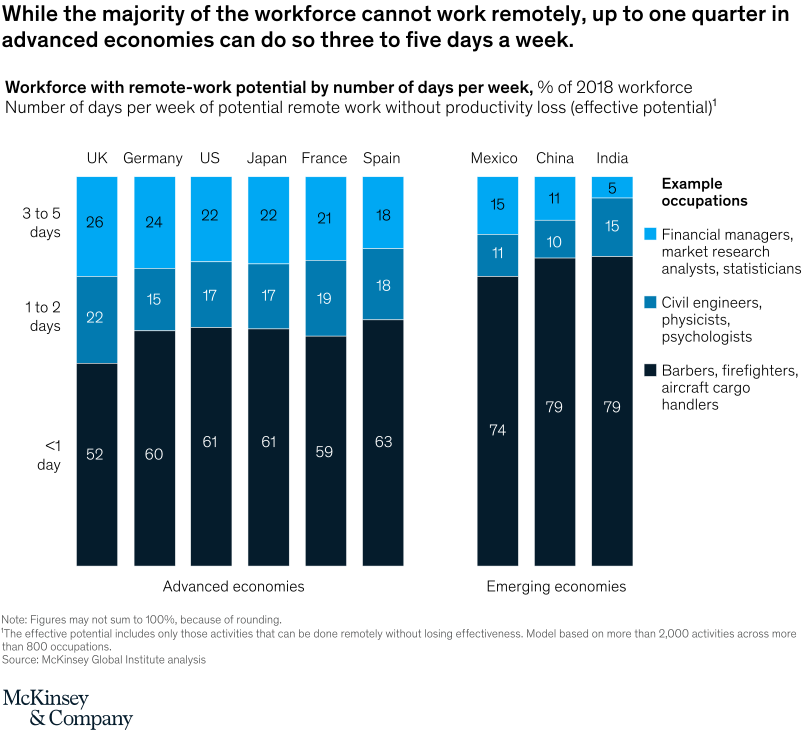
December 2, 2020 – Most workers globally can’t work a full day from home without suffering productivity losses, according to a McKinsey Global Institute analysis of more than 2,000 job tasks across more than 800 occupations. That’s because most of their tasks need to be done on-site.
To read more, see “What’s next for remote work: An analysis of 2,000 tasks, 800 jobs, and nine countries,” November 23, 2020.
customizer here
Visual form
Stacked workforce-distribution chart.
Layout / body structure
The chart is a single country-comparison view that splits each workforce into remote-work buckets. Read each bar or country grouping from the highest-remote segment through the partial-remote middle to the large low-remote remainder, then compare those distributions across advanced and emerging economies.
What is being compared
It compares how much of each country’s workforce can work remotely for three to five days a week, one to three days a week, or only a few hours a week or not at all. The comparison is across labor forces rather than across time.
Measurement system
The measure is share of the workforce, expressed in percentages for each remote-work band. Segment labels identify the amount of remote work possible without productivity loss, so the reader is tracking how each workforce is distributed across those three buckets.
Visible structure inside the graphic
The chart is organized as segmented country comparisons, with a relatively small high-remote section, a middle partial-remote section, and a much larger low-remote or not-remote section. The visual weight sits overwhelmingly in that final segment, which is what makes the chart read as a minority-can-work-from-home story instead of a remote-work boom story.
Main takeaway from the visual
Most workers still sit in the bucket with little or no remote-work potential, even after the pandemic proved that some jobs can be done from home. Advanced economies clearly have larger high-remote segments than emerging economies, but the majority share remains on-site almost everywhere.
Key standout values or extremes
The strongest numeric anchors are the US split of 22 percent able to work remotely three to five days a week, 17 percent able to do so one to three days a week, and 61 percent able to work remotely only a few hours or not at all. India is the opposite extreme on the high-remote end, with only 5 percent able to work remotely three to five days a week.
Controls / sequence, when applicable
This is a static chart image with no in-chart controls to operate.
Companion media, when applicable
There is no separate companion audio or video; the chart image is the full visual on this page.