Source page: McKinsey & Company
Commentary
Young minds, heavy mental burdens
Healthcare | Mental health
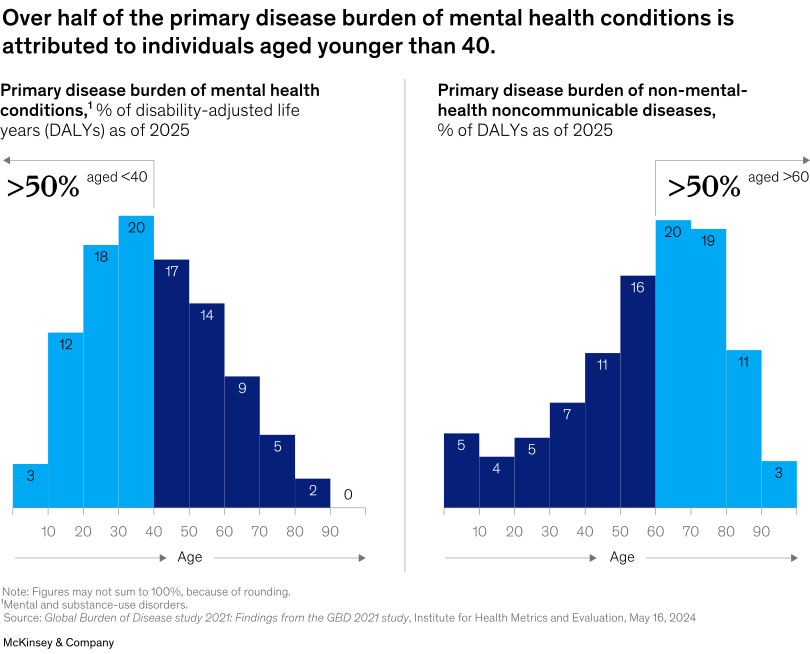
May 21, 2025 – More than half of the mental health disease burden affects those under age 40. Addressing mental health needs could set up individuals for better health throughout their lifespan. Investing in mental health interventions is thus critical, Partner Kana Enomoto and coauthors note, pointing to its ability to not only improve overall health but also workforce productivity.
To read the report, see “Investing in the future: How better mental health benefits everyone,” April 25, 2025.
customizer here
Visual form
Two-panel age-distribution bar chart. The visual uses paired age-band columns to contrast how disease burden is distributed for mental health conditions versus non-mental-health noncommunicable diseases.
Layout / body structure
The page is laid out as a side-by-side comparison, with mental health on the left panel and non-mental-health noncommunicable diseases on the right panel. Each panel uses the same age sequence from younger groups at the left to older groups at the right, so the reader can compare the shape of the two age distributions directly.
What is being compared
The chart compares the primary disease burden of mental health conditions with the primary disease burden of non-mental-health noncommunicable diseases, broken out by age group. It is specifically comparing where the burden is concentrated across the life course for the two condition groups.
Measurement system
The bars are measured as percentages of disability-adjusted life years, or DALYs, as of 2025. Age is the horizontal organizing scale inside each panel, and the percentage labels printed on the bars show how much of the burden sits in each age band.
Visible structure inside the graphic
Each panel is made of adjacent vertical bars for successive age groups, with larger bars concentrated in different parts of the age range depending on the condition type. The left panel carries a callout showing that more than 50 percent of the mental health burden is attributed to people younger than 40, while the right panel mirrors that structure with a callout showing that more than 50 percent of the non-mental-health burden is attributed to people older than 60.
Main takeaway from the visual
The visible takeaway is that mental health burden is much younger in profile than the burden of other major noncommunicable diseases. The left panel rises earlier and peaks in the younger adult decades, while the right panel shifts decisively toward the older age groups.
Key standout values or extremes
In the mental health panel, the largest bars are 18 percent in one young-adult band and 20 percent in the next, helping push the younger-than-40 share above 50 percent. In the non-mental-health panel, the tallest bars are 20 percent and 19 percent in older age bands, which drives the older-than-60 share above 50 percent.
Controls / sequence, when applicable
This is a static chart image with no in-chart controls to operate.
Companion media, when applicable
There is no separate companion audio or video; the chart image is the full visual on this page.