Category Definition
The Formal Sciences are the disciplines that study abstract structures using symbols, axioms, and rules of inference. They construct self-contained systems—such as logics, number systems, algebraic structures, and geometric frameworks—and investigate what necessarily follows once these systems are defined. Their results do not depend on observation of the physical world but on deductive reasoning within precisely specified languages.
Core Object of Study
The core object of study is formal structure: patterns of relation that can be expressed symbolically and manipulated according to explicit rules.
This includes:
- inference and logical consequence;
- quantity, order, relation, and form;
- sets, functions, and structures;
- abstract spaces and transformations.
These objects exist as possibilities defined by axioms, not as empirical entities.
| Domain Name | Focus | Function |
|---|---|---|
| Logic | The structure of inference and truth | Determines validity and consistency; defines the permissible operations of reason within any system. |
| Mathematics | The structure of quantity, relation, and form | Constructs fully specified systems of number, geometry, and transformation; provides the universal syntax through which rational order is expressed. |




Fundamental Questions
The Formal Sciences are organized around questions such as:
- Which patterns of reasoning are valid, and which lead to contradiction?
- What structures arise from specified axioms for number, geometry, sets, or algebra?
- How can quantity, relation, symmetry, and change be represented precisely?
- What are the limits of formal systems—completeness, consistency, decidability?
- How do different branches of mathematics and logic relate and unify?
These questions define the deductive core of scientific thought.
Methods and Evidence Base
The methods of the Formal Sciences are non-empirical and strictly deductive:
- Axiomatization: specifying primitive terms, axioms, and rules of inference.
- Proof: deriving theorems from axioms using valid logical steps.
- Structural analysis: classifying and comparing structures up to isomorphism.
- Abstraction and generalization: identifying common patterns across different concrete instances.
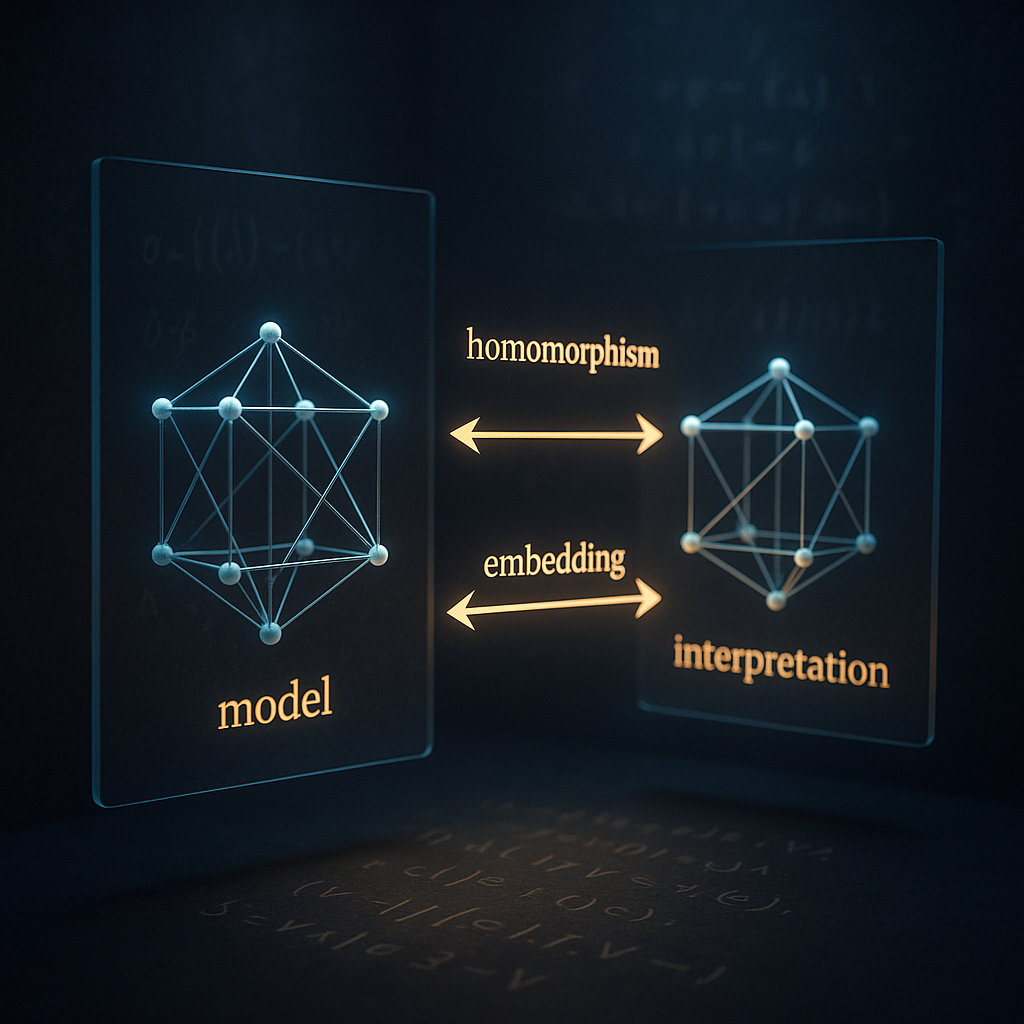
- Representation theorems: showing how one kind of structure can be modeled inside another.
“Evidence” is a correct proof or construction; validity is determined by adherence to the rules of the system, not by experiment.
Internal Structure
The Formal Sciences have a two-pillar architecture:
- Logic provides the general theory of inference: validity, consequence, proof systems, and the meta-theory of formal languages. It specifies what counts as a legitimate step of reasoning in any formal context.
- Mathematics develops structured theories of number, relation, space, and transformation using the tools of logic. It organizes these theories into domains such as arithmetic, algebra, geometry, analysis, topology, and set theory.
Within this architecture, areas such as proof theory, model theory, set theory, category theory, theoretical computer science, information theory, probability theory, and statistics appear as internal regions of logic and mathematics, not as separate core disciplines.





Boundary Conditions
The Formal Sciences are delimited by several boundaries:
- They do not rely on empirical observation, measurement, or experimentation.
- They do not directly describe physical, biological, or social phenomena; that task belongs to the Natural and Social Sciences.
- They do not make normative claims about values or policy, except concerning correctness within a formal system.
- Applied domains—applied mathematics, programming, engineering mathematics, quantitative finance—draw on formal results but are not themselves foundational formal sciences.
Their scope is limited to what can be defined and deduced within explicit symbolic frameworks.
Role in the Larger Scientific Hierarchy
The Formal Sciences supply the languages, structures, and standards of rigor used throughout the rest of science. They provide:
- the logical frameworks that govern proof and argument;
- the mathematical tools used to model physical, biological, and social systems;
- the formal foundations of computation, information, and quantitative inference.
Natural Sciences fill these structures with empirical content; Social Sciences apply them to human behavior and institutions. The Formal Sciences stand beneath both, defining the architecture of exact reasoning itself.