Logic is the formal science that studies valid reasoning—the structure of inference, truth, and derivation within symbolic systems.
It establishes the principles that determine when conclusions follow necessarily from premises, independent of empirical content.
Where natural sciences rely on observation and measurement, logic relies on syntax, semantics, and axiomatic structure, providing the foundation upon which mathematics, computation, and rigorous argumentation are built.
Logic links the syntactic world of proofs with the semantic world of models, supplying the framework in which mathematical objects are defined, truths are established, and computability is determined.



| Branch Name | Focus | Examples |
|---|---|---|
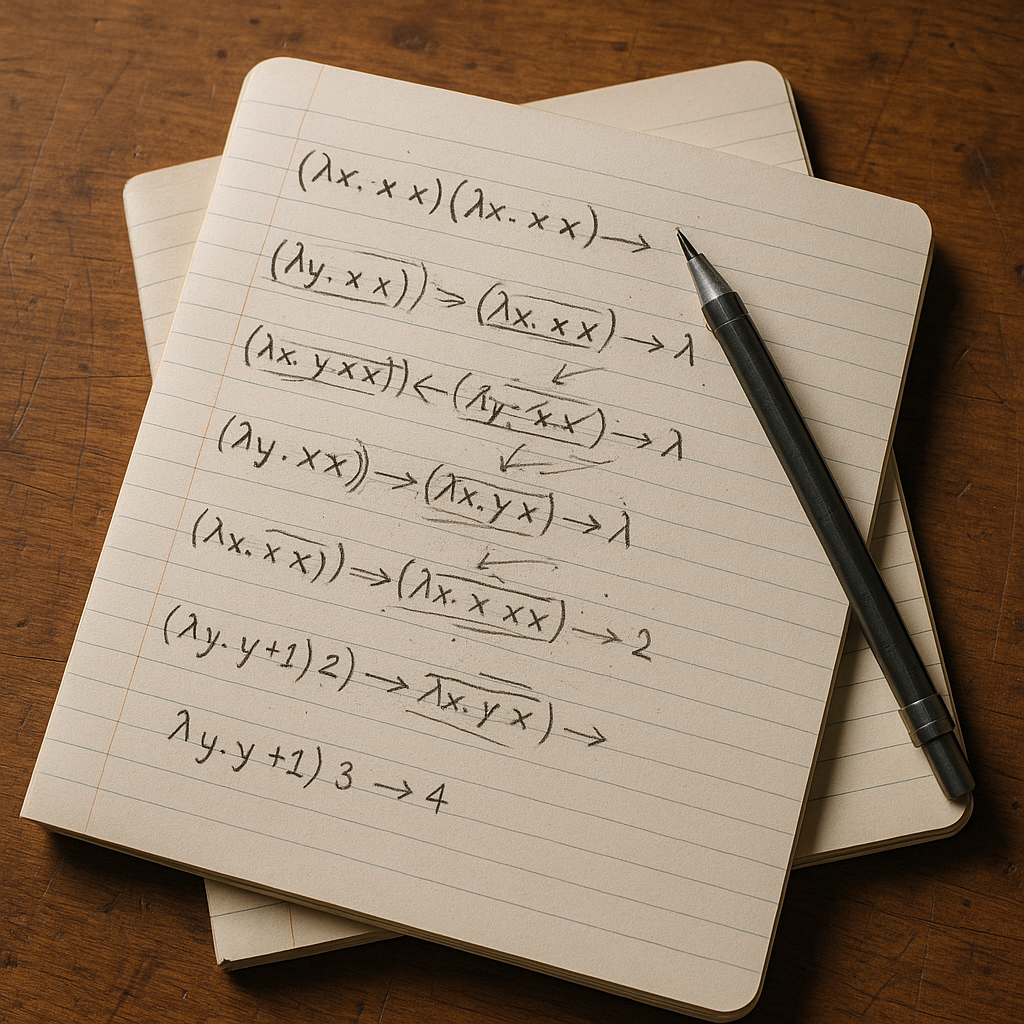
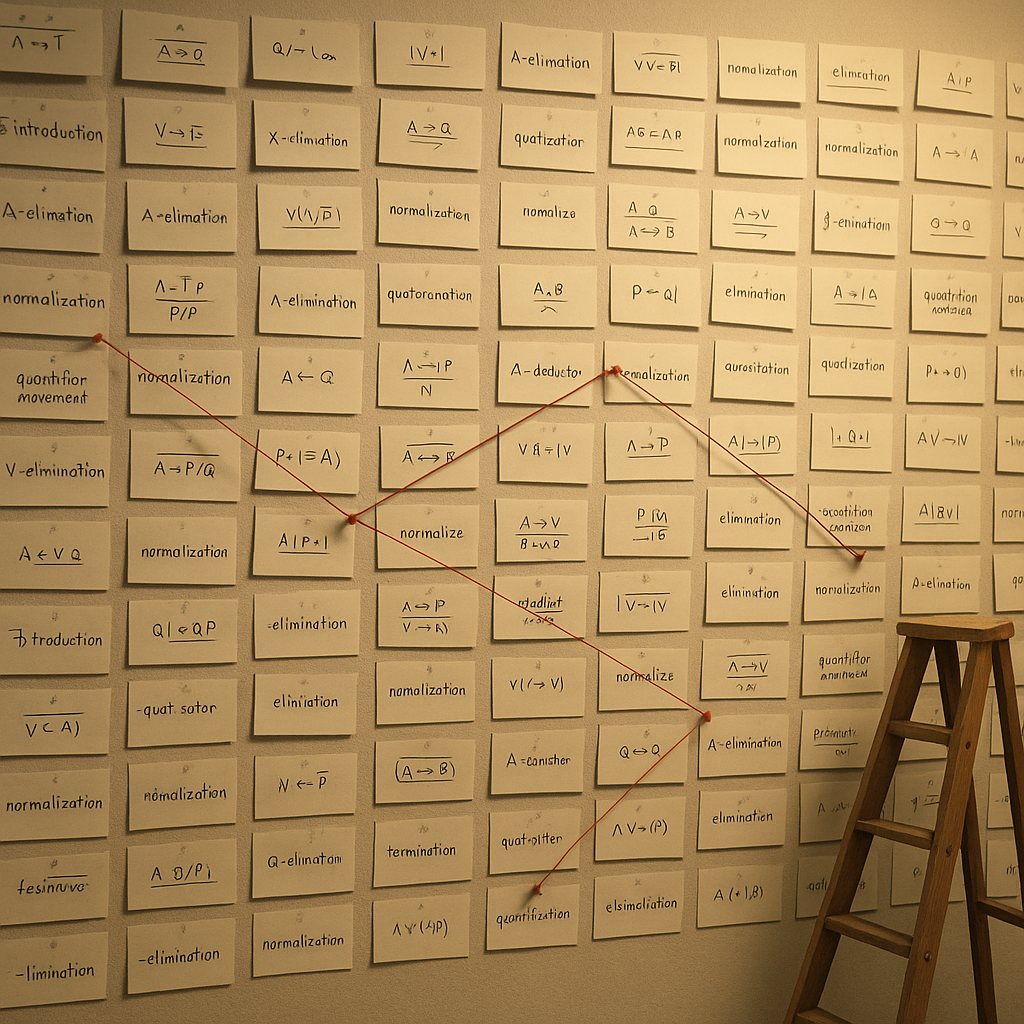
| Proof Theory | Studies formal derivations and inference rules that determine how valid conclusions are mechanically obtained from premises. | Natural deduction, sequent calculus, Hilbert systems, cut-elimination, normalization, proof search, Curry–Howard correspondence. |
| Model Theory | Analyzes truth in mathematical structures through interpretations, satisfaction, and semantic consequence. | Structures and models, compactness, completeness, Löwenheim–Skolem, definability theory, categoricity results. |
| Set Theory | Investigates the axiomatic foundations of mathematics and the universe of mathematical objects. | ZFC axioms, ordinals and cardinals, large cardinals, forcing, constructible universe (L), independence proofs. |
| Computability Theory | Examines effective procedures, decidability, algorithmic limits, and the boundary between computable and non-computable problems. | Turing machines, recursive/RE sets, halting problem, reductions, degrees of unsolvability, primitive recursive functions. |
Role in the Sciences
- In Mathematics: Provides the foundations for proof, truth, and the existence of mathematical structures.
- In Computer Science: Defines computability, algorithms, formal languages, automata, and complexity.
- In Philosophy: Supplies the framework for rigorous argument, semantics, modality, and formal epistemology.
- In Linguistics: Underpins formal semantics, syntax, grammar hierarchies, and meaning composition.
- In the Formal Sciences: Serves as the validating core for all symbolic systems and deductive frameworks.




Summary
All fields of logic—proof-theoretic, model-theoretic, set-theoretic, and computability-theoretic—form a single formal continuum.
Each branch spans foundational theory and practical application, ensuring that mathematics, computation, and structured reasoning rest upon a consistent and complete methodological base.
Logic remains the fundamental formal science, defining the rules of inference that govern proof, truth, and effective reasoning across every domain that relies on symbolic structure.