Structure is the layer where Aggregation & Dynamics transforms raw macroeconomic observations and domain commitments into organized, system-level theory. It specifies the patterns and invariants the field recognizes—business cycles, trend–cycle decompositions, inflation persistence, comovement across aggregates, propagation channels, and equilibrium relationships—and the mechanisms and pathways it posits to explain them. It establishes the vocabulary in which macroeconomic explanations are framed: shocks, frictions, expectations, multipliers, transmission mechanisms, propagation dynamics, stability conditions, and steady states. Structure is also where formal representations emerge: dynamic equations of motion, state-space systems, DSGE architectures, VAR representations, growth models, financial–real linkages, and mapping functions that determine how policy affects aggregates.
Within this layer, macroeconomics distills laws and regularities from data—Okun’s relationship, Phillips-curve patterns, monetary transmission invariants, consumption and investment dynamics—and maps their underlying causal architectures. It stabilizes core concepts (output gaps, potential output, trend productivity, nominal rigidities, capital accumulation) and classification schemes (types of shocks, types of frictions, types of equilibria). It also formalizes idealized structures and their regimes of validity: linearized dynamics around steady states, representative-agent approximations, rational expectations equilibria, and frictionless benchmark models, along with the conditions under which each abstraction breaks or requires augmentation.
Finally, Structure situates macroeconomics within the broader analytic landscape: linking aggregate dynamics to microfoundations, financial theory, labor economics, international flows, and political economy, creating a unified map of how local mechanisms integrate into system-wide behavior. In Aggregation & Dynamics, the Structural layer is the architecture of macroeconomic understanding—the conceptual and formal scaffolding through which evidence becomes intelligible, predictions become coherent, and explanations of economy-wide phenomena acquire systematic shape.
Aggregation & Dynamics (Macroeconomic Systems) – Structure – SAT
| Element | Macroeconomic – SAT – Structure | |||||||||||
|---|---|---|---|---|---|---|---|---|---|---|---|---|
| Scope Category | 3.1 Patterns & Regularities | 3.2 Causal Architecture | 3.3 Theoretical Vocabulary | 3.4 Formal Representations | 3.5 Idealized Structures | 3.6 Integrative Frameworks | ||||||
| Sub-Item | Aggregation – Laws / Relations | Aggregation – Invariants | Aggregation – Mechanisms | Aggregation – Pathways | Aggregation – Concepts | Aggregation – Classifications | Aggregation – Equations | Aggregation – Models | Aggregation – Simplified Models | Aggregation – Limit Conditions | Aggregation – Unifying Theories | Aggregation – Interdisciplinary Links |



3.1 Patterns & Regularities
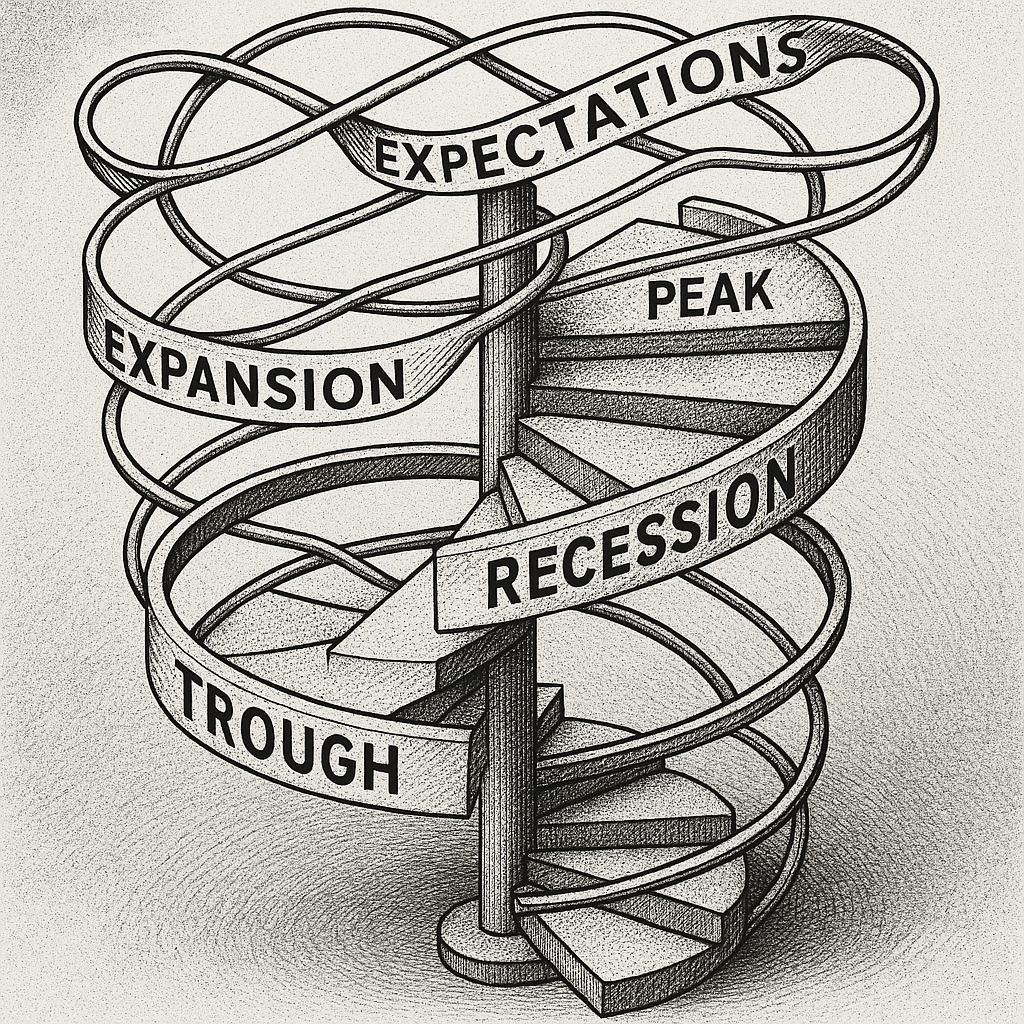
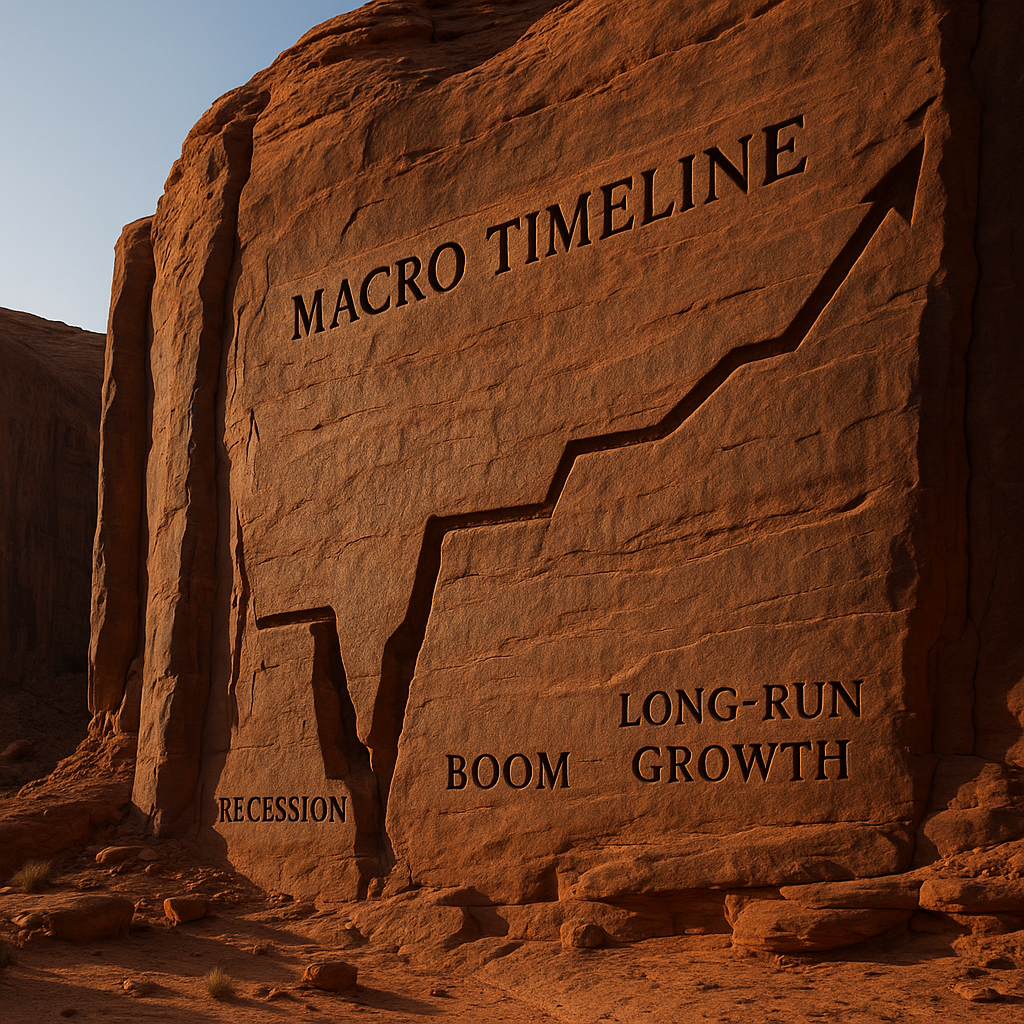
Patterns & Regularities in Aggregation & Dynamics identify the stable, repeatable structures in macroeconomic behavior that any admissible theory must explain. These patterns include recurring features of business cycles—comovement across output, employment, consumption, and investment; systematic leads and lags across aggregates; persistence of deviations from trend; and characteristic recovery profiles. They also include empirical invariants such as long-run growth relationships, Okun’s link between output and unemployment, Phillips-curve patterns in inflation dynamics, stable consumption–income ratios over horizons, cross-country regularities in capital accumulation, and predictable responses of financial conditions to policy changes.
Patterns summarize the consistent empirical relationships that appear across countries, eras, and institutional settings. Invariants mark quantities or structures that remain stable when economies undergo scaling, rebasing, regime shifts, or statistical transformations—for example, trend productivity growth, certain cointegration relationships, or the stability of long-run budget identities.
Together, these features reveal the underlying order in aggregate economic phenomena and impose strict constraints on theoretical explanations. Any model of macroeconomic dynamics must replicate these structural patterns—persistence, comovement, propagation, equilibrium adjustment, and long-run balance—if it is to be considered empirically coherent within the domain.
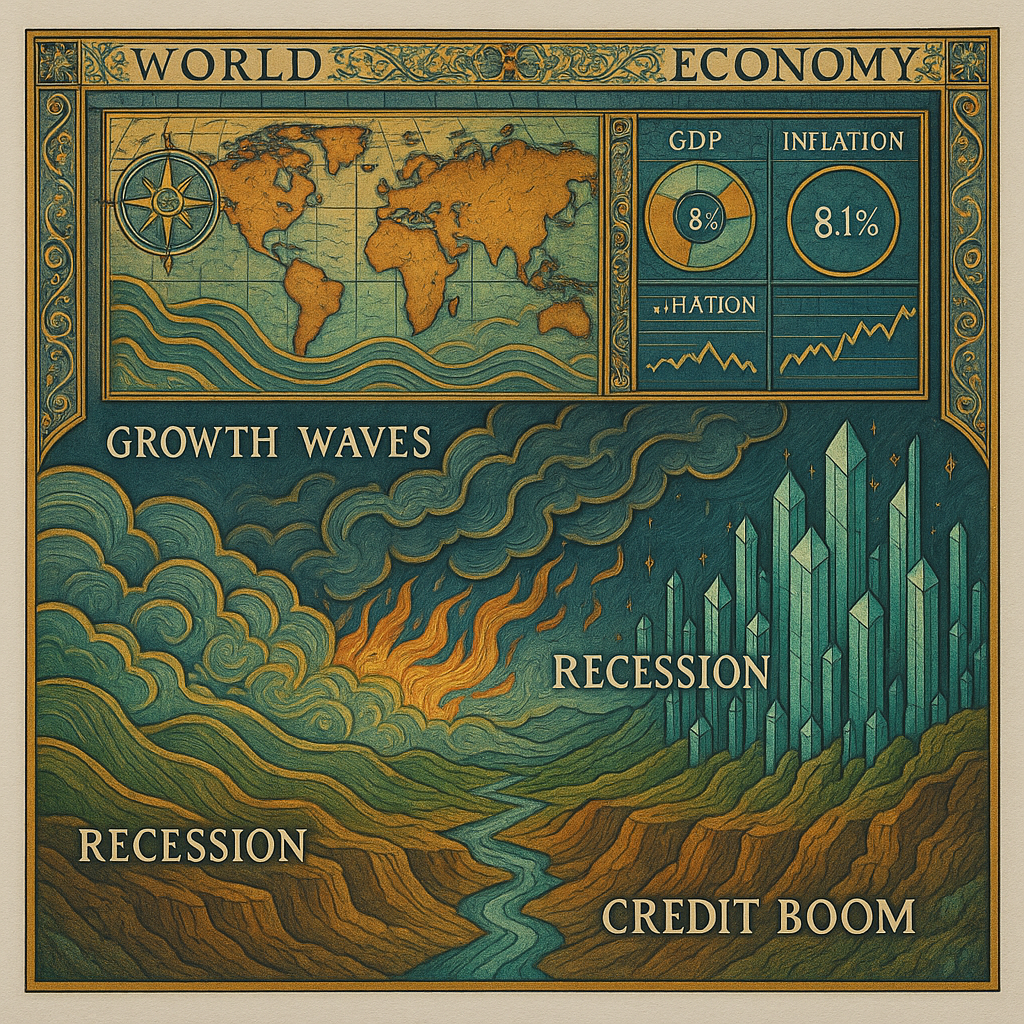
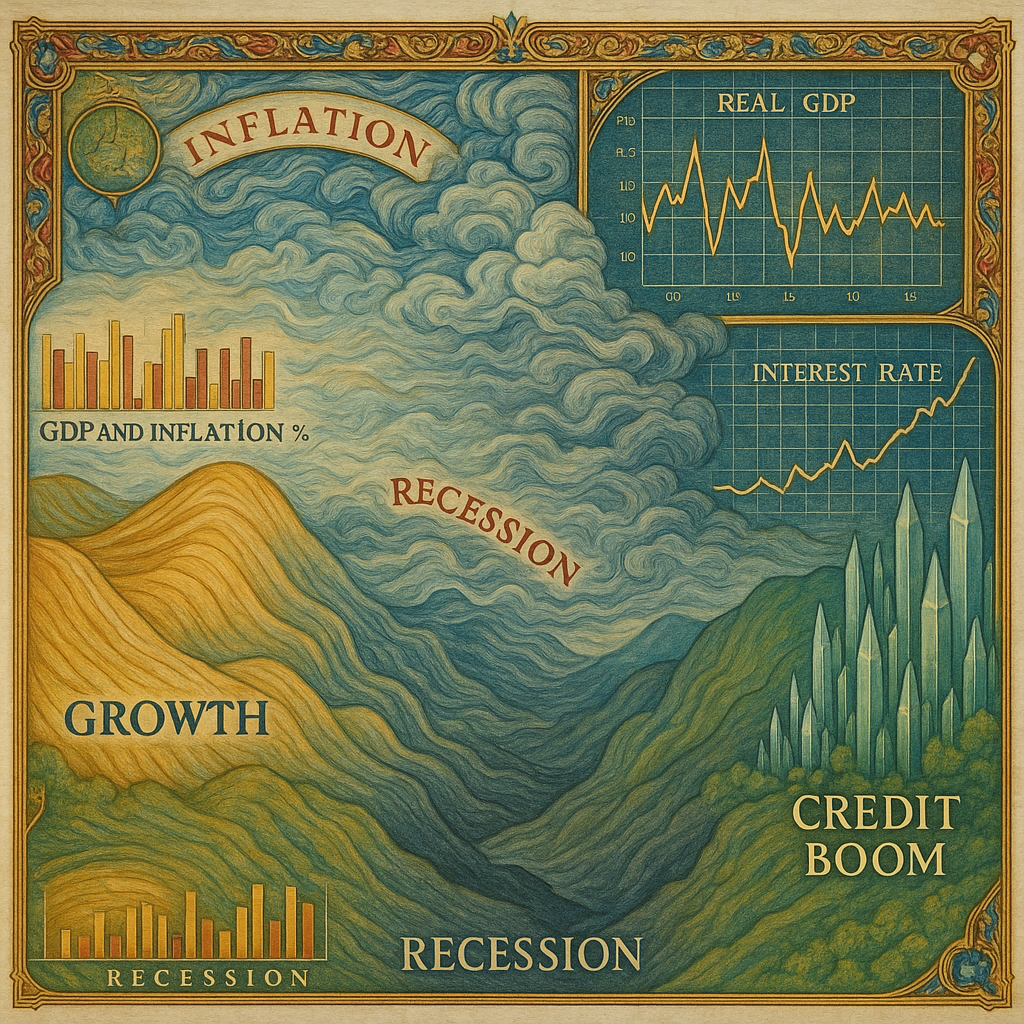
In Aggregation & Dynamics, patterns are the consistent relationships that appear repeatedly in macroeconomic data—regularities that summarize “what happens” at the system level. These include the cyclical comovement of output, employment, and investment; the tendency for consumption to be smoother than income; the persistence of inflation and unemployment; the predictable sequencing of expansions and recessions; and the systematic way monetary and financial conditions propagate through the economy. Patterns also appear across countries and eras: similar recovery shapes after downturns, stable long-run ratios of consumption to output, recurrent relationships between productivity growth and living standards, or common responses of credit cycles to policy shocks. These relationships endure under comparable conditions and are not isolated anomalies—they are the empirical backbone of macroeconomics. Once established, such patterns become constraints any theory must satisfy: business cycles must cohere with observed comovement, inflation models must match persistence, and growth theories must account for long-run scaling behavior. Patterns reveal the system’s underlying order and serve as the empirical signals pointing toward deeper causal structures and mechanisms.
In Aggregation & Dynamics, invariants are the system-level relationships that remain stable even as the economy undergoes shocks, structural adjustments, policy changes, or statistical transformations. They mark the deeper constraints that macroeconomic behavior cannot violate—long-run accounting identities, budget constraints, steady-state growth relations, cointegration patterns, demographic balance conditions, or stable ratios such as capital–output relationships in balanced growth. Some invariants arise from institutional structure (national income must equal expenditure; savings must equal investment in closed economies), while others emerge empirically as robust cross-country or long-horizon regularities (the trend path of productivity growth, long-run neutrality of money, or stable consumption–output ratios over decades).
These invariants function as the macroeconomic equivalent of conservation laws: they sharply restrict how aggregate variables can evolve, rule out impossible system trajectories, and provide anchor points around which more volatile dynamics move. Any macroeconomic model must respect these constraints—violating an invariant signals a conceptual or empirical error. Because invariants indicate the underlying architecture of the system, they help unify macroeconomic phenomena across time and space, revealing the deep structural forces that govern aggregate behavior and distinguishing true dynamics from statistical noise.


3.2 Causal Architecture
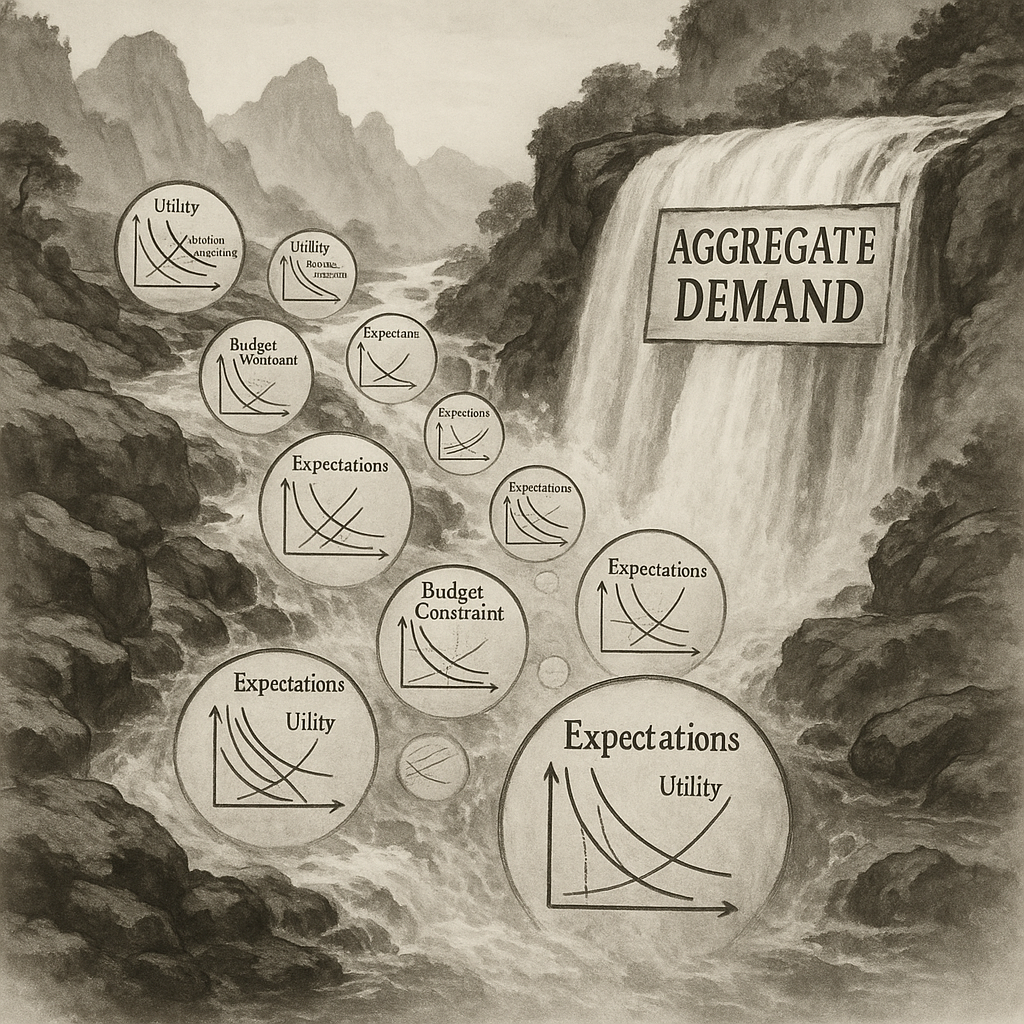
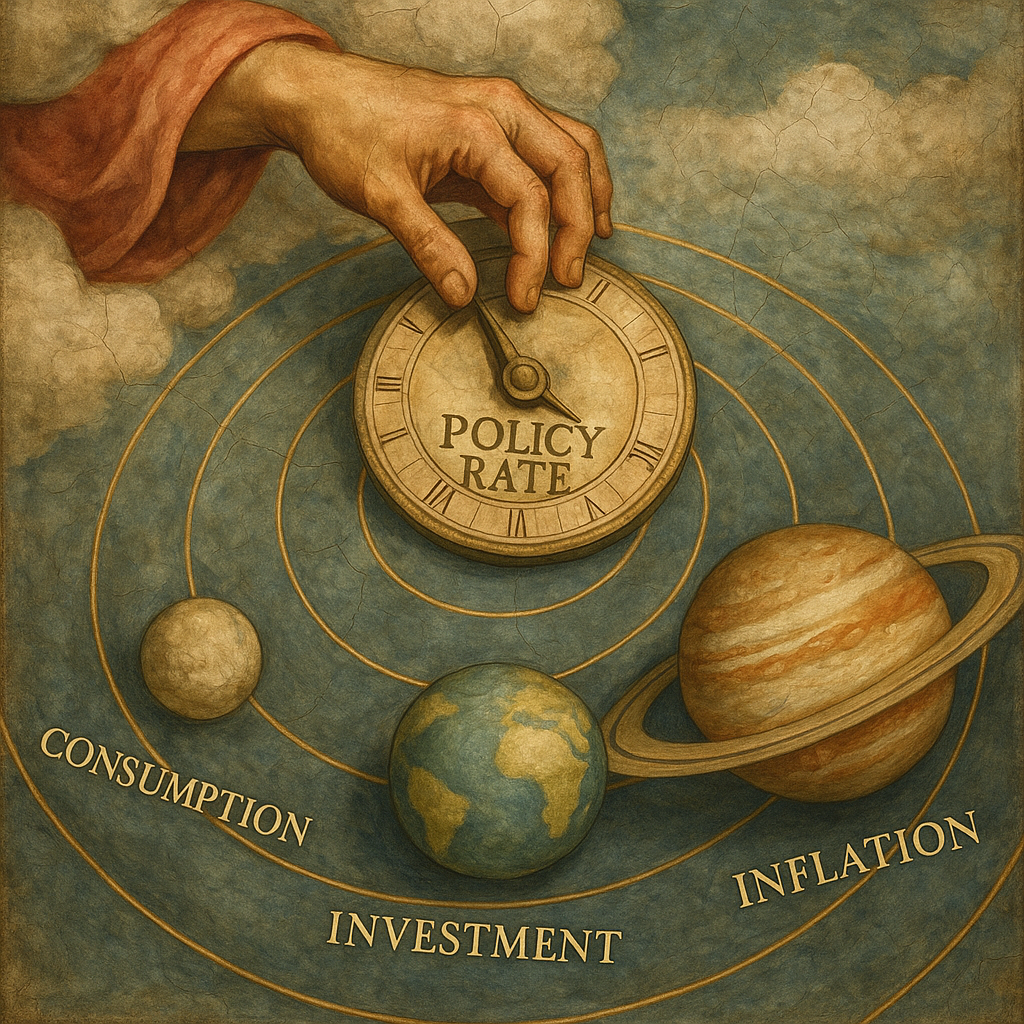
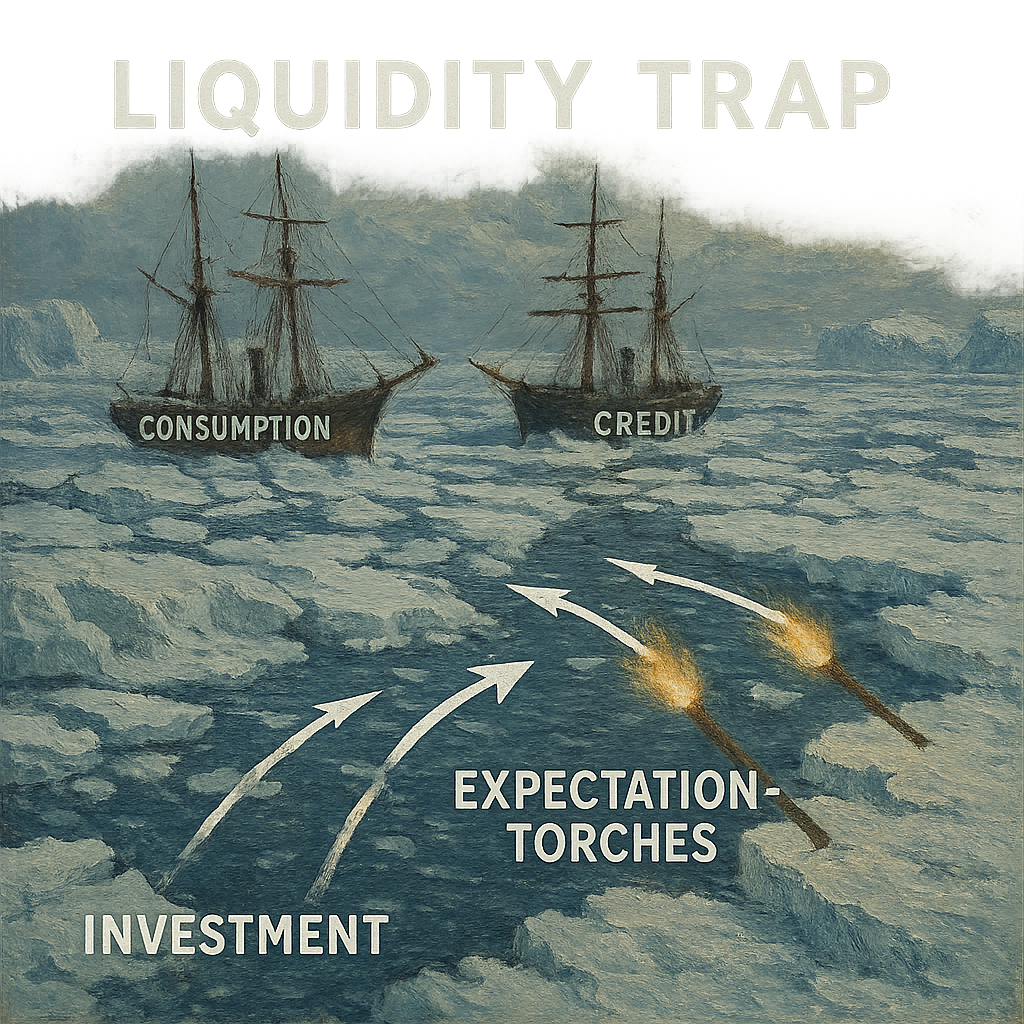
Causal Architecture in Aggregation & Dynamics maps how system-level forces generate the macroeconomic patterns we observe. It identifies the mechanisms—shock transmission, price and wage adjustment, expectation formation, financial amplification, capital accumulation, policy response, and propagation through real and nominal frictions—that produce recurring behavior across aggregates. It then traces the pathways through which these mechanisms operate: how demand shocks move through income and employment, how supply shocks propagate through productivity and relative prices, how financial disturbances travel through leverage, credit channels, and balance-sheet effects, and how policy interventions shape interest rates, expectations, and spending dynamics.
Together, these mechanisms and pathways form the explanatory backbone of macroeconomics: a structured account of how causal forces propagate across households, firms, financial intermediaries, and institutions to yield comovement, persistence, cycles, inflation dynamics, and growth trajectories. A coherent causal architecture specifies not just what relationships hold at the aggregate level, but why—mapping the dynamic, interconnected machinery that drives system-wide behavior.
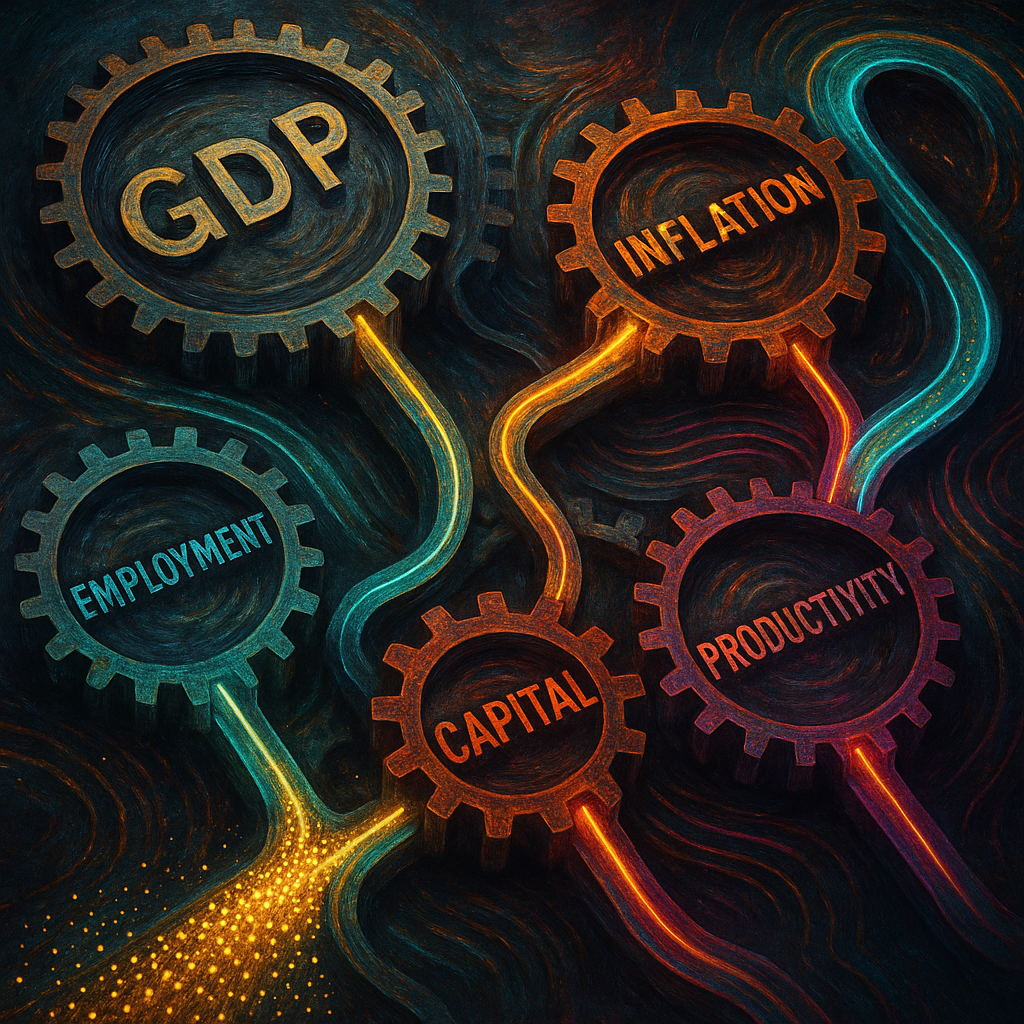
In Aggregation & Dynamics, mechanisms are the internal processes that explain how and why aggregate economic patterns arise. They identify the step-by-step system dynamics that translate shocks into observable movements in output, employment, prices, and financial conditions. These mechanisms include demand propagation (how income changes feed back into spending), supply-side adjustment (how productivity shifts alter costs and output), price and wage setting under nominal rigidities, expectation formation and revision, interest-rate transmission through borrowing and investment, balance-sheet amplification in financial cycles, and capital accumulation shaping long-run growth.
Mechanisms reveal the hidden gears of the macroeconomy: the interplay among households, firms, financial intermediaries, and policy institutions that produces persistence, comovement, inflation dynamics, and cyclical turning points. They allow macroeconomics to move beyond mere correlation—showing not only that variables co-move, but why they co-move in structured, predictable ways. Strong causal mechanisms increase confidence in theoretical models because they demonstrate how specific forces can logically generate system-level outcomes and indicate where interventions—fiscal policy, monetary policy, regulatory action—can alter macroeconomic trajectories.
In Aggregation & Dynamics, pathways trace the sequence or network of causal steps through which macroeconomic forces propagate from an initial disturbance to its final aggregate outcome. Whereas mechanisms describe the local workings of adjustment—price setting, spending responses, credit constraints—pathways chart how these mechanisms connect across sectors, institutions, and time. A demand shock, for example, may travel through income changes → consumption responses → inventory adjustments → employment decisions → wage dynamics → inflationary pressure → monetary policy reaction → financial conditions → investment behavior. A supply shock might propagate through productivity shifts → cost structures → relative prices → sectoral reallocations → wage bargaining → potential output revisions.
Pathways make explicit that macroeconomic outcomes rarely result from a single direct cause; they emerge from chains of intermediate steps distributed across households, firms, financial markets, and policy institutions. Mapping these pathways identifies leverage points where the system can amplify or dampen disturbances, clarifies how shocks in one domain (financial, real, external, policy) appear in another, and reveals where the sequence may stall or break. Understanding pathways gives macroeconomics predictive structure: perturbations can be traced forward through their transmission routes, and interventions can be designed to modify specific links in the causal chain.



3.3 Theoretical Vocabulary
Theoretical Vocabulary in Aggregation & Dynamics provides the conceptual language through which macroeconomic systems are described, analyzed, and explained. It defines the core concepts—output gaps, potential output, business cycles, shocks, frictions, expectations, equilibria, persistence, propagation, transmission mechanisms, financial amplification, nominal rigidities, and steady-state growth—that form the domain’s fundamental ideas. It also establishes the classification schemes that organize aggregates and relationships into coherent structures: types of shocks (demand, supply, financial, policy), types of frictions (nominal, real, informational, financial), types of equilibria (static, dynamic, rational expectations, stochastic steady states), and categories of macroeconomic variables (stocks vs. flows, real vs. nominal, trend vs. cycle).
Together, this vocabulary supplies the terms, distinctions, and taxonomies through which macroeconomic theory is expressed, communicated, and extended. It stabilizes meaning across models, enables precise formulation of causal and dynamic claims, and provides the conceptual scaffolding that allows diverse empirical findings and theoretical mechanisms to be integrated into a unified system-level framework.
In Aggregation & Dynamics, core concepts are the central theoretical terms that structure how macroeconomists describe and reason about system-level behavior. They include aggregates such as output, consumption, investment, employment, prices, wages, and productivity; dynamic constructs such as business cycles, persistence, propagation, expectations, equilibria, and steady states; structural elements such as shocks, frictions, transmission mechanisms, multipliers, and adjustment dynamics; and long-run anchors such as trend growth, capital accumulation, demographic structure, and potential output. These concepts carry the domain’s theoretical weight: they appear in its fundamental equations of motion, its stability conditions, its policy frameworks, and its empirical decompositions.
Precisely defined core concepts allow macroeconomists to communicate complex system behavior succinctly and unambiguously, ensuring that discussions of “inflation,” “output gap,” “financial conditions,” or “neutral interest rate” refer to well-specified objects. They also shape inquiry itself: the vocabulary of shocks, frictions, and equilibria frames how causal questions are posed, what mechanisms are considered plausible, and which explanations are judged coherent. Identifying and stabilizing these core concepts is essential for maintaining a unified theoretical language through which macroeconomic evidence, models, and predictions can be integrated into a cohesive understanding of aggregate dynamics.
In Aggregation & Dynamics, classification schemes organize the domain’s concepts, entities, and relationships into structured taxonomies that make sense of the diversity of macroeconomic phenomena. These schemes sort shocks into types (demand, supply, financial, external, policy), categorize frictions (nominal rigidities, real rigidities, informational frictions, credit constraints), distinguish variables (real vs. nominal, stocks vs. flows, trend vs. cycle), and delineate equilibria (static, dynamic, rational expectations, stochastic steady states). They also classify policy regimes (inflation targeting, fixed exchange rates, discretionary fiscal systems), propagation mechanisms (multiplier effects, interest rate channels, balance-sheet channels), and macroeconomic environments (closed vs. open economies, frictionless vs. frictional settings).
Such classification systems bring order to the complexity of macroeconomic behavior: they highlight similarities across seemingly different phenomena, make differences analytically explicit, and allow researchers to infer properties from an object’s place within the taxonomy. Like taxonomies in biology or the periodic table in chemistry, macroeconomic classification schemes often reveal deeper structural principles—how shocks relate to propagation channels, how frictions constrain adjustment, or how equilibria vary across institutional settings. Explicit classification provides a coherent organizational map that any macroeconomic theory must respect and helps integrate diverse models and empirical findings into a unified system-level framework.


3.4 Formal Representations
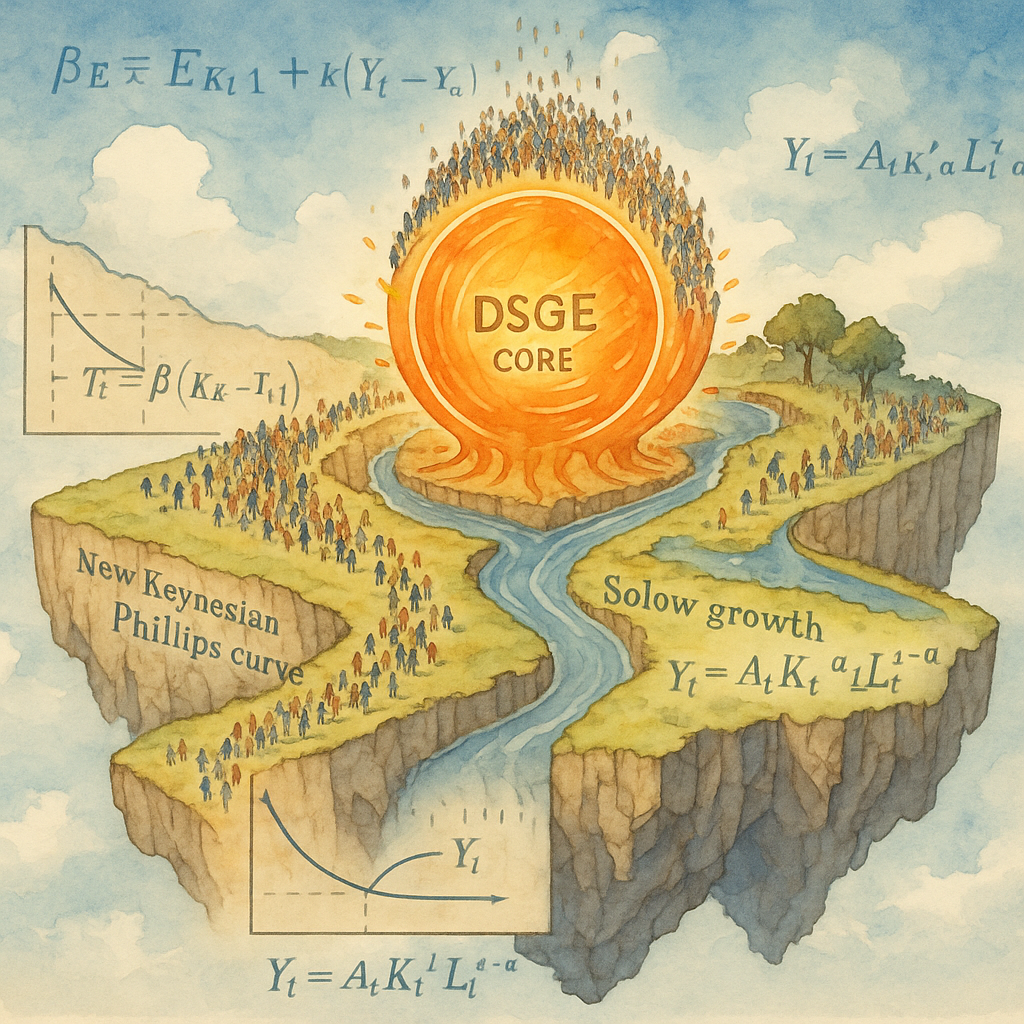
Formal Representations in Aggregation & Dynamics provide the precise mathematical and structural machinery through which macroeconomic theory expresses its commitments. Equations encode dynamic relationships among aggregates—laws of motion for output, capital, prices, wages, productivity, and expectations; equilibrium conditions linking consumption, investment, interest rates, and policy rules; accounting identities that bind sectoral flows; and stability conditions that characterize long-run behavior. Models integrate these variables and rules into coherent structures: DSGE frameworks, VAR systems, state-space representations, growth models, overlapping-generations models, financial accelerator models, and open-economy macro architectures.
These representations translate macroeconomic concepts into calculable, testable forms that support simulation, prediction, counterfactual analysis, and causal inference. They specify exactly how shocks propagate, how frictions shape adjustment, how expectations influence dynamics, and how policy interventions alter system trajectories. Formal representations ensure internal coherence by making assumptions explicit; they ensure empirical relevance by generating patterns and dynamics that can be directly compared to data. In Aggregation & Dynamics, they form the technical backbone of explanation—turning theoretical architecture into operational models capable of illuminating system-wide behavior.
In Aggregation & Dynamics, equations are the mathematical statements that encode the core structural relationships governing macroeconomic behavior. They formalize how aggregates evolve, interact, and respond to shocks. These include dynamic laws of motion for output, capital, consumption, investment, prices, wages, and productivity; budget and accounting identities linking income, expenditure, and financial flows; equilibrium conditions balancing supply and demand across markets; Euler equations capturing intertemporal optimization; Phillips-curve relationships describing inflation dynamics; Taylor rules formalizing monetary policy behavior; and stochastic processes governing shocks and expectations.
By translating macroeconomic concepts into precise mathematical form, equations allow researchers to derive predictions, enforce internal consistency, and test theoretical claims directly against data. They reveal hidden assumptions, constrain allowable dynamics, and make explicit the conditions under which models behave in stable or unstable ways. Equations also enable simulation, counterfactual analysis, and scenario evaluation, giving Aggregation & Dynamics the quantitative backbone required for rigorous, predictive system-level reasoning. In this domain, the presence of an established equation signals not just conceptual clarity but a mature, empirically testable theoretical relationship.
In Aggregation & Dynamics, models are integrated representations of the macroeconomic system that combine variables, equations, behavioral rules, shocks, and structural assumptions into a coherent whole. They provide the operational environment in which theories are tested, mechanisms explored, and predictions generated. Macroeconomic models take many forms: DSGE frameworks that embed intertemporal optimization and frictions; VAR and SVAR systems that capture empirical dynamics; state-space models for filtering and estimation; growth models that characterize long-run evolution; overlapping-generations models that incorporate demographic structure; financial accelerator and balance-sheet models that link real and financial cycles; and open-economy models that map international transmission channels.
Unlike single equations, a model specifies the entire causal and dynamic architecture of the system—how aggregates interact, how shocks propagate, how expectations form, how constraints bind, and how policy interventions shift trajectories. Models allow macroeconomists to simulate counterfactual scenarios, analyze stability and equilibrium properties, assess policy effects, and explore how theoretical assumptions translate into observable outcomes. They also serve as conceptual sandboxes: by adjusting frictions, altering shock processes, or modifying behavioral rules, researchers probe the structure of the economy and identify which components are essential or dispensable. In Aggregation & Dynamics, well-defined models are indispensable—they turn theoretical commitments into testable, predictive, and structurally interpretable representations of the aggregate economy.


3.5 Idealized Structures
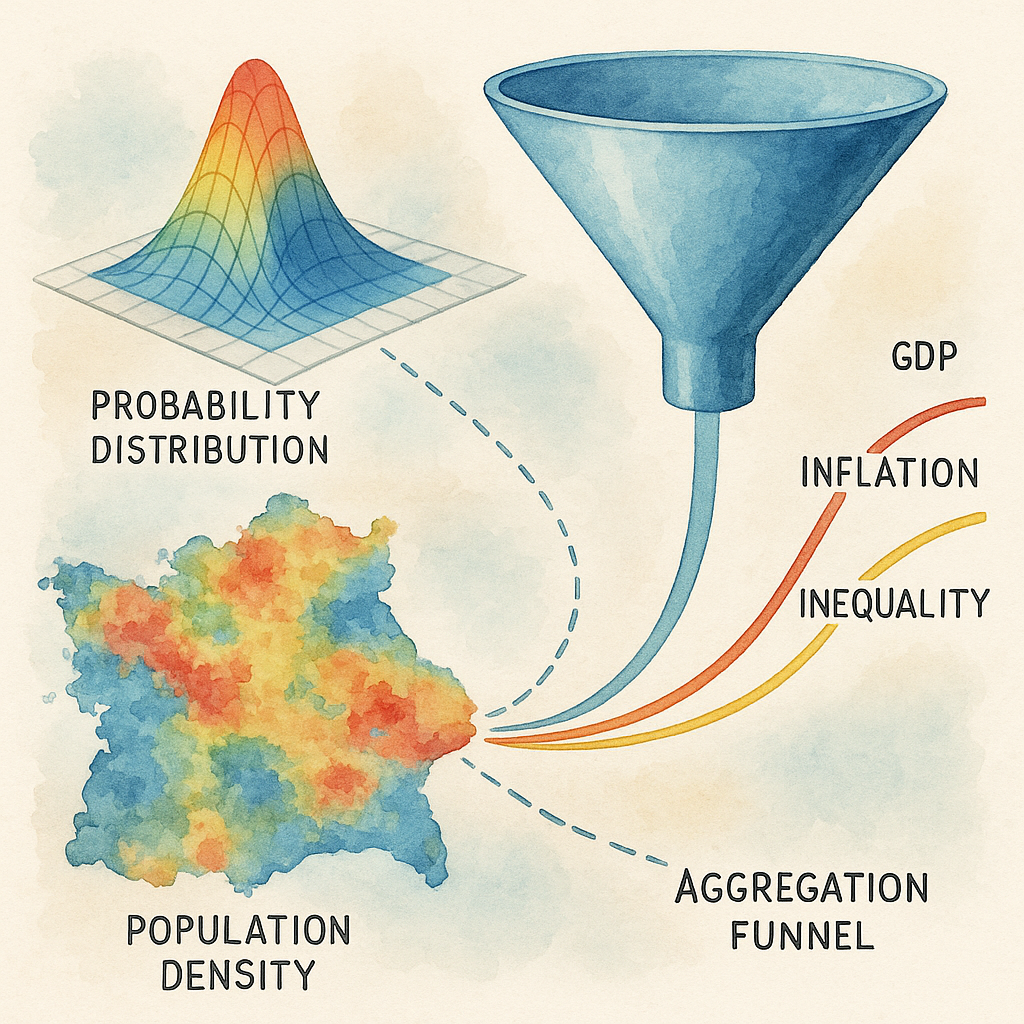
Idealized Structures in Aggregation & Dynamics formalize the abstractions that make the analysis of large, heterogeneous economies tractable. They include representative-agent constructions, frictionless benchmark models, linearizations around steady states, rational expectations equilibria, simplified shock processes, and reduced-form propagation systems. These structures strip away institutional detail, distributional complexity, nonlinear adjustment, and informational heterogeneity to isolate the essential dynamics that drive comovement, persistence, cyclical behavior, and long-run growth.
Regimes of validity specify the conditions under which these abstractions hold—linear approximations near equilibrium points, representative agents when heterogeneity is inessential, rational expectations when forecasting rules are stable, or frictionless settings when studying long-run neutrality. Outside those regimes—during crises, structural breaks, distributional shifts, or nonlinear amplification—idealized structures must be refined or replaced by richer models that incorporate financial frictions, bounded rationality, heterogeneity, or nonlinear dynamics.
Together, simplified structures and their validity boundaries define the controlled distance between macroeconomic theory and reality that allows for calculation, explanation, prediction, and simulation. They are the disciplined approximations that give Aggregation & Dynamics its analytical power without severing it from empirical relevance.
In Aggregation & Dynamics, simplified models (abstractions) are the idealized theoretical constructions that make macroeconomic systems analytically manageable. They deliberately strip away layers of real-world complexity to expose the essential dynamics that drive aggregate behavior. Examples include frictionless benchmark economies with flexible prices and wages, representative-agent models that collapse heterogeneous populations into a unified decision-maker, rational expectations frameworks that assume stable forecasting rules, linearized systems that approximate nonlinear dynamics near equilibrium, and stylized shock processes that reduce the messiness of real disturbances to tractable stochastic forms.
These abstractions isolate core mechanisms—propagation, amplification, adjustment, and equilibrium restoration—without being overwhelmed by institutional detail, distributional heterogeneity, or nonlinear feedbacks. Their purpose is not realism but clarity: they provide the conceptual skeleton upon which intuition and formal results are developed. They serve as stepping stones for deeper analysis, teaching tools for understanding macroeconomic foundations, and baselines against which richer models can be compared.
Yet every abstraction carries assumptions that bound its validity. Documenting these assumptions is essential for scientific clarity, ensuring others can judge when an idealized structure illuminates macroeconomic behavior and when it oversimplifies. In practice, macroeconomists begin with simplified structures to derive clean insights, then relax assumptions—adding frictions, heterogeneity, financial interactions, or nonlinearities—to bring models closer to the complexity of real economies.
In Aggregation & Dynamics, regimes of validity identify the conditions under which a particular idealized macroeconomic structure provides accurate and meaningful insights—and the conditions under which it must be replaced by a different representation. Linearized models are valid near steady states or small deviations but fail during crises, structural breaks, or nonlinear amplification episodes. Representative-agent frameworks work when distributional differences are immaterial for aggregate outcomes, but break down when inequality, heterogeneous balance sheets, or sectoral asymmetries drive system dynamics. Frictionless benchmark models approximate long-run relationships but misrepresent short-run adjustment when nominal rigidities, credit constraints, or informational frictions dominate. Rational expectations models perform well in stable policy regimes but fail when expectations are unstable or subject to structural change.
By mapping these regimes, macroeconomists build an atlas of models—each chart valid in its region—rather than relying on a single, universally applicable structure. Explicitly stating regimes of validity prevents misapplication of benchmark models in inappropriate contexts and highlights where richer frameworks or alternative theories are required. It reflects a mature theoretical stance: understanding the limits of abstraction, knowing when to shift modeling strategies, and recognizing that aggregate behavior can occupy qualitatively different dynamic regimes depending on economic conditions, institutional settings, and shock environments.

3.6 Integrative Frameworks
Integrative Frameworks in Aggregation & Dynamics situate macroeconomic theory within the broader architecture of economic explanation and its adjacent scientific domains. Unifying theories connect disparate mechanisms—business cycle dynamics, inflation processes, financial propagation, growth behavior, and policy effects—under deeper structural principles such as intertemporal optimization, general equilibrium constraints, national accounting identities, and dynamic stability conditions. These frameworks reconcile short-run fluctuations with long-run growth, link monetary and real sectors through coherent transmission mechanisms, and integrate heterogeneous empirical regularities into unified dynamic models.
Interdisciplinary links anchor macroeconomics to fields whose concepts it must engage to remain complete. Microeconomics provides foundations for preferences, technologies, and behavioral rules; finance contributes balance-sheet dynamics, risk transmission, and expectations formation; labor economics offers insights into wage setting and employment adjustment; international economics supplies exchange-rate, capital-flow, and external-balance mechanisms; political economy and institutional analysis explain policy regimes and regime shifts; and applied statistics and econometrics provide the inferential machinery for estimating and testing system behavior.
Together, these integrative structures ensure coherence across scales—from individuals to aggregates—and across systems—from domestic economies to global networks. They position Aggregation & Dynamics within the wider landscape of knowledge, allowing macroeconomic theory to draw on deeper principles, communicate across disciplines, and provide explanations that are structurally consistent, empirically grounded, and intellectually unified.
In Aggregation & Dynamics, unifying theories are the overarching frameworks that connect what initially appear to be disparate macroeconomic phenomena—cycles, growth, inflation, financial instability, policy transmission—under deeper structural principles. These theories reduce the number of independent assumptions needed to understand the aggregate economy by revealing how seemingly distinct behaviors stem from shared mechanisms. Examples include general equilibrium theory, which unifies household, firm, and market interactions into a coherent system; intertemporal optimization frameworks, which link consumption, investment, and policy responses across time; monetary and fiscal transmission models that unify price dynamics, expectations, and aggregate demand; and dynamic stability principles that connect business-cycle fluctuations with long-run growth behavior.
Unifying theories bring coherence by showing that the same structural forces—frictions, shocks, expectations, constraints, propagation channels—explain a wide range of macroeconomic outcomes. They allow insights developed in one sub-field (e.g., finance, labor, or international economics) to carry over to others through shared underlying principles. They also guide the construction of models that integrate real, nominal, and financial sectors into a single explanatory architecture. In Aggregation & Dynamics, unifying theories are prized because they reveal the underlying simplicity beneath complex system behavior, enhance predictive power, and ensure that macroeconomic explanations remain internally consistent and connected across time horizons, sectors, and institutional settings.
In Aggregation & Dynamics, interdisciplinary links recognize that macroeconomic phenomena span multiple domains of knowledge and often cannot be understood solely through macroeconomic tools. Microeconomics provides the behavioral foundations for consumption, labor supply, firm dynamics, and price setting. Finance contributes models of risk, leverage, asset pricing, balance-sheet constraints, and amplification mechanisms that shape both cycles and crises. Labor economics informs wage formation, employment adjustment, and human-capital dynamics. International economics supplies exchange-rate behavior, capital flows, global spillovers, and balance-of-payments constraints. Political economy and institutional economics explain policy regimes, credibility, governance structures, and regime shifts. Econometrics and statistics provide the inferential machinery that translates macroeconomic data into testable claims. Even fields outside economics—such as network theory, complexity science, psychology, and demography—contribute crucial insights into propagation channels, expectation formation, social dynamics, and long-term structural change.
These interdisciplinary connections ensure that macroeconomics remains grounded in the broader landscape of explanatory systems, allowing it to import mechanisms, validate assumptions, and integrate evidence across scales. They also enable macroeconomic theory to influence neighboring fields, providing frameworks for understanding systemic risk, long-run development, and policy design. Interdisciplinary links thus prevent Aggregation & Dynamics from becoming a closed theoretical silo, instead embedding it within the wider scientific architecture required to explain complex, interdependent economies.