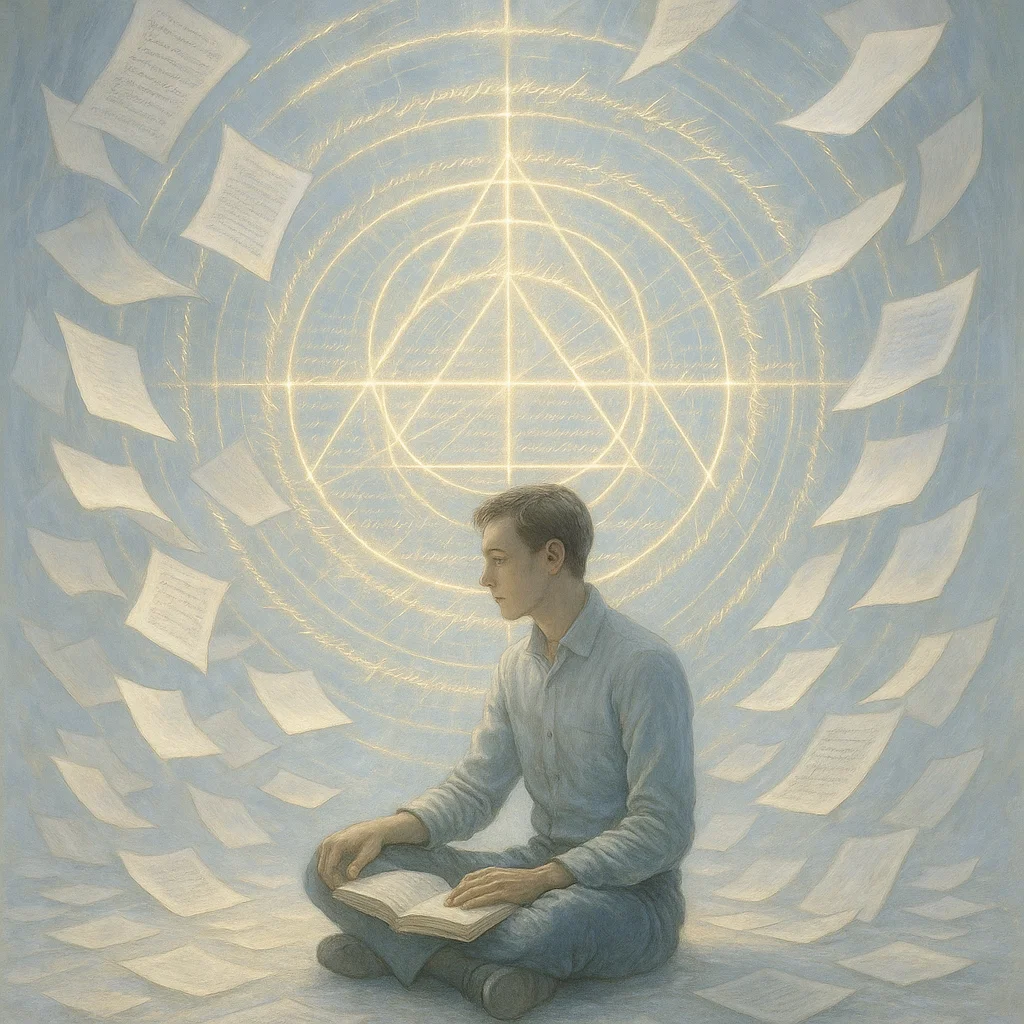
The Essay is thinking in written motion.
It is the literary form of deliberate reflection, where an individual mind works through an idea in public.
Where myth asserts and drama enacts, the essay examines.
Essential Characteristics
- Exploratory Structure – The essay does not begin with certainty; it advances through inquiry.
- Personal Intellect – A thinking voice is present, but disciplined.
- Reasoned Movement – Ideas unfold through association, contrast, and clarification.
- Provisionality – Conclusions are offered, not imposed.
- Style as Thought – How something is said reflects how it is understood.
List of Essays



Cognitive Function
The essay models thinking itself.
It allows humans to:
- Test ideas without final commitment
- Examine assumptions
- Trace reasoning step by step
- Refine belief through articulation
Cognitively, the essay is reason made visible.
Relationship to Language
In the essay:
- Language is analytical but flexible
- Precision matters, but so does tone
- Metaphor may serve reasoning, not replace it
The essay lives between poetry and philosophy.
Structural Modes
Essays organize thought through recurring approaches:
- Personal Essay – Experience as lens for insight
- Critical Essay – Evaluation of ideas, texts, or systems
- Philosophical Essay – Conceptual exploration
- Scientific / Analytical Essay – Structured reasoning and evidence
- Meditative Essay – Slow inquiry into meaning or value
These are modes of inquiry, not genres.




Epistemological Status
The essay is a transitional epistemology.
It bridges:
- Intuition and argument
- Experience and abstraction
- Individual insight and shared reason
It is how thought learns to trust itself.
Boundary Condition
The essay ends when reasoning becomes rigid system.
It begins where a mind says: “Let me see if this is true.”