This section specifies the actual coordinates of the system’s state in each field: the concrete quantities that must be given at a moment in time to say “this is the condition of the system.” These variables are measurable or at least well-defined—positions, fields, temperatures, concentrations, stresses, populations, prices, activation levels, network indices, and so on. For every science, this row identifies which subset of its properties are promoted to state-variables, meaning they are the inputs to its laws of motion, balance equations, or update rules. Once these variables are fixed, the field’s dynamics can, in principle, determine how the system evolves.
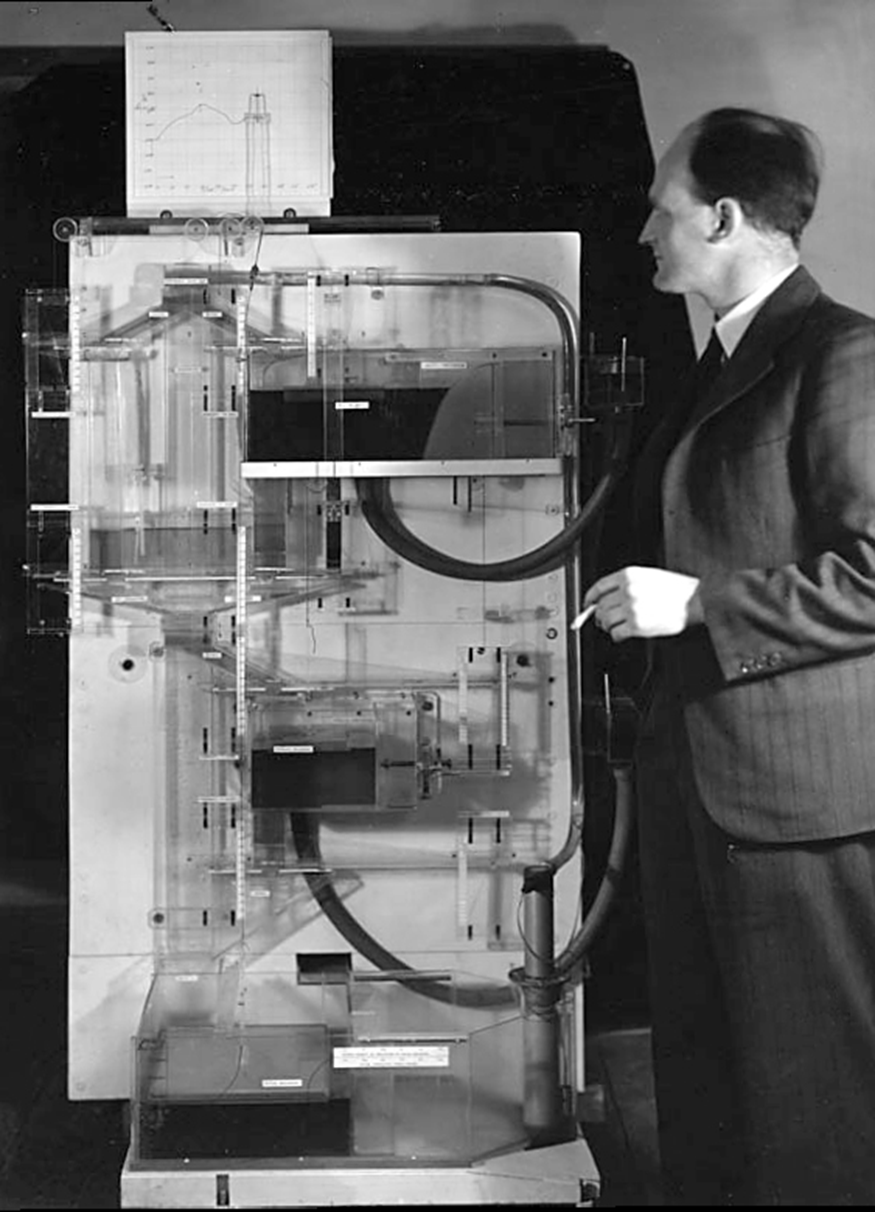
Figure 1: An example of an analogical model bridging disciplines – the Phillips Hydraulic Computer (MONIAC). This analog computer built in 1949 uses water flowing through tanks and pipes to simulate an economy’s monetary flows. Water height in a tank represents economic quantities (e.g. national income “stock” as water volume, and flow through
Science Analysis Template
Below are the results of cycles 1 & 2 of The Science Project
State variables are a set of quantities used to characterize the state of a system at a given time, such that their values, along with input information, determine the system’s future behavior. In other words, knowing the state variables of a system provides enough information to predict its evolution (absent external disturbances).
Major Types of State Variables and Their Cross-Disciplinary Occurrence
Below are identified several major types or categories of state variables and define each. We then discuss how each type manifests in multiple scientific domains. Despite differences in the physical meaning of these variables in each context, we will see recurring abstract roles they play in modeling.
Charges and Quantized Quantities
Definition: Charge in physics refers to a property (like electric charge) that causes forces (electromagnetism) and is conserved. More generally, we might extend “charge” to mean any quantized conserved unit that accumulates and produces field-like effects. The primary example is electric charge measured in coulombs. Other uses of the term within physics include color charge in quantum chromodynamics (though that’s abstract and doesn’t have a classical analogy), or even “charge” as an accounting unit (like in queueing theory one might accumulate “charge” as backlog). In everyday use, to charge can mean to load or fill with some quantity (as in “charging a battery” or even “charging money” meaning billing). We will focus on electric charge and analogous notions of conserved quantities in other fields.
Summary: Charge in the literal sense is specific to physics and chemistry (and underlying biology via physics). Its broader significance to our theme is as a conserved count that acts as a source for fields/forces. The abstract pattern here is the idea of conservation laws and source variables in field theories. Many systems have something conserved (like total mass-energy, total probability, total population in a closed ecosystem, total money in a closed economy, etc.) and associated “fields” or influences that spread out (gravitational field, diffusion field, price adjustments). Recognizing conservation is crucial: e.g. in population models, total population might be conserved in absence of births/deaths (just redistributed among compartments), akin to charge conservation in different capacitors. Conservation gives powerful predictive power because it restricts possible state changes (no net loss/gain, only redistribution or flux across boundaries). Modeling strategies often start by identifying conserved state variables (mass, energy, charge, individuals) and writing continuity equations for them (rate of change = inflows – outflows), which is a universal approach from physics to ecology. Charges also highlight the pattern of source-sink dynamics: positive and negative sources, etc., which could be analogous to birth (source) and death (sink) in population or income (source) and expenditure (sink) in wealth. All these parallels stem from the deep mathematical similarities in conservation laws.
Concentrations (and Gradients)
Definition: Concentration is a subtype of density focusing on the amount of a substance (or count of entities) per unit volume. We treat it separately because in many contexts (especially chemistry and biology) “concentration” is the preferred term and it specifically implies a well-mixed quantity in a volume (whereas density could be spatially varying or refer to mass). Concentration typically has units like mol/L or individuals/L, etc., and often one considers concentration gradients as drivers for diffusion. Concentration is essentially a number density, but its frequent usage in chemical and biological sciences warrants special attention.
Summary: Concentration is essentially the specific case of density concerning mixtures or countable entities. Its recurrence across fields underlines the universal idea of “per-volume measure” and the significance of gradients. A unifying theme is that flows are driven by concentration differences: chemicals diffuse down concentration gradients, organisms move from low to high resource concentration, heat moves from high to low temperature (temperature itself is proportional to concentration of thermal energy quanta in some interpretations), and so on. This is an example of a general modeling pattern: gradient-driven flux – whether it’s concentration, pressure, or potential, differences cause movement. Concentration variables are central to any model of transport or mixing and thus show up in disciplines that deal with fluids, gases, populations, or networks. The wide use of concentration also highlights the concept of local vs global state: one can speak of local concentrations (varying in space), which introduces the idea of fields in physics and spatial structure in ecology. Many cross-disciplinary equations (like Fick’s law in diffusion, analogous to Fourier’s law of heat conduction, or even migration equations in ecology) share the same mathematical form with concentration or density as the driving variable. This commonality reveals a deep connection in modeling strategies: treat the system as having a continuous distribution described by a density, and model changes via partial differential equations representing conservation of that quantity (matter, organisms, probability, etc.).
Densities and Distributions
Definition: Density generally refers to an amount of some quantity per unit of space. This could be mass per volume, number of entities per area, probability per outcome range, etc. Densities are intensive variables – they characterize a distribution without depending on the total size of the system. Common examples include mass density in physics, number density in chemistry, and population density in ecology.
Summary: Density-type variables recur across disciplines as measures of “stuff per space.” They allow modeling of systems where local interactions or crowding matter: from mass creating pressure in physics to individuals creating competition in ecology. Mathematically, many diffusion, flow, or distribution models rely on densities (be it charge density producing electric fields, or population density producing growth or migration). These variables often enter equations through their gradients – a common functional role is that differences in density drive fluxes: e.g. concentration gradients drive diffusion of chemicals, pressure gradients drive fluid flow (see Pressures below), and population density differences can drive migration. The abstraction of density thus provides a unifying concept for systems as diverse as gases, solutions, and populations.
Energies and Related Quantities
Definition: Energy is a measure of the capacity to do work or cause change. It is an extensive state variable (dependent on system size) in many physical systems, often conserved or transferred between forms. The concept of energy (and related potentials) has been exported to other domains as an abstract quantity that systems seek to minimize or that constrains their behavior. Forms of energy in physics include kinetic, potential, thermal (internal) energy, etc. Analogous concepts appear in chemistry (enthalpy, free energy), biology (metabolic energy, ATP), neuroscience (electrochemical potential energy), and even in computational or economic contexts (objective functions or utility as analogs of energy).
Summary: Energy-like variables are a prime example of abstraction across sciences. They illustrate conservation laws and optimization principles that are widespread. Many systems, whether physical, chemical, or even biological, are intelligible through the idea that something (energy, free energy, analogous “potential”) is minimized or conserved. Epistemologically, that suggests scientists seek unifying principles (like least energy) to explain why systems tend toward certain states (equilibria, optima). Recurring use of energy and its variants across disciplines indicates a powerful modeling strategy: define a scalar function of state (energy, fitness, cost) that encapsulates the system’s tendencies. However, caution is needed in analogies (a point returned to later): not everything that maximizes some utility truly behaves like physical energy minimization. Nonetheless, the successes – e.g. statistical mechanics being applied to evolutionary biology by mapping fitness to negative energy – are striking. In that PNAS analogy, “fitness” in an evolutionary model played a role like negative energy in a statistical physics model, and population size acted like the inverse of temperature controlling fluctuations. Such cross-disciplinary mappings of energy concepts have deepened understanding, suggesting that at an abstract level, many systems can be viewed through a common lens of energetic or pseudo-energetic considerations.
Pressures and Intensities
Definition: Pressure is force per unit area in physics, an intensive variable representing how concentrated a force or impulse is on a surface. More generally, “pressure” can denote any kind of intensity or tension in a system that may drive a flow. For example, we colloquially say “selection pressure” in biology or “peer pressure” in social contexts to mean a force-like influence. Formally, in physical sciences pressure has units (Pascals = N/m²) and is a state variable in thermodynamics. Analogous intensive variables include stress (force per area within solids), partial pressure of gases (a measure of concentration producing pressure), osmotic pressure (pressure from solute concentration), and in electronics, voltage (which is potential difference, conceptually akin to an “electrical pressure” pushing charge). We consider pressure-type variables as those that drive flows from high to low levels when a difference exists.
Summary: Pressure-type variables highlight the role of gradients and forces in systems. A pressure difference (or any intensity difference) drives a flow until it equilibrates – this is a pervasive theme. In a generalized sense, any system has some “generalized forces” and “generalized flows” – pressure is force/area causing volume flow in fluids, voltage is force/charge causing current flow, concentration difference is force/mole causing diffusion, etc. The recurrence of this pattern suggests that formulating a problem in terms of an intensive variable (pressure, potential, tension) and an associated extensive variable (volume, charge, quantity moved) is fruitful across science. It also relates to how we explain causation: a difference in pressure causes motion, a difference in potential causes current – similarly, one might say a difference in opinion fraction causes social change, or a difference in fitness causes evolutionary change. Those analogies can be made formal (e.g. Fisher’s fundamental theorem in evolution can be seen as a variance “pressure” driving mean fitness increase). On the epistemological side, pressure demonstrates how scientific fields abstract the idea of a “driving force.” This concept is central in crosscutting teaching: students learn that “energy and matter: flows, cycles, and conservation” involves understanding what drives the flows. Pressure is one such driver in physical flows; recognizing analogous drivers in other contexts (like selection pressure in evolution) can help in interdisciplinary thinking, albeit one must be careful to quantify it properly if making it a real state variable.
Rates and Flows
Definition: Rate refers to the change in a quantity per unit time (or occasionally per another quantity). Rates are often derivatives of state variables with respect to time, or they describe frequencies of events. In dynamic models, rates typically appear as the time-derivatives of state variables (e.g. ,
), representing how fast the state changes. We also consider fluxes or flows – amounts per time crossing a boundary – as closely related to rates. In many systems, state variables (stocks) are increased or decreased by flow variables (rates). Common examples: velocity (rate of change of position), growth rate of a population, reaction rate in chemistry, firing rate of neurons, or economic inflation rate.
Summary: Rate-type variables (including fluxes) are fundamentally about dynamics – how systems change. Across disciplines, we see that specifying the rates of change of state variables is key to building predictive models. In fact, formulating a problem in terms of state variables and their time-evolution (derivatives) is the hallmark of dynamical modeling. Whether it’s Newton’s law or a logistic growth, an equation relating to the current state encapsulates a cause-and-effect mechanism. The recurrence of rate-based formulations underscores a shared modeling strategy: one identifies important state quantities and then posits rules for their change (often through other state variables or external inputs). These rules often have similar mathematical forms across fields (exponential decay in radioactive nuclei, first-order chemical decay, and population decline are formally analogous). By comparing rates across fields, we also see how different sciences handle stability and change – a crosscutting concept: “conditions of stability and determinants of rates of change… are critical elements of study” in any system. Moreover, distinguishing between state variables (levels) and rates (changes) provides insight into causation: in ecology and other fields, thinking in terms of rates forces one to identify underlying processes (birth, death, etc.) rather than just correlating state variables. This approach aligns with seeking mechanisms and not just patterns.
Functional Roles of State Variables in Modeling and Explanation
Having surveyed the common types of state variables, we now compare their functional roles in system modeling across disciplines. In general, state variables serve as the bookkeepers of system state – by tracking them, one can predict future behavior. They often correspond to physically or conceptually conserved quantities, or to accumulations that integrate the history of processes. Their functional roles can be categorized in a few broad ways:
- Descriptors of System State for Prediction: State variables define the state space of a model. In a dynamical system, the current values of state variables are enough to determine future evolution (given the governing equations and inputs). This is true whether we are modeling a swinging pendulum (state = angle and angular velocity) or an economy (state = stocks of capital, employment, etc.). The function of state variables here is to provide a minimal, sufficient summary of the past (through their current value) so that we can compute what happens next. For example, knowing the present population size and resources may allow us to project next year’s population. In control theory and engineering, selecting appropriate state variables is crucial to construct a state-space model that can be simulated or controlled. Across fields, this often means choosing variables that follow first-order differential (or difference) equations. This formalism is widely applicable – from classical mechanics (Hamiltonian form) to ecology (Lotka-Volterra equations) to economics (state-space representation of macro models). Thus, state variables function as the fundamental coordinates in which a system’s laws are written. They enable quantitative prediction when plugged into those laws.
- Intermediaries for Causal Mechanisms: State variables often link causes to effects in a model. Instead of saying “X causes Z directly,” a mechanistic model might say “X changes state variable Y, which in turn affects Z.” For instance, in physiology: exercise (X) raises body temperature (Y, a state variable), which triggers sweating to cool down (effect Z). Here temperature is a state variable mediating cause and effect. In ecology, predator introduction (X) increases predation rate (affecting prey population state Y), which causes prey decline (Z). By explicitly modeling state variables, we insert causal intermediates that give explanatory power. Compare this to a purely statistical model that might correlate X and Z; the state-variable-centric model can explain how X leads to Z through changes in Y. This aligns with the scientific quest for mechanisms. In dynamic modeling, one typically doesn’t say “predators cause prey to decline in one step,” but rather “predators increase prey mortality (a rate), thus prey population declines over time as reflected in the state variable for prey density.” The state variable (prey density) and its rate equation embody the causal story: cause operates through changing the rate of change of a state variable. Across disciplines, we see similar mediating roles: temperature as a state variable mediates between energy input and reaction rate in chemistry (Arrhenius law), or between greenhouse gas emissions and climate effects; electrical charge mediates between voltage applied and current flow (charging a capacitor takes time, with charge being the intermediate state). By adjusting state variables and seeing how the system responds, scientists infer causal structure (e.g. charge buildup causes voltage rise, which causes current decrease, etc.). Thus, state variables frequently serve as the loci of cause-effect relationships in models – they are where processes (forces, reactions, decisions) have their impact.
- Conserved Quantities and Constraints: Many state variables represent conserved quantities or are governed by conservation laws (mass, energy, charge, probability, individuals in absence of birth/death, money in closed economy). These act as constraints on system behavior, adding predictive power and cross-linking equations. In modeling terms, conservation laws often lead to differential equations of continuity that are similar in form across domains (e.g. continuity equation in fluid mechanics vs. population balance equation in ecology). The functional role of these state variables is to enforce consistency: you cannot get mass or individuals from nowhere. This carries over to stochastic domains too – e.g. total probability in a probabilistic model is conserved at 1, so state variables like probability densities are constrained (normalization condition). Economists enforcing budget constraints are likewise applying a conservation-of-money principle in models. In thermodynamics, recognizing energy as a conserved state variable (first law) and entropy as non-decreasing (second law) allows modelers to rule out impossible processes and identify equilibrium (minimum free energy). Therefore, one major function of certain state variables is to act as bookkeepers that ensure accounting consistency of some fundamental quantity. This makes models more robust and broadly applicable (conservation is a general principle not tied to specific material).
- Drivers of Flows and Equilibria: Some state variables, especially intensive variables (pressure, temperature, chemical potential, voltage), serve as drivers that push the system toward equilibrium. When such variables differ in different parts of a system or between system and environment, they drive flows until equilibrium (equalization) is reached. For example, pressure differences drive fluid flow until pressures equalize; temperature differences drive heat flow until temperatures equalize; voltage differences drive current until charges redistribute and voltage equilibrates. In epidemiology, the difference between current susceptible fraction and herd immunity threshold is an “intensity” driving infection spread until equilibrium (herd immunity) is reached. These analogies show a common modeling idea: define an intensive state variable that indicates the system’s deviation from equilibrium; then model flow rates as responses to gradients in that variable. Consequently, the system will evolve (via those flows) to reduce the gradient – achieving balance (equal pressure, equal temperature, etc.). This is essentially Lagrange’s approach to equilibrium: many equilibria are found by setting intensive variables equal across the system (no more net flow). Thus, the role of these state variables is both descriptive (quantifying intensity) and normative (the system “seeks” a configuration where this variable is uniform, reflecting stability). In economics, prices can be thought of similarly: price differences cause arbitrage flows, and at equilibrium, a single price prevails (analogous to pressure equalization).
- Measures of System Performance or Fitness: In some models, a particular state variable is singled out as a measure of the system’s overall performance or goal. For example, in biology, population fitness or total population could be seen as a measure of success; in engineering, energy or efficiency might be a performance metric. These variables often drive optimization: e.g. evolutionary models might assume traits change to maximize fitness (a state variable) – akin to a system finding a peak in a fitness landscape. In neuroscience, free-energy is used as a measure that the brain tries to minimize (a “self-organizing” principle where the state variable free-energy has a special minimizing role). In machine learning, which can be considered an extension of computational science, a loss function (analogous to negative performance) is defined and treated like a state variable of the network+data system that is driven downward by learning dynamics. So across disciplines, sometimes a state variable doubles as a Lyapunov function or objective function that the dynamics seem to optimize. The functional role here is that such a variable encodes the outcome of interest, and the system’s behavior can be understood as attempting to extremize that variable (maximize or minimize). Physicists see this with energy (minimize energy), economists with utility/profit (maximize utility), biologists with fitness (maximize reproductive success in some models). While not every system literally optimizes (and one must be cautious with teleological interpretations), modeling often purposefully defines these variables to succinctly describe why a process goes in a certain direction (because it increases efficiency, decreases free-energy, etc.). They serve as summaries of many interactions in a single scalar quantity that either increases or decreases – providing an explanatory thread (e.g. “this ecosystem successional change can be seen as increasing total biomass until a steady state,” analogous to an increase in entropy in closed systems). In education, highlighting such common tendencies (growth to carrying capacity, relaxation to minimum energy, etc.) can reveal an abstract principle of stability and change.
In summary, state variables play analogous roles in modeling across fields by: (a) capturing the minimal information needed for prediction; (b) serving as nodes where causal mechanisms act and interact; (c) enforcing conservation laws and thus constraining dynamics; (d) acting as potentials or intensities that drive flows and determine equilibria; and (e) providing global measures of system behavior (like objectives that systems tend toward extremizing). These functions are deeply interrelated. For instance, because energy is conserved and tends to distribute, it can serve as both a constraint and a measure that the system minimizes to reach equilibrium – hence energy as state variable covers (c), (d), and (e) at once in physics. Likewise, population in ecology is conserved (with births/deaths adding/removing), differences in population density cause flows (migration) or growth changes, and total population or fitness might be seen as something that tends to maximize under certain conditions. This kind of parallel suggests a profound structural similarity in how we approach complex systems: we identify key quantities, track their changes with equations (often ensuring none disappear mysteriously), look at differences in those quantities to drive fluxes, and sometimes find a single quantity that encapsulates what the system is doing overall. This is essentially the toolkit of system dynamics and is common to physics, chemistry, engineering, and increasing in adoption in biological and social sciences as well.
Another important functional aspect is modularity and hierarchy: state variables allow us to break systems into components and subsystems. For example, in modeling a human body, we might treat blood pressure, body temperature, and blood sugar each as state variables of sub-systems (circulatory, thermoregulatory, metabolic). Each follows its dynamics but they interrelate (via exercise affecting all, etc.). This modular approach is mirrored in engineering (multi-state system with interacting state variables) and ecology (multi-species models). The recurrence of similar state variable types means one can sometimes borrow modeling modules across fields: a population model (stock-flow) might be repurposed to model chemical reactor volume and flow (with appropriate interpretation). This modularity underscores that state variables function as the interfaces between different processes: they are common “languages” different processes speak (e.g. mechanical and thermal processes meet at energy; biological and chemical processes meet at concentrations and energy, etc.).
Epistemological Implications of Recurring State-Variable Patterns
The observation that diverse sciences use analogous state variables and modeling patterns has significant epistemological implications. It suggests that there are abstract, formal structures underlying many apparently different phenomena. This touches on themes of model generality, analogy, and unity of science:
- Modeling Strategies and the Search for Universality: Scientists often seek general models that can apply to multiple systems. The recurring patterns in state variables hint at the existence of “models of second degree order”, i.e. models of properties common to many specific models. This idea was expressed in systems theory: for example, “regulation in general is a global model including the basics of many specific regulations in different disciplines”. In our context, the stock-and-flow (state variable and rate) structure is a candidate for such a general model. The epistemology here is that by abstracting away domain-specific details, one can capture the essence of dynamics in a form that is widely applicable (e.g. a logistic growth model can describe populations, adoption of innovation, the spread of a rumor, or filling of a container – if one interprets variables appropriately). This reflects a stance that nature (and human systems) may operate according to a limited set of principles or patterns, which we can mathematically formulate. It aligns with the reductionist or at least unifying ambition in science: that there is a “limited and universal set of fundamental interactions” and common formal structures underlying processes across scales. The recurrence of variables like energy, rate, density across disciplines supports this: it’s not a coincidence but rather because those concepts truly matter in a broad range of contexts. Some philosophers and scientists (e.g. proponents of general system theory) argue that recognizing such crosscutting patterns provides a kind of transdisciplinary metalanguage – a shared framework that can facilitate communication among disciplines. Indeed, terms like energy, flow, feedback have become part of a general scientific vocabulary used in fields from engineering to sociology (think of phrases like “information flow” or “energy of a social movement”), illustrating conceptual unification.
- Analogies and Formal Correspondences: The use of similar state variables encourages analogical reasoning across domains. Historically, analogies have led to breakthroughs: the hydraulic model of an economy (Phillips’ MONIAC machine) was literally a physical analogy where water flowing through tanks represented money flows in the economy. This analogical model didn’t just entertain people; it provided insights and a teaching tool for macroeconomics. It exemplifies what philosophers call a formal analogy: where two systems share the same abstract relationships despite differing in physical substance. The billiard ball model of a gas (atoms as hard spheres) or the predator-prey model in economics (firms and consumers interact like predators and prey) are other examples. Recurring state variables are a big part of making such analogies work – one can map population <-> particle number, or money stock <-> water volume, etc. When these mappings hold, one system’s behavior can be studied to infer the other’s (to an extent). Epistemologically, this raises questions: are these analogies merely convenient metaphors, or do they indicate isomorphisms in the structure of reality? If many systems can be cast as, say, a set of coupled oscillators or as optimization of some “energy” function, one might speculate a deep unity (some even attempt theories of everything by extending concepts like free energy minimization to life and mind). On the other hand, caution is warranted: analogies can mislead if taken too literally. As J.W. Sutherland warned, one should avoid “unwarranted and assumptive reductionism… based on sweeping and invalid analogies”. In practice, modelers must always check where an analogy breaks down. For instance, treating an economy exactly like a fluid with pressure and volume can fail because human agents don’t behave like molecules. Yet, partial analogies (like conservation of money analogous to conservation of mass) can still hold in certain domains or models. So, one implication is that while recurring patterns hint at common underlying logics, applying models across domains is a creative but careful enterprise. It demands identifying which aspects of the analogy are meaningful and which are not.
- Abstraction and Generalizability: The fact that we can discuss “state variables” in the abstract, without tethering to a single discipline’s definition, points to the power of abstraction in science. By focusing on form (mathematical structure) over content (specific material), scientists can generalize findings. For example, a stability analysis of a fixed point in a predator-prey model uses the same math as stability of an equilibrium in chemical kinetics or in a supply-demand model. Thus, techniques (e.g. linearization, finding eigenvalues) and insights (e.g. the possibility of oscillations or multiple equilibria) transfer readily. This cross-applicability accelerates knowledge growth – one field can borrow the tools of another. As evidence, many ecologists and epidemiologists have imported differential equation models directly from chemistry and physics traditions. Similarly, economists have drawn from statistical physics (Boltzmann distributions for wealth) and from control theory (state-space methods for macroeconomic forecasting). The epistemological view here is that models are not mirrors of reality but tools, and good tools often work on multiple problems. The recurring abstract patterns are precisely what make a model tool widely useful. A formal model that captures an essential feedback loop or conservation law can often be redeployed in a new context with minor adaptations. This suggests a kind of structural realism – that the structure captured by these models is what’s truly real or fundamental, more so than the specific objects. Whether or not one subscribes to that philosophy, practically it means scientists value models that scale and generalize, and recurring state variables are indicators of such models. In short, recognizing these patterns enhances our confidence that we understand something fundamental about how systems work (because it works in so many contexts).
- Limits and Domain-Specificity: On the flip side, noting common patterns also highlights what’s different between fields. For instance, energy is rigorously defined and conserved in physics, but “energy” in an economic or cognitive sense may not be conserved or even quantifiable in units. By comparing, we see the boundary: physics deals with concrete measurable quantities, whereas social sciences often use analogies that can’t be measured with the same precision. This has an epistemological implication: it underscores the importance of operationalization – how a concept is defined and measured in each field. A state variable only gains scientific meaning if we can measure it or at least define it consistently. In thermodynamics, pressure is measured by a gauge; in psychology, “stress level” might be measured by a survey – clearly a different level of objectivity. Thus, while we strive for unified modeling, the methods of validation and scope of applicability of state variables differ. Recognizing recurring patterns should not blind us to necessary specializations and context. In the philosophy of science terms, models involve idealizations and abstractions; using the same abstraction in a new domain might require stronger idealizations (which could reduce realism). For example, treating individuals like particles (each with identical rules of interaction) is an idealization that may lose aspects of human behavior. Therefore, one implication is the need for multi-level modeling: understanding how high-level phenomena (like social behavior) relate to lower-level patterns (like physics-like interactions) is complex. Sometimes the analogy is only at the mathematical level, not a direct correspondence of entities. A sophisticated epistemic stance is to see these models as partial maps of reality – useful in certain regimes.
- Interdisciplinary Insights and Metaphors: These recurring patterns also reveal the role of metaphor and cross-disciplinary pollination in scientific creativity. Phrases such as “the brain is an inference machine that conforms to the same principles that govern the interrogation of scientific data” or “value is synonymous with negative free-energy” show a deliberate attempt to unify concepts across neuroscience, economics, and physics. Epistemologically, one might ask: is this just a turn of phrase, or does it point to a deep principle? If the latter, it may guide new research (indeed, Friston’s free energy principle has spurred much work in neuroscience). Similarly, analogies like network flows in computers and circulation in organisms have led to concepts of “information metabolism”. These are not just poetic; they generate hypotheses (e.g. maybe the brain really does perform a form of Bayesian inference because it follows free-energy minimization). The recurring state variables serve as bridges for these analogies. By quantifying something in one field (like entropy in information theory) and seeing the same formula appear in another (entropy in statistical mechanics), scientists discovered a profound connection (that information entropy and thermodynamic entropy are linked). Thus, recurring patterns can hint at unifyable concepts (Shannon information measured in bits turned out to be directly proportional to physical entropy measured in Boltzmann’s constant units under certain interpretations, establishing a field of thermodynamic information). Such connections are epistemologically rich: they can lead to new fields (e.g. econophysics, biophysics, sociophysics all emerged from noticing shared variables and math).
- Philosophy of Science – Models as Analogues: The Stanford Encyclopedia of Philosophy discusses analogical models, noting examples like the hydraulic model of economics and how analogies can be based on shared relations rather than shared material properties. Our analysis confirms that many scientific models are indeed built on formal analogies. This supports a view that understanding in science often comes from finding isomorphic structures between different phenomena. It may also suggest a kind of pragmatism: we use whatever model works, and if a model from physics works for ecology, we use it, not because rabbits are literally molecules, but because the model’s predictions hold approximately. This resonates with the idea of model transfer studied in philosophy (models migrating between disciplines and how their interpretation changes).
In conclusion, the recurring patterns in state variables reveal both an encouraging unity and the careful line between analogy and reality. They show that scientists, when faced with complexity, independently invent or converge upon similar representational and analytical strategies – implying those strategies are somehow natural or effective for the world we live in. This strengthens the case for interdisciplinary approaches, where insights from one domain can illuminate another. It also underscores the importance of education and communication: one can talk about “feedback loops” or “state equilibrium” in mixed company of biologists, engineers, and sociologists and find common ground, thanks to these shared concepts. Epistemologically, one might say these patterns are part of the syntax of nature’s language – the fact that nature allows itself to be described in these terms across contexts suggests something about how the world works (or at least how our perception and cognition of the world works, finding patterns everywhere). Yet, as general as these patterns are, truly making them explain phenomena in detail still requires empirical grounding in each domain. Science advances by balancing this generality with specificity, borrowing the general ideas and tailoring them to the particulars.
Across the sciences – from the motion of planets to the growth of populations to the fluctuations of economies – we find recurring patterns in how state variables are used to model and explain phenomena. We identified major categories of state variables (densities, rates, energies, concentrations, pressures, charges, etc.) and illustrated their presence in a variety of fields. This comparative analysis revealed that despite the vast differences in subject matter, many scientific models share a common formal language: conserved stocks that accumulate, flows or rates that cause change, gradients that drive those flows, and potential-like quantities that systems optimize or equilibrate. These patterns are more than coincidental; they reflect underlying principles like conservation laws, feedback and equilibrium, which appear to be nearly universal features of complex systems.
Functionally, state variables enable prediction by encapsulating the system’s condition and linking causes to effects through dynamic laws. They serve as the cornerstone of mechanistic understanding – one cannot articulate “how” a change happens without referencing what state variable changed and at what rate. The comparative tables and discussion highlighted that each discipline, in its own way, harnesses these variables to build explanations and make forecasts, whether it’s an engineer calculating how a capacitor’s voltage changes, or an ecologist calculating how a prey population changes. The similarities in these calculations are striking and instructive.
In closing, the analysis of common state-variable patterns is a testament to the unity and elegance of scientific modeling. Different sciences are like different languages describing the same reality; when we translate between them, we find cognates – similar terms and grammar. State variables are part of that shared grammar of nature’s narratives. Recognizing this can inspire a greater appreciation for both the diversity of phenomena and the underlying order that science strives to uncover. It shows that abstraction is not anathema to understanding – rather, abstraction (when grounded in observation) is our bridge from the particular to the general, from isolated facts to coherent knowledge. The recurring motifs of stocks and flows, forces and balances, growth and decay are the melodies that play throughout the grand symphony of science, each discipline contributing its own instrumentation but all following the same fundamental score.
| Element | ||||
|---|---|---|---|---|
| Scope Category | 1.3 State-Variables | |||
| Sub-Item | Variables | |||
| Science Name Link | Branch Name Link | Field Name Link | Definition | The measurable or definable properties that describe system conditions. |
| Natural Sciences | Physics | Classical Physics | Classical Mechanics | The system’s condition is described by measurable variables: positions (or generalized coordinates), velocities (or momenta), energies, and forces. |
| Natural Sciences | Physics | Classical Physics | Classical Electromagnetism | Electric field E(r,t), magnetic field B(r,t), charge density ρ(r,t), current density J(r,t), electromagnetic potentials, and material parameters (ε, μ, σ) that together describe the instantaneous EM state. |
| Natural Sciences | Physics | Classical Physics | Classical Thermodynamics | The measurable macroscopic quantities defining state: (T, P, V, U, S, H, G, F), along with material-specific properties like compressibility and heat capacity. |
| Natural Sciences | Physics | Classical Physics | Statistical Mechanics (Classical) | Microscopic variables (positions and momenta of all particles) and macroscopic variables (T, P, V, N, E, S). Probability distributions over phase space (ρ(q,p)) serve as state descriptors. |
| Natural Sciences | Physics | Classical Physics | Optics (Classical Wave Theory) | Optical field values (E(\mathbf{r},t)), (B(\mathbf{r},t)); wavelength λ; frequency ν; refractive index n; intensity I; phase φ; wavevector k; polarization vectors; coherence functions. |
| Natural Sciences | Physics | Classical Physics | Acoustics | Pressure variation p(r,t), particle velocity u(r,t), density variation rho(r,t), frequency, wavelength, intensity, and phase, describing the instantaneous acoustic state. |
| Natural Sciences | Physics | Classical Physics | Continuum Mechanics | Velocity field v(x,t), deformation measures, stress tensor, strain tensor, density, pressure, temperature, and other measurable quantities describing the instantaneous material state. |
| Natural Sciences | Physics | Classical Physics | Classical Field Theory | Field values at each point in space and time, field derivatives, potentials, source densities, energy and momentum densities, and field configuration data describing the instantaneous global state. |
| Natural Sciences | Physics | Classical Physics | Pre-Relativistic Frameworks | Positions, velocities, accelerations, forces, energy, momentum, pressure, field intensities (in pre-Maxwellian theories), density of continuous media, and wave amplitudes defined relative to absolute time and space. |
| Natural Sciences | Physics | Modern & Fundamental Physics | Quantum Mechanics | Quantum state (wavefunction or density matrix), probabilities, expectation values, energy levels, spin states, potential parameters, and measurement outcomes. |
| Natural Sciences | Physics | Modern & Fundamental Physics | Relativistic Quantum Mechanics | Relativistic wavefunction components, probability densities, probability currents, spin components, relativistic energy values, and parameters defining external potentials. |
| Natural Sciences | Physics | Modern & Fundamental Physics | Special Relativity | Position, time, velocity, relativistic energy, relativistic momentum, spacetime interval, proper time, and transformation parameters connecting one inertial frame to another. |
| Natural Sciences | Physics | Modern & Fundamental Physics | General Relativity | Metric components, curvature values, stress-energy values, geodesic parameters, gravitational wave amplitudes, and initial conditions specifying spacetime geometry or matter configuration. |
| Natural Sciences | Physics | Modern & Fundamental Physics | Quantum Field Theory (QFT) | Field values, field operators, particle occupation numbers, correlation functions, coupling constants, renormalization scales, and initial or boundary states for scattering processes. |
| Natural Sciences | Physics | Modern & Fundamental Physics | Particle Physics (High-Energy Physics) | Momentum, energy, charge, spin orientation, particle type, decay products, cross-sections, branching ratios, event probabilities, and detector-level quantities like track momentum and energy deposition. |
| Natural Sciences | Physics | Modern & Fundamental Physics | Nuclear Physics | Nuclear energy levels, spin states, binding energies, reaction cross-sections, decay constants, neutron and proton numbers, reaction rates, and measurable properties of nuclear transitions. |
| Natural Sciences | Physics | Modern & Fundamental Physics | Quantum Statistical Physics | Temperature, chemical potential, particle number, occupation numbers, correlation functions, density, entropy, pressure, energy distributions, and order parameters describing phase behavior. |
| Natural Sciences | Physics | Modern & Fundamental Physics | Quantum Optics | Photon occupation numbers, field amplitudes, quadrature values, polarization states, atomic excitation levels, coherence times, entanglement measures, and cavity parameters such as mode frequency and decay rate. |
| Natural Sciences | Physics | Modern & Fundamental Physics | Quantum Information Science | Quantum state, gate operations, measurement outcomes, error syndromes, entanglement metrics, channel parameters, logical-qubit states, and performance indicators such as fidelity or decoherence rate. |
| Natural Sciences | Physics | Theoretical & Mathematical Physics | Symmetry & Group Theory | Group parameters, representation indices, generator coefficients, transformation matrices, eigenvalues, conserved quantities, and symmetry-related labels for physical states. |
| Natural Sciences | Physics | Theoretical & Mathematical Physics | Gauge Theory | Gauge potentials, matter field values, field strength values, coupling strengths, gauge-fixing parameters, and symmetry-breaking values such as the Higgs field value. |
| Natural Sciences | Physics | Theoretical & Mathematical Physics | String Theory | String vibration states, brane positions, background geometric parameters, coupling constants, and values specifying the shape and size of extra dimensions. |
| Natural Sciences | Physics | Theoretical & Mathematical Physics | Differential Geometry in Physics | Metric components, connection components, curvature quantities, coordinate values, and geometric data defining field configurations. |
| Natural Sciences | Physics | Theoretical & Mathematical Physics | Statistical Field Theory | Field values over space and time, probability distributions, temperature, interaction strengths, correlation lengths, and noise parameters. |
| Natural Sciences | Physics | Condensed Matter & Materials Physics | Mathematical Foundations of Quantum Mechanics | Quantum states, operator values, probability distributions, expectation values, and parameters specifying physical or mathematical configurations. |
| Natural Sciences | Physics | Condensed Matter & Materials Physics | General Mathematical Physics | Variables include fields, coordinates, functional values, system parameters, initial conditions, boundary conditions, and other quantities defining the mathematical state of a physical model. |
| Natural Sciences | Physics | Condensed Matter & Materials Physics | Solid-State Physics | Band occupation numbers, lattice displacement values, defect densities, charge carrier densities, conductivity, magnetization, and thermal variables. |
| Natural Sciences | Physics | Condensed Matter & Materials Physics | Semiconductor Physics | Carrier density, band energies, Fermi level position, electric potential, recombination rate, mobility, temperature, and impurity concentration. |
| Natural Sciences | Physics | Condensed Matter & Materials Physics | Magnetism & Spin Physics | Magnetization, spin polarization, domain configuration, external field strength, temperature, relaxation rate, and anisotropy constants. |
| Natural Sciences | Physics | Condensed Matter & Materials Physics | Superconductivity | Order parameter magnitude, carrier density, temperature, applied field strength, current density, vortex density, and energy gap size. |
| Natural Sciences | Physics | Condensed Matter & Materials Physics | Soft Matter Physics | Density, volume fraction, viscosity, elastic modulus, order parameter, strain, stress, surface tension, and characteristic relaxation times. |
| Natural Sciences | Physics | Condensed Matter & Materials Physics | Nanomaterials & Nanostructures | Particle size, aspect ratio, surface chemistry, carrier density, optical absorption, band energies, mechanical modulus, thermal conductivity, and surface potential. |
| Natural Sciences | Physics | Condensed Matter & Materials Physics | Strongly Correlated Electron Systems | Electron density, spin configuration, interaction parameters, temperature, doping concentration, conductivity, susceptibility, and order parameter magnitudes. |
| Natural Sciences | Physics | Condensed Matter & Materials Physics | Topological Matter | Topological invariant values, carrier density, band gap size, chemical potential, magnetic field strength, symmetry class indicators, and edge or surface state occupancy. |
| Natural Sciences | Physics | Condensed Matter & Materials Physics | Materials Science (Physical Perspective) | Temperature, pressure, composition, defect density, grain size, phase fraction, strain, stress, conductivity, and microstructural descriptors. |
| Natural Sciences | Physics | Astrophysics & Cosmology | Stellar Astrophysics | Central temperature, core density, opacity, luminosity, radius, composition fractions, rotation rate, magnetic field strength, and age. |
| Natural Sciences | Physics | Astrophysics & Cosmology | Galactic Astrophysics | Gas density, temperature, metallicity, star formation rate, rotation curve values, velocity fields, dark matter profile parameters, magnetic field strength, and radiation flux. |
| Natural Sciences | Physics | Astrophysics & Cosmology | Extragalactic Astrophysics | Redshift, luminosity, gas density, temperature, star formation rate, metallicity, velocity fields, halo mass, and clustering strength. |
| Natural Sciences | Physics | Astrophysics & Cosmology | Cosmology | Scale factor, Hubble parameter, density parameters, temperature, curvature, redshift, fluctuation spectrum, and cosmic time. |
| Natural Sciences | Physics | Astrophysics & Cosmology | High-Energy Astrophysics | Photon energy distribution, particle density, magnetic field strength, accretion rate, variability frequency, jet velocity, shock speed, and radiation flux. |
| Natural Sciences | Physics | Astrophysics & Cosmology | Gravitational Astrophysics | Temperature, pressure, density, atmospheric composition, orbital period, eccentricity, inclination, surface composition, internal heat, and stellar flux. |
| Natural Sciences | Physics | Astrophysics & Cosmology | Planetary Science & Exoplanets | Temperature, pressure, density, atmospheric composition, orbital elements, surface features, internal heat production, stellar irradiation level, and rotation rate. |
| Natural Sciences | Physics | Astrophysics & Cosmology | Astrochemistry & Interstellar Medium Physics | Gas density, temperature, ionization fraction, molecular abundance ratios, dust to gas ratio, radiation field strength, pressure, turbulent velocity, and chemical reaction rate coefficients. |
| Natural Sciences | Physics | Astrophysics & Cosmology | Astrobiology | Temperature, pressure, pH, radiation flux, chemical abundance, solvent content, atmospheric gas concentration, bioindicator levels, and environmental stability metrics. |
| Natural Sciences | Physics | Plasma & Fluid Physics | Fluid Dynamics | Velocity components, pressure, density, temperature, vorticity, strain rate, and energy density. |
| Natural Sciences | Physics | Plasma & Fluid Physics | Hydrodynamics (Ideal Fluids) | Velocity field, magnetic field, density, pressure, current density, resistivity, temperature, vorticity, and electric field. |
| Natural Sciences | Physics | Plasma & Fluid Physics | Magnetohydrodynamics (MHD) | Velocity field, magnetic field, electric field, density, pressure, current density, temperature, resistivity, and vorticity. |
| Natural Sciences | Physics | Plasma & Fluid Physics | Plasma Physics (General) | Density, temperature, pressure, velocity, electric field, magnetic field, charge distribution, current density, collision rate, and plasma potential. |
| Natural Sciences | Physics | Plasma & Fluid Physics | Space & Astrophysical Plasmas | Density, temperature, velocity, magnetic field, electric field, current density, pressure, distribution functions, radiation flux, and turbulence amplitude. |
| Natural Sciences | Physics | Plasma & Fluid Physics | Fusion Plasma Physics | Density, temperature, velocity, magnetic field, electric field, current density, pressure, distribution functions, impurity fraction, and edge gradient parameters. |
| Natural Sciences | Physics | Plasma & Fluid Physics | Computational Fluid & Plasma Physics | Density, velocity components, pressure, temperature, magnetic field, electric field, distribution function values, vorticity, current density, and auxiliary numerical variables such as residuals or timestep values. |
| Natural Sciences | Physics | Plasma & Fluid Physics | Non-Newtonian & Complex Fluids | Shear rate, shear stress, strain, strain rate, viscosity, normal stresses, relaxation variables, structural parameters, particle concentration, velocity field, and pressure field. |
| Natural Sciences | Physics | Plasma & Fluid Physics | High-Energy-Density Physics (HEDP) | Density, temperature, pressure, ionization level, radiation flux, velocity field, entropy, shock position, material composition, and opacity. |
| Natural Sciences | Physics | Interdisciplinary & Applied Physics | Biophysics | Concentration, membrane potential, force, displacement, reaction rates, probability of conformational states, diffusion rates, firing rates, pressure, elasticity, and strain. |
| Natural Sciences | Physics | Interdisciplinary & Applied Physics | Medical Physics | Beam energy, dose rate, fluence, detector counts, voxel intensities, attenuation coefficients, field uniformity, decay activity, contrast concentration, and patient positioning parameters. |
| Natural Sciences | Physics | Interdisciplinary & Applied Physics | Geophysics | Temperature, pressure, density, stress, strain, displacement field, fluid saturation, seismic velocity, magnetic field strength, electrical conductivity, and gravitational acceleration. |
| Natural Sciences | Physics | Interdisciplinary & Applied Physics | Optics & Photonics | Electric field amplitude, phase, intensity, polarization state, coherence length, spectral distribution, photon flux, refractive index profile, mode occupation, and beam shape parameters. |
| Natural Sciences | Physics | Interdisciplinary & Applied Physics | Computational Physics | Position arrays, velocity fields, density fields, electric and magnetic fields, wavefunctions, temperature fields, stress tensors, distribution functions, and auxiliary solver variables such as residuals or timesteps. |
| Natural Sciences | Physics | Interdisciplinary & Applied Physics | Engineering Physics | Displacement, velocity, acceleration, stress, strain, temperature, heat flux, current, voltage, charge density, field intensity, wave amplitude, mode occupancy, control inputs, and system response variables. |
| Natural Sciences | Physics | Interdisciplinary & Applied Physics | Chemical Physics | Electron density, nuclear coordinates, molecular orientation, energy levels, temperature, pressure, concentration, reaction progress coordinates, population distributions, and correlation functions. |
| Natural Sciences | Physics | Interdisciplinary & Applied Physics | Environmental & Climate Physics | Temperature field, pressure field, humidity, wind velocity, radiation flux, cloud fraction, sea surface temperature, ocean salinity, greenhouse gas concentration, ice thickness, and energy imbalance. |
| Natural Sciences | Physics | Interdisciplinary & Applied Physics | Applied Materials Physics | Temperature, pressure, stress, strain, defect concentration, carrier density, magnetization state, polarization, phase fraction, chemical potential, and crystallographic orientation. |
| Natural Sciences | Chemistry | Physical Chemistry | Quantum Chemistry | Electron density, nuclear coordinates, orbital occupations, total energy, spin multiplicity, vibrational quantum numbers. |
| Natural Sciences | Chemistry | Physical Chemistry | Statistical Mechanics | Temperature, entropy, pressure, particle number, volume, distribution functions, partition function parameters. |
| Natural Sciences | Chemistry | Physical Chemistry | Thermodynamics | T, P, V, S, U, H, G, F, composition, phase variables, equation-of-state parameters. |
| Natural Sciences | Chemistry | Physical Chemistry | Kinetics & Reaction Dynamics | Concentrations, rate constants, temperature, pressure, reaction progress variables, energy distributions, collisional parameters. |
| Natural Sciences | Chemistry | Physical Chemistry | Spectroscopy | Frequency, wavelength, intensity, linewidth, polarization, phase, delay time, excitation power, environmental conditions. |
| Natural Sciences | Chemistry | Physical Chemistry | Electrochemistry | Electrode potential, current density, concentration profiles, ionic strength, cell voltage, charge, chemical potentials, pH. |
| Natural Sciences | Chemistry | Physical Chemistry | Surface & Interface Science | Surface coverage, adsorption energy, charge density, potential, local composition, roughness, temperature, pressure, interfacial thickness. |
| Natural Sciences | Chemistry | Physical Chemistry | Colloid & Solution Chemistry | Concentration, ionic strength, pH, temperature, dielectric constant, particle-size distribution, zeta potential, turbidity, viscosity. |
| Natural Sciences | Chemistry | Physical Chemistry | Chemical Physics | Coordinates, momenta, energies, quantum numbers, phase-space variables, temperature, density, polarization, field strength. |
| Natural Sciences | Chemistry | Organic Chemistry | Structural & Mechanistic Organic Chemistry | Concentrations, temperature, solvent polarity, substituent parameters, stereochemical configuration, electronic population distributions. |
| Natural Sciences | Chemistry | Organic Chemistry | Stereochemistry & Conformational Analysis | Torsion angles, dihedral angles, bond lengths/angles, energy differences between conformers, population ratios, temperature, steric parameters. |
| Natural Sciences | Chemistry | Organic Chemistry | Synthetic Organic Chemistry | Concentration, temperature, solvent, pH, catalyst loading, oxidant/reductant strength, reaction time, stoichiometry, reagent purity, stereochemical configuration. |
| Natural Sciences | Chemistry | Organic Chemistry | Physical Organic Chemistry | Rate constants, equilibrium constants, activation energies, substituent constants (σ, σ*), solvent polarity, temperature, ionic strength, reaction coordinate position. |
| Natural Sciences | Chemistry | Organic Chemistry | Organometallic Organic Chemistry | Oxidation state, electron count, ligand environment, solvent polarity, temperature, concentration, pressure (especially for gas-involving catalysis), metal–ligand bond strength. |
| Natural Sciences | Chemistry | Organic Chemistry | Polymer Chemistry (Carbon-based) | Conversion, monomer concentration, temperature, pressure, solvent quality, chain length distribution, initiator concentration, propagation/termination rate constants. |
| Natural Sciences | Chemistry | Organic Chemistry | Bioorganic Chemistry | pH, ionic strength, temperature, concentration, redox state, conformational populations, protonation states, solvent polarity (aqueous vs mixed), binding affinities. |
| Natural Sciences | Chemistry | Organic Chemistry | Natural Products Chemistry | Concentration, pH, temperature, solvent polarity, biosynthetic flux, oxidation state, metabolite pool composition, enzyme availability, stereochemical configuration, conformation. |
| Natural Sciences | Chemistry | Organic Chemistry | Medicinal Chemistry | Concentration, pH, ionic strength, logP/logD, binding constants, metabolic turnover rates, plasma protein binding, clearance, half-life, receptor occupancy, redox state. |
| Natural Sciences | Chemistry | Inorganic Chemistry | Main-Group Chemistry | Oxidation state, coordination number, charge, electron count, electronegativity differences, pH, solvent polarity, ionic strength, temperature, pressure. |
| Natural Sciences | Chemistry | Inorganic Chemistry | Transition-Metal Chemistry | Oxidation state, electron count, ligand field strength (Δ), spin multiplicity, coordination number, solvent polarity, pH, redox environment, temperature, pressure. |
| Natural Sciences | Chemistry | Inorganic Chemistry | f-Block Chemistry | Oxidation state, spin state, electron configuration, ligand field strength, ionic radius, solution pH, redox environment, temperature, pressure, solvent polarity, coordination number. |
| Natural Sciences | Chemistry | Inorganic Chemistry | Coordination Chemistry | Oxidation state, electron count, coordination number, ligand field splitting (Δ), spin multiplicity, pH, ionic strength, solvent polarity, redox environment, concentration, temperature. |
| Natural Sciences | Chemistry | Inorganic Chemistry | Solid-State Chemistry | Temperature, pressure, composition, defect density, carrier concentration, phase identity, crystallite size, oxidation state distribution, stoichiometry, lattice parameters. |
| Natural Sciences | Chemistry | Analytical Chemistry | Qualitative Analysis | pH, solvent polarity, temperature, ionic strength, analyte presence/absence, functional-group expression, spectral signal appearance/disappearance, matrix composition. |
| Natural Sciences | Chemistry | Analytical Chemistry | Quantitative Analysis | Analyte concentration, standard concentration, pH, temperature, ionic strength, instrument response, noise level, sample volume/mass, matrix composition, equilibrium conditions. |
| Natural Sciences | Chemistry | Analytical Chemistry | Separation Science | Flow rate, temperature, pressure, voltage, mobile-phase composition, pH, ionic strength, stationary-phase characteristics, viscosity, analyte concentration, retention time. |
| Natural Sciences | Chemistry | Analytical Chemistry | Instrumental Analysis | Wavelength, frequency, m/z, voltage, current, temperature, pressure, flow rate, signal intensity, baseline level, integration time, detector gain, analyte concentration, instrument mode. |
| Natural Sciences | Chemistry | Biochemistry | Structural Biochemistry | Temperature, pH, ionic strength, redox state, ligand concentration, folding state, protonation state, conformational ensemble distribution, hydration shell organization, structural order/disorder. |
| Natural Sciences | Chemistry | Biochemistry | Enzymology | Substrate concentration, enzyme concentration, pH, temperature, ionic strength, redox state, ligand concentration, conformational ensemble, catalytic-site protonation, cofactor availability. |
| Natural Sciences | Chemistry | Biochemistry | Metabolism & Bioenergetics | Metabolite concentrations, redox ratios (NAD⁺/NADH), ATP/ADP/AMP levels, pH, membrane potential (ΔΨ), proton gradient (ΔpH), oxygen availability, enzyme concentrations, flux rates, temperature. |
| Natural Sciences | Chemistry | Biochemistry | Molecular Biology & Gene Expression | Gene expression level, transcript abundance, promoter occupancy, epigenetic modification density, chromatin compaction, ribosome loading, transcription rate, splicing efficiency, RNA turnover rate. |
| Natural Sciences | Chemistry | Biochemistry | Cellular Biochemistry | Compartment-specific pH, redox potential, ion gradients (Ca²⁺, H⁺, Na⁺/K⁺), metabolite pool sizes, enzyme activity states, post-translational modification states, trafficking flux, signaling amplitude/duration. |
| Natural Sciences | Chemistry | Biochemistry | Membrane Biochemistry | Membrane potential (ΔΨ), pH of compartments, ion gradients, lateral lipid composition, membrane tension, curvature, protein conformational state, cholesterol content, diffusion rates, local domain size. |
| Natural Sciences | Chemistry | Biochemistry | Protein Chemistry | pH, temperature, ionic strength, redox environment, PTM occupancy, ligand concentration, folding/unfolding state, conformational ensemble, oligomerization state, solvent polarity, denaturant concentration. |
| Natural Sciences | Chemistry | Biochemistry | Biochemical Genetics | Gene expression level, allele dosage, mutation frequency, enzyme activity, pathway flux, metabolite concentrations, redox balance, compensation capacity, developmental stage, environmental influences. |
| Natural Sciences | Earth & Space Sciences | Geology | Mineralogy & Crystallography | Temperature, pressure, composition, oxidation state, lattice parameters, defect concentration, hydration state, stress, strain, magnetic/electric field exposure. |
| Natural Sciences | Earth & Space Sciences | Geology | Petrology | Temperature, pressure, composition (bulk + mineral), volatile content (H₂O/CO₂/S), oxygen fugacity, melt fraction, grain size, strain, deformation rate, time, fluid activity, reaction progress. |
| Natural Sciences | Earth & Space Sciences | Geology | Structural Geology & Tectonics | Stress magnitude/orientation, strain magnitude/orientation, temperature, pressure, fluid pressure, strain rate, displacement, thickness, viscosity, lithospheric thickness, plate velocity. |
| Natural Sciences | Earth & Space Sciences | Geology | Sedimentology & Stratigraphy | Flow velocity, shear stress, sediment load, grain-size distribution, water depth, accommodation space, subsidence rate, sedimentation rate, sea-level position, chemical saturation state, bioturbation intensity. |
| Natural Sciences | Earth & Space Sciences | Geology | Geomorphology | Slope angle, flow discharge, sediment supply rate, uplift rate, precipitation rate, grain-size distribution, shear stress, ice velocity, soil moisture, temperature, chemical weathering rate, channel geometry. |
| Natural Sciences | Earth & Space Sciences | Geology | Geophysics | Stress, strain, seismic velocity, density, resistivity, temperature, pressure, magnetic field strength, gravity anomaly, displacement, velocity, acceleration, heat-flow rate, viscosity. |
| Natural Sciences | Earth & Space Sciences | Geology | Geochemistry | Temperature, pressure, concentration, activity coefficients, pH, redox potential, partial pressures (CO₂, O₂, H₂), fluid composition, mineral modes, isotope ratios, chemical gradients, saturation indices. |
| Natural Sciences | Earth & Space Sciences | Geology | Paleontology | Sedimentation rate, burial depth, redox conditions, temperature, pressure, decay rate, biological productivity, fossil abundance, diversity, isotopic ratios, stratigraphic ranges, evolutionary rates. |
| Natural Sciences | Earth & Space Sciences | Geology | Hydrogeology | Hydraulic head, pressure, saturation, conductivity, temperature, dissolved-ion concentrations, redox state, pH, salinity, isotopic ratios, contaminant concentrations, recharge flux, discharge flux. |
| Natural Sciences | Earth & Space Sciences | Geology | Economic & Applied Geology | Metal concentrations, fluid temperature/pressure, reservoir pressure, porosity, permeability, saturation, geothermal gradient, structural stress, hydrothermal flow rate, isotopic compositions, alteration mineralogy, grade variability. |
| Natural Sciences | Earth & Space Sciences | Meteorology | Dynamic Meteorology | Core variables: wind components (u, v, w), pressure, density, temperature, potential temperature, geopotential height, moisture variables, and vorticity measures. |
| Natural Sciences | Earth & Space Sciences | Meteorology | Thermodynamic Meteorology | Temperature, pressure, density, moisture variables, virtual temperature, potential temperature, equivalent potential temperature, saturation mixing ratio, CAPE, CIN, and enthalpy. |
| Natural Sciences | Earth & Space Sciences | Meteorology | Cloud Physics & Microphysics | Particle-size distributions, number concentrations, liquid/ice water content, supersaturation, aerosol concentration, temperature, humidity, cloud optical properties, and hydrometeor mixing ratios. |
| Natural Sciences | Earth & Space Sciences | Meteorology | Synoptic & Mesoscale Meteorology | 3D wind fields, temperature, pressure, density, humidity, potential vorticity, geopotential height, vertical motion, stability parameters, moisture convergence, and mesoscale heating rates. |
| Natural Sciences | Earth & Space Sciences | Meteorology | Atmospheric Physics & Chemistry | Concentrations of gases and aerosols, radiation intensity, optical depth, spectral irradiance, chemical production/loss rates, photolysis frequencies, temperature, pressure, humidity, and energy fluxes. |
| Natural Sciences | Earth & Space Sciences | Meteorology | Climatology & Climate Dynamics | Temperature, precipitation, radiation fluxes, cloud cover, sea-surface temperatures, ocean salinity, sea ice extent, greenhouse-gas concentrations, wind fields, and energy imbalances. |
| Natural Sciences | Earth & Space Sciences | Oceanography | Physical Oceanography | Temperature, salinity, density, velocity components (u, v, w), sea-surface height, pressure, buoyancy frequency, vorticity, heat/salt fluxes, turbulence parameters, ice cover, internal-wave energy. |
| Natural Sciences | Earth & Space Sciences | Oceanography | Chemical Oceanography | Temperature, salinity, pH, alkalinity, O₂, CO₂, nutrient concentrations, trace-metal concentrations, redox species, dissolved organic carbon, particulate loads, saturation indices, isotopic ratios. |
| Natural Sciences | Earth & Space Sciences | Oceanography | Biological Oceanography | Nutrient concentrations, chlorophyll-a, biomass, grazing pressure, primary productivity, oxygen, DOM/POC/PIC, stoichiometric ratios, temperature, light availability, turbidity, mixed-layer depth, pCO₂, microbial abundance. |
| Natural Sciences | Earth & Space Sciences | Oceanography | Geological Oceanography | Sediment thickness, accumulation rate, mineral/chemical composition, porosity, shear strength, temperature, heat flow, magnetic intensity, spreading rate, tectonic stress, bottom-current velocity. |
| Natural Sciences | Biology | Molecular Biology | Nucleic Acid Biology | Nucleotide sequence, GC content, base-pairing stability, methylation levels, supercoiling density, transcription rate, replication fork velocity, mutation frequency, and RNA folding states. |
| Natural Sciences | Biology | Molecular Biology | Gene Regulation & Epigenetics | Chromatin accessibility, histone-mark densities, methylation percentages, transcription factor occupancy, enhancer–promoter interaction frequency, transcription rates, and regulatory-RNA abundance. |
| Natural Sciences | Biology | Molecular Biology | Protein Biology | Sequence composition, folding state, structural conformation, modification status, binding occupancy, catalytic rate, interaction strength, oligomeric state, and dynamic conformational transitions. |
| Natural Sciences | Biology | Molecular Biology | Molecular Complexes & Information Flow | Complex composition, assembly/disassembly rate, conformational state, occupancy of subunits, interaction frequencies, information-transfer rate, post-translational or nucleic-acid modifications, and spatial position within the cell. |
| Natural Sciences | Biology | Molecular Biology | Molecular Methods & Technologies | Instrument settings, reaction conditions, probe concentrations, amplification cycles, read-depth, signal intensities, noise levels, detection thresholds, reagent states, and calibration parameters. |
| Natural Sciences | Biology | Cell Biology | Cell Structure & Organelles | Organelle size, shape, number, membrane curvature, protein concentration, lipid composition, pH, ion gradients, trafficking rate, cytoskeletal tension. |
| Natural Sciences | Biology | Cell Biology | Cellular Dynamics & Trafficking | Vesicle position, velocity, track occupancy, fusion frequency, cargo concentration, motor binding state, membrane curvature, cytoskeletal organization, Rab identity state, energy availability (ATP levels). |
| Natural Sciences | Biology | Cell Biology | Cell Signaling & Communication | Ligand concentration, receptor occupancy, phosphorylation levels, second-messenger abundance, activation probabilities, diffusion coefficients, pathway flux, transcriptional output, feedback strength. |
| Natural Sciences | Biology | Cell Biology | Cell Cycle, Fate & Death | Cyclin levels, CDK activity, DNA damage counts, replication completion status, checkpoint activation state, chromatin marks, transcription-factor levels, mitochondrial integrity, caspase activity, cell-identity marker expression. |
| Natural Sciences | Biology | Cell Biology | Cell Interactions & Microenvironment | Adhesion intensity, mechanical stress, matrix stiffness, ligand density, gradient steepness, cell polarity, junction integrity, ECM composition, signaling flux, remodeling enzyme levels, niche-factor concentration. |
| Natural Sciences | Biology | Cell Biology | Cell Morphology & Motility | Cell shape descriptors (area, curvature, aspect ratio), protrusion dynamics, actin density, microtubule organization, cortical tension, adhesion number and size, polarity vector, traction-force distribution, migration speed, persistence. |
| Natural Sciences | Biology | Genetics & Evolution | Classical & Transmission Genetics | Genotype, segregation ratios, recombination frequencies, phenotypic ratios, penetrance values. |
| Natural Sciences | Biology | Genetics & Evolution | Population Genetics | Allele frequencies (p, q, etc.), genotype frequencies, fitness distributions, selection and migration parameters, mutation rates, F, Ne, LD coefficients, variance in allele-frequency change per generation. |
| Natural Sciences | Biology | Genetics & Evolution | Quantitative Genetics | Phenotypic values, additive genetic values, dominance deviations, environmental deviations, variance components (VA, VD, VI, VE), trait means, heritability estimates, selection differential (S), response to selection (R), G-matrix elements. |
| Natural Sciences | Biology | Genetics & Evolution | Genomic Evolution & Comparative Genomics | Sequence divergence levels, substitution rates, gene family sizes, copy-number variation, TE composition, synteny conservation metrics, phylogenetic branch lengths, mutation rates, recombination variation across the genome. |
| Natural Sciences | Biology | Genetics & Evolution | Phylogenetics & Systematics | Character-state matrices, sequence distances, substitution rates, branch lengths, likelihood scores, posterior probabilities, bootstrap values, taxonomic assignments, species-delimitation parameters. |
| Natural Sciences | Biology | Genetics & Evolution | Macroevolution & Speciation Theory | Speciation/extinction rates, lineage diversity, morphological disparity scores, range size, isolation-barrier strength, ecological niche metrics, diversification parameters (λ, μ), transition probabilities among speciation modes. |
| Natural Sciences | Biology | Physiology | Cellular & Tissue Physiology | Membrane voltage, ion concentrations, osmotic gradients, tension/pressure, intracellular Ca²⁺ levels, transport rates, mechanical strain, signaling activity, and tissue hydration. |
| Natural Sciences | Biology | Physiology | Neurophysiology | Voltage, ionic gradients, conductance states, firing rate, synaptic weight, neurotransmitter release probability, intracellular Ca²⁺, and network activity levels. |
| Natural Sciences | Biology | Physiology | Endocrine & Regulatory Physiology | Plasma hormone levels, receptor density, downstream signaling-activity levels, secretion rates, metabolic readouts (glucose, lipids), ion balances, and feedback-loop set points. |
| Natural Sciences | Biology | Physiology | Cardiovascular & Respiratory Physiology | Blood pressure, heart rate, stroke volume, cardiac output, vascular resistance, oxygen saturation, arterial/venous PO₂ and PCO₂, ventilation rate, alveolar volume, and perfusion distribution. |
| Natural Sciences | Biology | Physiology | Metabolic & Energetic Physiology | VO₂, VCO₂, RQ/RER, ATP/ADP ratio, blood glucose, lipid oxidation rate, lactate levels, metabolic heat output, substrate fluxes, mitochondrial membrane potential, and hormone concentrations relevant to metabolism. |
| Natural Sciences | Biology | Physiology | Renal, Fluid & Homeostatic Physiology | GFR, plasma osmolarity, urine osmolarity, Na⁺/K⁺ concentrations, pH, bicarbonate level, blood volume, urine flow rate, RAAS/ADH activity levels, and ECF/ICF fluid distribution. |
| Natural Sciences | Biology | Developmental Biology | Cell Fate & Lineage Specification | Expression levels of key transcription factors, chromatin modification profiles, signaling pathway activity, positional coordinates, lineage-branch probabilities, potency-state metrics, cell-cycle phase dependency in lineage commitment. |
| Natural Sciences | Biology | Developmental Biology | Pattern Formation & Embryonic Axes | Morphogen concentrations, receptor occupancy levels, spatial gradients, positional-response thresholds, oscillation phase (segmentation), polarity markers, organizer activity levels, symmetry-breaking directionality. |
| Natural Sciences | Biology | Developmental Biology | Morphogenesis & Tissue-Level Mechanics | Tension fields, strain maps, curvature distributions, adhesion patterns, cytoskeletal activity levels, cell-shape descriptors, tissue-flow velocities, pressure gradients, ECM density, junctional tension asymmetries. |
| Natural Sciences | Biology | Developmental Biology | Organogenesis & Multi-Tissue Assembly | Spatial position of tissue primordia, signaling-center activity, inter-tissue adhesion strength, ECM density, lumenal pressure, branching angles, compartment-boundary integrity, multi-tissue force distributions, proliferation/renewal rates. |
| Natural Sciences | Biology | Developmental Biology | Growth, Timing, Regeneration & Life-Cycle Transitions | Cell-division frequency, tissue-growth rate, hormone levels, metabolic flux, injury-signal intensity, stem-cell activation state, regeneration progress index, checkpoint status, life-stage markers, circadian phase. |
| Natural Sciences | Biology | Developmental Biology | Evolutionary Development (Evo–Devo) | Gene-expression levels, enhancer activity, spatial transcription-factor domains, timing of developmental events, GRN connectivity, module boundary positions, morphological trait metrics, evolutionary divergence in developmental sequences. |
| Natural Sciences | Biology | Ecology | Organismal Ecology | Body temperature, metabolic rate, hydration state, energy reserves, foraging rate, movement speed, behavioral state, environmental temperature, humidity, light level, and resource availability. |
| Natural Sciences | Biology | Ecology | Population Ecology | N(t) population size, birth and death rates, age-specific survival, reproductive rates, density metrics, migration/dispersal rates, resource levels, and environmental conditions affecting growth. |
| Natural Sciences | Biology | Ecology | Community Ecology | Species richness, abundance distributions, interaction coefficients, trophic flows, resource availability, environmental gradients, recruitment rates, and species turnover. |
| Natural Sciences | Biology | Ecology | Ecosystem Ecology | Biomass, primary productivity (GPP/NPP), respiration rates, nutrient pool sizes, carbon and nitrogen fluxes, water availability, soil moisture, decomposition rates, and trophic transfer efficiencies. |
| Natural Sciences | Biology | Ecology | Landscape & Spatial Ecology | Patch occupancy, dispersal rate, landscape connectivity indices, spatial distribution of species, habitat-quality gradients, edge effects, corridor use intensity, and spatial-temporal turnover of landscape elements. |
| Natural Sciences | Biology | Ecology | Global Ecology & Earth-System Interactions | Global temperature, CO₂ concentration, atmospheric composition, ocean heat content, global NPP, precipitation distribution, carbon storage pools, nutrient fluxes, cryosphere extent, and global circulation indices. |
| Formal Sciences | Logic | Proof Theory | Proof Calculi | Current sequent/formula, active rule, proof depth, branching factor, open/closed tableaux branches, structural configuration. |
| Formal Sciences | Logic | Proof Theory | Structural Proof Theory | Active sequent, context configuration (Γ, Δ), presence/absence of structural rules, proof depth, branching structure, number of cut occurrences, rule-permutation state. |
| Formal Sciences | Logic | Proof Theory | Proof Theory of Non-Classical Logics | World labels, resource counts, polarity markers, context configurations, accessibility relations, structural-rule availability, sequent form (single-succedent, multi-succedent), cut occurrences, valuation indices. |
| Formal Sciences | Logic | Proof Theory | Ordinal & Strength Analysis | Assigned ordinal, rank of induction, reflection level, complexity class of recursion, proof length relative to ordinal bounds, depth of the ordinal notation system used. |
| Formal Sciences | Logic | Proof Theory | Proof Complexity | Current proof size, width, depth, degree, resource usage, branching factor, clause count, derived polynomial degree, rank of derivation, height of proof DAG, complexity of rule application. |
| Formal Sciences | Logic | Proof Theory | Automated & Interactive Reasoning | Current solver configuration, active constraints, search frontier, clause or formula sets, tactic stack, goal state, rewrite state, unification constraints, partial models, partial proofs, proof obligations. |
| Formal Sciences | Logic | Model Theory | Structures, Languages & Interpretations | Assignments, valuations, tuples from the domain, truth values of formulas under interpretations, definable element-sets, definable functions. |
| Formal Sciences | Logic | Model Theory | Satisfaction & Definability Theory | Variable assignments, tuples from the domain, truth conditions for formulas, definability predicates, type realizations. |
| Formal Sciences | Logic | Model Theory | Quantifier Theory & Model Completeness | Variable assignments, bound/free variable status, tuples from the domain used to instantiate quantifiers, satisfaction states of quantified formulas. |
| Formal Sciences | Logic | Model Theory | Classification Theory | Types over parameters, independence configurations, rank assignments, forking patterns, definability patterns, saturation cardinalities. |
| Formal Sciences | Logic | Model Theory | Tame / O-Minimal Model Theory | Variable assignments, definable maps, parameters defining subsets, dimension values, cell decomposition data, stratification data. |
| Formal Sciences | Logic | Set Theory | Axiomatic Foundations & Cumulative Hierarchy | Assignment of sets to ranks, ordinal indices, cardinal values, membership chains, definability status, structural parameters of (V_\alpha). |
| Formal Sciences | Logic | Set Theory | Constructibility & Inner Models | Stage index (\alpha), definability predicates, fine-structure parameters, Skolem functions, extender sequences (in advanced core models), coding functions. |
| Formal Sciences | Logic | Set Theory | Large Cardinal Theory | Critical point of embeddings, rank of cardinals, extender length, measures, normality of ultrafilters, closure properties, embedding targets, cofinality, consistency strength indicators. |
| Formal Sciences | Logic | Set Theory | Forcing & Independence Theory | Forcing conditions, generic filters, rank levels of names, valuations, cardinal characteristics, chain-condition parameters, closure degrees. |
| Formal Sciences | Logic | Set Theory | Descriptive Set Theory | Definability parameters, ranks of sets, codes for trees, game positions, Wadge degrees, equivalence relation classes, norms/scales on sets. |
| Formal Sciences | Logic | Computability Theory | Models of Computation & Recursive Function Theory | Current machine state, tape head position, tape contents, register values, recursion/iteration counters, λ-term reduction state, oracle query state, step count, encoding indices, current partial output. |
| Formal Sciences | Logic | Computability Theory | Recursively Enumerable (r.e.) Sets & Degrees | Stage of enumeration, current approximation to set membership, requirement satisfaction state, injury level, reducibility configuration, oracle state for relative computations, current priority module status. |
| Formal Sciences | Logic | Computability Theory | Reducibility & Degrees of Unsolvability | Oracle state, reduction step index, approximation stage, encoding choice, current reducibility status, degree-invariant markers, jump iteration level. |
| Formal Sciences | Logic | Computability Theory | Arithmetical & Analytical Hierarchies | Quantifier depth, alternation count, oracle level, Turing jump level, definability rank, stage of approximation for limit constructions, coding parameters for sets or functions. |
| Formal Sciences | Mathematics | Algebra | Group Theory | Current group element or tuple, generating set, subgroup chosen, action domain, representation matrix, structure constants, order of elements, conjugacy class index, kernel/image of a homomorphism. |
| Formal Sciences | Mathematics | Algebra | Ring Theory | Selected ideal, chosen factorization, current ring element, degree of polynomial, order of nilpotence, determinant/trace (for matrices), characteristic, localization choice, maximal/prime spectrum element. |
| Formal Sciences | Mathematics | Algebra | Field Theory | Current base field, chosen extension, degree of extension, minimal polynomial, automorphism group element, valuation value, residue characteristic, chosen embedding, coordinate representation under basis. |
| Formal Sciences | Mathematics | Algebra | Module Theory | Current generating set, chosen submodule, annihilator of an element, rank (if defined), torsion submodule, decomposition components, dimension parameters, tensor factors, homomorphism kernel and cokernel. |
| Formal Sciences | Mathematics | Algebra | Linear Algebra | Current vector coordinates; selected basis; matrix entries; rank; determinant; eigenvalue/eigenvector selection; projection coefficients; decomposition parameters (SVD, QR, Jordan). |
| Formal Sciences | Mathematics | Algebra | Representation Theory | Choice of basis; matrix form of representation; character values; dimension; irreducible decomposition components; weight vectors; highest-weight parameters; intertwiner maps; tensor-product multiplicities. |
| Formal Sciences | Mathematics | Algebra | Universal Algebra | Chosen signature; arity configuration; current term expressions; selected congruence; generating set; basis of free algebra; identity set; structural parameters defining a given variety. |
| Formal Sciences | Mathematics | Algebra | Algebraic Combinatorics | Partition shape; tableau filling; permutation pattern; rank or dimension of representation; generating-function parameters; adjacency eigenvalues; weight coordinates; basis choice (Schur, monomial, power-sum, etc.); cell/vertex labels. |
| Formal Sciences | Mathematics | Mathematical Analysis | Real Analysis | Function value at a point; sequence index; step size in approximations; limit parameter; measure of a set; norm of a function; oscillation over an interval; derivative/integral values; convergence rates; chosen ε and δ values. |
| Formal Sciences | Mathematics | Mathematical Analysis | Complex Analysis | Complex variable values; radius of convergence; residue at a point; Laurent-series coefficients; derivative values; contour selection; winding numbers; domain geometry parameters; singularity type; analytic continuation branch choice. |
| Formal Sciences | Mathematics | Mathematical Analysis | Functional Analysis | Norm values; inner-product values; operator norms; spectral radii; approximation error; weak/strong convergence states; dual pairing values; coefficients in basis expansions; operator domain choices; function-space parameters. |
| Formal Sciences | Mathematics | Mathematical Analysis | Harmonic Analysis | Frequency parameter ξ; scale parameter λ; convolution kernels; operator norms; spectral radii; transform coefficients; oscillation measures; cutoff functions; smoothness indices; localization windows. |
| Formal Sciences | Mathematics | Mathematical Analysis | Differential Equations (ODE/PDE) | Time variable t; spatial variables x; state vector y(t); gradients; Laplacians; divergence values; initial/boundary parameterization; regularity norms (H¹, Cᵏ, Lᵖ); stability exponents; spectral values; semigroup evolution parameters. |
| Formal Sciences | Mathematics | Geometry & Topology | Differential Geometry | Coordinate functions, components of the metric, connection coefficients, curvature components, tensor field values, geodesic parameters, differential-form coefficients. |
| Formal Sciences | Mathematics | Geometry & Topology | Algebraic Geometry | Polynomial coordinates, ideal generators, morphism components, divisor coefficients, local ring parameters, cohomology values, field characteristics. |
| Formal Sciences | Mathematics | Geometry & Topology | Metric Geometry | Distances between sampled points, lengths of curves, curvature-comparison parameters, covering numbers, Lipschitz constants, diameter values, Gromov–Hausdorff distances. |
| Formal Sciences | Mathematics | Geometry & Topology | Point-Set Topology | Choice of topology, neighborhood bases, convergence parameters, filter or net selections, cardinalities, separation levels, compactness indicators. |
| Formal Sciences | Mathematics | Geometry & Topology | Homotopy Theory | Homotopy classes of maps, basepoints, dimension level (n) for (\pi_n), cell structures, fibration/cofibration sequences, stabilization level, connectivity degree. |
| Formal Sciences | Mathematics | Geometry & Topology | Knot Theory | Crossing assignments, diagram presentation, Seifert surface choices, braid word parameters, polynomial invariant values, fundamental-group generators, Dehn-filling parameters of complements. |
| Formal Sciences | Mathematics | Number Theory | Elementary Number Theory | Integer values, modulus values, residues, gcd/lcm values, arithmetic-function outputs, exponents in factorization, congruence parameters, Diophantine coefficients. |
| Formal Sciences | Mathematics | Number Theory | Algebraic Number Theory | Field extension degrees, valuations, residue-field parameters, discriminant values, ideal factorizations, decomposition/ramification indices, norm/trace values, unit-rank parameters. |
| Formal Sciences | Mathematics | Number Theory | Analytic Number Theory | Complex variables s, real variables x or n, moduli q, coefficients of arithmetic functions, values of L(s,χ), zero locations, analytic error terms, short-interval parameters. |
| Formal Sciences | Mathematics | Number Theory | Arithmetic Geometry | Field of definition, reduction prime p, height values, local solubility conditions, Galois action parameters, cohomology classes, Selmer ranks, discriminants, conductor values. |
| Formal Sciences | Mathematics | Number Theory | Modular and Automorphic Forms | Complex variable τ, Fourier coefficients aₙ, weight k, level N, nebentypus character, eigenvalues of Hecke operators λₙ, local representation parameters, conductor, Satake parameters. |
| Formal Sciences | Mathematics | Number Theory | Transcendental Number Theory | Polynomial coefficients; heights of algebraic numbers; approximation exponents; linear-form values; logarithmic arguments; bound parameters; irrationality and transcendence measures. |
| Social Sciences | Anthropology | Human Evolutionary Anthropology | Allele frequencies; morphological measurements; isotope signatures; artifact counts; paleoclimate indicators; population sizes; migration rates; selection coefficients; sexual-dimorphism ratios; cranial/mandibular indices; mobility patterns. | |
| Social Sciences | Anthropology | Kinship, Descent & Domestic Organization | Household size; lineage depth; marriage rates; fertility rates; residence transitions; property-transfer ratios; caregiving labor distribution; kinship terminological distinctions; generational spacing; inter-household alliance frequency; dispersal patterns; domestic economic productivity. | |
| Social Sciences | Anthropology | Ritual, Cultural Practice & Symbolic Systems | Frequency of ritual performance; participant roles; symbolic density; narrative themes; emotional arousal levels; ritual duration; spatial configuration; material complexity; sensory modalities engaged; participation rate; rule strictness; variation across contexts; generational continuity. | |
| Social Sciences | Anthropology | Subsistence Systems, Environment & Human Adaptation | Resource availability; caloric yield; labor-time allocation; mobility distance; seasonal variation; population density; biodiversity indices; crop yields; herd sizes; risk levels; storage capacity; climatic parameters; soil fertility; water access; subsistence diversification ratios. | |
| Social Sciences | Anthropology | Material Culture, Technology & Archaeological Interpretation | Artifact frequency; raw-material availability; spatial density; wear/use indicators; residue presence; fracture patterns; feature dimensions; site stratigraphy; soil chemistry; production time; tool efficiency; distribution patterns across regions; technological diversity indices; depositional rate. | |
| Social Sciences | Anthropology | Ethnographic Method & Comparative Analysis | Frequency of observed behaviors; interaction patterns; narrative themes; cultural classifications; spatial arrangements; time allocation; social network metrics; emic categories; cross-cultural trait presence/absence; variation and consensus levels; contextual factors affecting behavior. | |
| Social Sciences | Economics | Choice (Microeconomic Foundations) | Consumption bundles; price vectors; income; wealth; discount factors; probability distributions; risk parameters; effort/production levels; marginal utilities; shadow values of constraints; expectation parameters; information states. | |
| Social Sciences | Economics | Interaction (Markets, Strategy & Mechanisms) | Price vectors; quantity vectors; strategy profiles; beliefs over types; payoff values; marginal costs; valuations in auctions; probabilities of strategic states; allocation rules; equilibrium actions; private information signals; contract parameters. | |
| Social Sciences | Economics | Aggregation & Dynamics (Macroeconomic Systems) | Aggregate output (Y); capital (K); labor supply (L); consumption (C); investment (I); inflation (π); interest rates (i, r); productivity (A); government spending (G); debt (B); expectations (E[·]); unemployment (u); wages; money supply (M); credit conditions. | |
| Social Sciences | Geography (Human) | Spatial Patterns & Spatial Analysis | Population density; travel distance; flow volumes; spatial interaction rates; land-use proportions; accessibility indices; spatial coordinates; clustering scores; Moran’s I values; distance-decay parameters; gradient magnitudes; centrality measures; spatial variance; regional differentiation indices. | |
| Social Sciences | Geography (Human) | Mobility, Flows & Connectivity | Flow volumes; travel times; network centrality measures; congestion levels; accessibility indices; migration rates; commuting frequencies; latency in digital networks; path redundancy; bottleneck severity; friction coefficients; mode-share distribution; transport capacity; temporal variation in flows; resilience scores. | |
| Social Sciences | Geography (Human) | Human–Environment Interaction & Landscape Modification | Land-cover composition; soil-nutrient levels; erosion rates; vegetation density; hydrological flow volumes; water availability; energy inputs; pollution concentrations; infrastructure footprint; settlement density; productivity indices; biodiversity measures; hazard frequency; vulnerability scores; resource extraction intensity. | |
| Social Sciences | Geography (Human) | Place, Territory & Spatial Experience | Levels of place attachment; perceived boundaries; territorial control intensity; symbolic density; experiential affordances; visibility lines; spatial familiarity; sense-of-belonging scores; emotional valence; cognitive-map accuracy; narrative frequency; conflict intensity over space; perceived risk or refuge; accessibility gradients. | |
| Social Sciences | Linguistics | Phonetics & Phonology | Articulatory position, vocal-fold vibration state, airflow patterns, acoustic frequency values, duration metrics, amplitude, tonal target, stress level, phonotactic probability, feature activation states. | |
| Social Sciences | Linguistics | Morphology | Feature values (number, gender, case, tense), morpheme order, stem alternation pattern, degree of productivity, paradigm slot occupancy, frequency of morphological forms, allomorph selection conditions. | |
| Social Sciences | Linguistics | Syntax | Feature values (case, tense, agreement), constituent order, structural position, movement landing sites, dependency length, phase boundaries, derivational steps, constraint violations (OT syntax), branching direction. | |
| Social Sciences | Linguistics | Semantics | Variable assignments, domain sizes, quantifier scope, event parameters, reference resolution states, type constraints, polarity contexts, intensional parameters (possible-world index). | |
| Social Sciences | Linguistics | Pragmatics | Context set, common-ground contents, speaker intention states, presupposition accommodation status, discourse-topic state, referent activation level, relevance weighting, implicature strength, felicity-condition satisfaction. | |
| Social Sciences | Political Science | Political Institutions & Formal Political Order | Distribution of authority; number and strength of veto players; electoral rules; party fragmentation; legislative procedure rules; executive powers; judicial independence levels; bureaucratic capacity indexes; centralization degree; institutional stability metrics; constitutional constraints; enforcement capacity. | |
| Social Sciences | Political Science | Political Behavior, Mobilization & Collective Action | Turnout rates; protest size; identity strength; ideology measures; preference intensity; belief accuracy; mobilization resources; network ties; group size; coordination levels; grievance indicators; perceived risk; thresholds for participation; emotional states (anger, fear, enthusiasm). | |
| Social Sciences | Political Science | Governance, Policy Formation & State Capacity | Bureaucratic capacity indexes; corruption scores; regulatory quality; fiscal space; tax-extraction ratios; policy output volume; implementation compliance; service-delivery metrics; interagency coordination; administrative turnover; policy coherence; crisis-response timeliness; public-trust levels. | |
| Social Sciences | Political Science | International Relations & Global Order | Military capabilities; economic size; alliance ties; trade flows; regime-compliance scores; diplomatic activity; threat/insecurity levels; sanctions intensity; power-projection capacity; international reputation; territory disputes; escalation thresholds; institutional membership. | |
| Social Sciences | Psychology | Cognitive Processes & Mental Architecture | Activation levels, working-memory load, attentional allocation, retrieval strength, processing time, decision thresholds, accuracy rates, confidence levels, representational stability/instability, interference magnitude. | |
| Social Sciences | Psychology | Learning, Conditioning & Behavioral Mechanisms | Response frequency, response latency, reward magnitude, probability of reinforcement, rate of learning, error rates, associative strength (e.g., Rescorla–Wagner values), habit stability, extinction duration, discriminative stimulus value. | |
| Social Sciences | Psychology | Emotion, Motivation & Affect Regulation | Arousal level, valence value, autonomic indicators (heart rate, GSR), cortisol or stress markers, motivational activation, reward expectation, regulation effort, emotional duration, variability, and recovery time. | |
| Social Sciences | Psychology | Development, Individual Differences & Psychometrics | Trait scores, ability scores, item responses, factor loadings, intercepts, slopes, developmental rates, error variances, intra-individual variability, reliability indices, stability coefficients. | |
| Social Sciences | Sociology | Social Interaction Mechanisms | Emotional intensity, interaction frequency, norm salience, role clarity, mutual recognition levels, face-threat severity, cognitive load, alignment/misalignment of definitions of the situation. | |
| Social Sciences | Sociology | Social Structure Mechanisms | Income, wealth, education level, occupational prestige, mobility rates, organizational authority levels, institutional access, formal rules, group-membership markers, boundary permeability, inequality indices. | |
| Social Sciences | Sociology | Social Network & Relational Dynamics | Degree, betweenness, closeness, eigenvector centrality, clustering coefficients, tie frequency, tie stability, relational balance, triadic closure, diffusion states, structural position indices. |